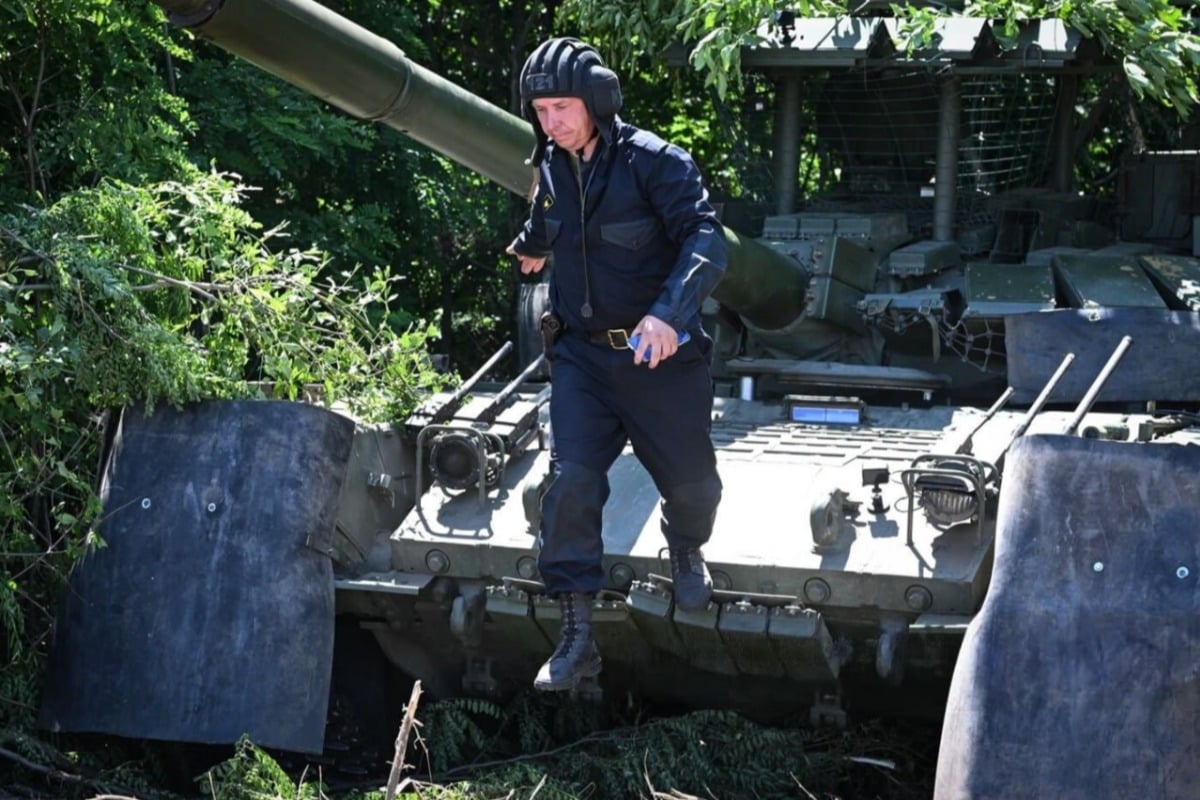
Russia is finally sending its long-delayed Arena-M active protection system into the mud and chaos of Ukraine, bolted onto the turret of a modernized T-72B3A main battle tank. Military analysts and spotters recently confirmed the deployment after footage emerged showing the distinct, hexagonal radar and missile interception enclosures mounted around the tank's turret.
For decades, Moscow has paraded various iterations of the "Arena" hard-kill system at defense expos, hoping to lure foreign buyers or convince domestic critics that Russian armor isn't just a rolling tinderbox. Now, with catastrophic tank losses mounting, the Kremlin is desperate. They're trying to prove that retrofitting Cold War legacies can stop modern anti-tank weapons.
It won't be that simple. The battlefield has changed drastically, and this system was built for a completely different war.
The Cold War Tech Trying to Survive a Drone War
To understand why the T-72B3A with Arena-M is hitting the front lines now, you have to look at what the system actually does. This isn't the old Shtora-1 soft-kill setup that simply blinked infrared lights to confuse old wire-guided missiles. Arena-M is a hard-kill system. It doesn't try to hide; it shoots back.
The system relies on a multi-function Doppler radar array mounted on the turret roof. This radar continuously scans a 300-degree arc around the vehicle. When it detects an incoming projectile—like a rocket-propelled grenade (RPG) or an anti-tank guided missile (ATGM)—the onboard digital ballistic computer calculates the trajectory in a fraction of a second. If the threat is moving between 70 and 700 meters per second and looks like a direct hit, the system fires one of its 26 quick-action protective munitions.
These specialized canisters detonate about 1.5 meters away from the tank. They spray a wall of dense fragments directly into the path of the incoming missile, shredding it mid-air before it touches the hull.
On paper, it sounds flawless. In reality, it's a massive gamble.
Why Top Attack and FPV Drones Ruin the Equation
The original Arena system was born out of Russia's brutal experience in the First Chechen War. During the 1994-1995 Battle of Grozny, Russian forces lost over 200 armored vehicles in a matter of weeks. Chechen fighters hid in basements and upper floors of buildings, firing RPGs into the weak side and top armor of Russian tanks. Arena was designed precisely to stop those direct, horizontal infantry ambushes.
But the war in Ukraine isn't Grozny.
Modern Western-supplied systems like the FGM-148 Javelin don't fly straight at the front glacis. They loft high into the air and plunge straight down into the thin roof armor. While the state defense conglomerate Rostec claims the modernized Arena-M can handle top-attack profiles, its physical radar placement and the upward-firing angles of the interception munitions face severe geometry limitations.
Worse yet, the primary threat to armor right now isn't the high-speed ATGM. It's the cheap, slow, hyper-maneuverable First-Person View (FPV) drone carrying a strapped-on RPG warhead.
Look at how Arena-M detects threats. Its Doppler radar is explicitly tuned to ignore slow-moving objects like birds, small-arms bullets, and dirt clumps to avoid false triggers. An FPV drone buzzing toward a tank often moves at speeds well below the system's minimum activation threshold. If a drone drifts in at 30 or 40 meters per second, the radar might just ignore it entirely. Even if the radar catches it, the erratic, loitering flight path of an FPV pilot can easily confuse a computer expecting a predictable, ballistic trajectory.
The Cost of Desperation
Russia's reliance on the T-72 platform highlights a much deeper failure within its military-industrial complex. The much-hyped, next-generation T-14 Armata tank has been a total no-show in actual combat operations. Production lines at Uralvagonzavod simply cannot build brand-new T-90M tanks fast enough to replace combat losses.
So, what do they do? They modify what they have.
The T-72B3A represents the latest attempt to wring every last drop of utility out of a chassis designed in the 1970s. The upgrade package includes:
- The 2A46M-5 125mm smoothbore gun.
- A 1,000-horsepower V-92S2 engine.
- Enhanced explosive reactive armor (ERA) layouts.
- The Sosna-U gunner sight.
Adding Arena-M to this mix adds roughly 900 kilograms of dead weight to an already overburdened frame. It also introduces a massive tactical headache: friendly fire. When an Arena-M munition detonates, it creates a lethal cloud of shrapnel stretching dozens of meters around the tank. This means infantry can no longer safely ride on the hull or stack up behind the vehicle for cover during an urban assault. The tank becomes a rolling hazard to its own supporting troops.
What to Watch Next
Keep an eye on frontline drone footage over the coming weeks. The real test of the T-72B3A with Arena-M won't happen in a controlled test environment or a state-media propaganda film shot in Mariupol. It will happen when Ukrainian drone operators spot one of these rare setups in the open. They will undoubtedly test its limits, utilizing multi-drone swarms to trigger the system's limited defensive canisters before sending a fatal strike into the blind spots. Watch for whether Russia can successfully scale this production or if it remains an expensive, experimental band-aid on a bleeding fleet.