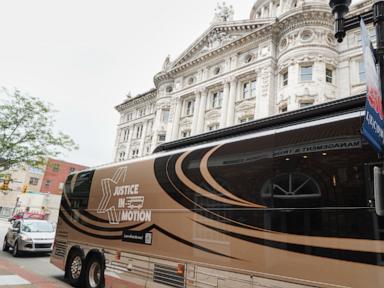
A tour bus rolling through Rust Belt corn fields and coal towns isn't something you usually associate with the American judiciary. Judges don't typically do road trips. They don't mingle with coffee shop regulars in rural Pennsylvania or stop at a Cracker Barrel to chat about constitutional law.
But right now, as the United States marks its 250th anniversary, a group of retired judges hit the road to defend judicial independence because they believe the American legal system is facing an existential crisis.
This isn't a theoretical academic debate. It's a rescue mission.
A bipartisan coalition of about 30 former federal and state jurists just wrapped up an extraordinary four-day, multi-state barnstorming tour. Dubbed "Justice in Motion," the bus tour kicked off in western Pennsylvania, rolled through Ohio, and ended in Grosse Pointe, Michigan. The mission was simple but urgent. They want to talk directly to everyday Americans to rebuild collapsing public trust and issue a stark warning: if we lose an independent judiciary, we lose the country.
Inside the Justice in Motion Bus Tour
The reality of this tour is a massive shift from how the American judicial branch usually operates. Traditionally, federal and state judges stay insular. They speak through written opinions and restrict their comments to the specific facts of individual cases. They don't campaign, and they certainly don't go on tour.
The tour started in Greensburg, Pennsylvania, a former coal hub. The jurists walked into local coffee shops to meet citizens where they are. From there, they held events at the Westmoreland County Courthouse before traveling to Washington, Pennsylvania—a town deeply rooted in Civil Rights history. They then pushed west into Columbus, Ohio, and Wooster, right in the heart of Amish country, before heading up to Cleveland and circling Lake Erie to Michigan.
Why go to these specific places? Organizers from the nonpartisan groups behind the tour—Keep Our Republic and the Democracy Rising Collaborative—purposely avoided ivory-tower venues. They wanted the judges in front of regular people.
The jurists on the bus represent a broad cross-section of the political spectrum. You have judges appointed by Democrats alongside those appointed by Republicans. Former Pennsylvania Governor Tom Corbett and former Ohio attorneys general joined the ride.
Former Ohio Supreme Court Justice Michael Donnelly put it bluntly during the tour. He noted that while America has teetered before throughout its history, this specific moment is a crossroad where citizens must decide whether we remain a country of laws rather than a country of men.
Why Sitting Judges Can't Fight Back
You might wonder why we don't see active, sitting judges out on the trail defending their own courts. The answer comes down to strict judicial ethics.
Active judges are bound by rules that prevent them from wading into political fights, commenting on public controversies, or defending themselves against political attacks. When a politician calls a judge crooked or claims a ruling is a partisan hit job, the judge who wrote that ruling cannot hold a press conference to clarify the law. They have to sit there and take it.
That silence leaves a massive vacuum.
Former Chief Justice of the Ohio Supreme Court Maureen O'Connor pointed out that when judges remain completely silent, they cede the narrative to voices of misinformation. This is precisely why retired judges are stepping up. They still hold a deep allegiance to their lifetime oaths, but they are no longer bound by the ethical gags that keep sitting judges silent. They can speak standard English to regular people, without the legal jargon, and explain how the system actually works.
The Global Strategy that Inspired the American Road Trip
The idea for this American bus tour didn't come out of thin air. It was actually inspired by a striking democratic defense movement overseas.
Back in 2021, independent judges in Poland faced an aggressive takeover of their judicial institutions by the country's then-governing party. Rather than quietly disappearing, those Polish judges launched a grassroots campaign. They traveled to dozens of small towns, set up tables in public squares, and taught citizens about the Polish constitution and the rule of law.
The organizers of the American tour saw how effective that face-to-face contact was. If Polish judges could fight for their courts, American judges could do the same.
The Movement Is Gaining Massive Traction Nationwide
This Rust Belt tour isn't an isolated event. The anxiety over the rule of law is vibrating across the entire country.
Out west, a parallel movement is exploding. More than 100 retired California judges recently wore their judicial robes again to create a collective "Wall of Justice." Spearheaded by the California Judges Association's Retired Judges Initiative, these jurists filmed a joint video project to renew their oaths publicly.
Led by figures like retired Santa Barbara County Judge George C. Eskin and retired California Supreme Court Chief Justice Tani Cantil-Sakauye, the initiative aims to counter the flood of public misunderstanding. Like their colleagues on the Midwest bus tour, these West Coast jurists are using their retirement to protect the judiciary from becoming collateral damage in partisan wars.
Why the Crisis Has Reached a Tipping Point
The data behind this judicial anxiety is alarming. Public confidence in the court system has plummeted to historic lows. The judiciary relies entirely on public compliance. The courts don't have an army. They don't control the budget. If the public and the other branches of government decide to ignore a court order, the entire constitutional framework collapses.
We are seeing real-world consequences from the constant political rhetoric targeted at the courts. Consider these factors:
- Surging Security Threats: The U.S. Marshals Service reported that threats against federal judges climbed to 564 in a single recent fiscal year, up from 509 the year before. Jurists on the tour noted a massive spike in vulgar, profane, and dangerous messages targeted at their offices.
- The Weaponization of Appointments: Timothy Lewis, a former judge on the 3rd U.S. Circuit Court of Appeals who joined the tour, traced his deep worries back a decade. He pointed to the intense polarization surrounding Supreme Court nominations, starting with the block of Merrick Garland and the subsequent rapid appointment of Amy Coney Barrett.
- Direct Defiance of Orders: When the executive branch openly undermines or ignores district court injunctions, it breaks a foundational norm.
When courts are treated like political super-legislatures rather than impartial arbiters of law, everyone loses. An independent judiciary ensures that if the government breaks the law, a citizen can sue the government and get a fair shake. If the courts are captured by partisan interests, that protection vanishes entirely.
Practical Steps to Protect the Rule of Law
Defending the courts isn't just a job for retired judges on a bus. It requires action from citizens who understand what is at stake. You don't need a law degree to protect the system.
Demand Civics Education in Local Schools
Public misunderstanding is the biggest vulnerability the courts face. Support local school board initiatives that prioritize robust civics and constitutional education. People need to know the difference between the legislative, executive, and judicial branches before they can defend them.
Research Judicial Candidates Before Voting
In many states, judges are elected. Too often, voters skip the judicial section of the ballot or vote purely based on a party label. Use nonpartisan voter guides like Ballotpedia or resources from your state bar association to evaluate a judge’s experience, temperament, and commitment to ethics.
Focus on Legal Reasoning, Not Outcomes
When a court releases a major decision, don't just read the headline to see if your "side" won or lost. Look at the legal reasoning. A good judge can rule in a way that goes against their personal political beliefs because the text of the law demands it. We must value judges who follow the law, even when the outcome is unpopular.
Support Nonpartisan Judicial Selection Models
Advocate for merit-based judicial selection systems over hyper-partisan judicial elections. States that use nonpartisan nominating commissions tend to insulate judges from the constant pressure of raising campaign cash from special interest groups.
The tour bus has wrapped up its route through Ohio and Pennsylvania, but the work is far from finished. The rule of law isn't a permanent fixture of nature. It’s a fragile human invention. It survives only because citizens agree to respect it. If we don’t actively protect that agreement, 250 years of democratic history can slip away remarkably fast.