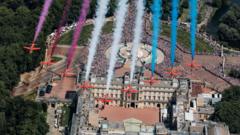
The Royal Air Force aerobatic team is shrinking before our eyes, and it has nothing to do with a lack of pilot skill. If you watched the recent flypasts, you probably noticed something off. The iconic nine-jet Diamond formation spent most of this year scaled back to just seven planes. The reason is simple. The Hawk T1 airframes are old, exhausted, and running on borrowed time.
The Ministry of Defence just dropped a lifeline. A new £360 million investment plan promises a full recapitalisation of the jet training system. This funding guarantees that the Red Arrows will get a brand-new fleet to replace their ancient trainers. It sounds like an easy win, but the reality behind the scenes is messy, expensive, and politically charged.
This is not just about keeping red, white, and blue smoke in the skies. It is about a structural crisis in how the UK trains its elite fast-jet pilots. The decision to buy these aircraft comes at a point where British sovereign aerospace manufacturing is hitting a wall, and the choices left on the table are bound to upset purists.
The Red Arrows New Jets Are Finally Coming But Not Without A Fight
The Defence Investment Plan threw a massive bone to aviation enthusiasts by confirming the retirement of the Hawk T1. The plan explicitly says the new aircraft will let the display team retire their current planes and keep inspiring young generations for decades.
People who follow military procurement closely know this announcement was an emergency intervention. The Red Arrows have flown the Hawk T1 since 1979. Think about that for a second. The planes entertaining crowds today were built during the Cold War. They are the last remaining operational Hawk T1 units in the entire British military. Every other squadron using them has shifted or disbanded.
Finding spare parts for a forty-five-year-old airframe is a nightmare. Maintenance costs have spiralled to nearly £28 million annually just to keep a handful of these red jets airworthy. Scaling back the displays to seven aircraft was a clear admission that the fleet was structurally spent. The metal is tired. The engineering teams are working miracles daily, but you cannot fight physics.
The search intent behind this news goes beyond national pride. People want to know what plane will wear the red paint next, when it arrives, and why we cannot just build it ourselves.
The Broken Wings of the Current Hawk Fleet
To understand why this £360 million plan matters, you have to look at the wider jet training system. The RAF runs a two-tier advanced training programme. The old Hawk T1 serves the Red Arrows, while the newer Hawk T2 trains future frontline Typhoon and F-35 pilots at RAF Valley on Anglesey.
You would think the newer Hawk T2 fleet would be the obvious answer to save the day. It isn't. The twenty-eight Hawk T2 aircraft entered service around 2012, but they have been crippled by severe engine reliability issues. On any given day, a shocking percentage of the T2 fleet is grounded. This has created a massive bottleneck in the flight training pipeline. Student pilots are waiting months, sometimes years, just to get enough cockpit hours to qualify for frontline fighter squadrons.
The Strategic Defence Review took a hard look at this mess and realized that fixing the T2 while patching up the ancient T1 was a losing battle. The review recommended replacing both marks of the Hawk with a single, cost-effective training aircraft.
This means the upcoming competition will look for one uniform platform. The jet chosen to train a pilot to fly a stealth fighter will be the exact same jet pulling high-G loops over the beach at Blackpool.
Where the 360 Million Pounds Is Actually Going
Let us be completely transparent about the money. A budget of £360 million does not buy you a bespoke, top-tier fleet of custom British fighter jets from scratch. In modern military procurement, that amount of money is relatively modest.
The government states this cash is for the full recapitalisation of the Jet Training System. It is designed to deliver both sovereign and international training. Crucially, the plan demands a significant UK workshare.
What does that actually mean? It means the UK is highly unlikely to buy an off-the-shelf foreign jet without forcing the manufacturer to build a substantial portion of it on British soil. The government wants to protect assembly line jobs in places like Warton, Samlesbury, or Scotland. They also need to satisfy a furious lobby of former military pilots and defense experts who argue that a foreign-designed plane representing the UK across the globe is a severe blow to national prestige.
The money will fund the procurement process, initial simulator setups, ground support infrastructure, and the first batch of airframes. The actual long-term contract value will end up much higher once lifecycle maintenance and engineering support are factored in over twenty or thirty years.
The Collapse of Aeralis and the Sovereign Dilemma
The ideal solution was sitting on a British drawing board until very recently. A start-up aerospace company called Aeralis had spent years pitching a brilliant, radical idea. They designed a unique modular jet system where a common core fuselage could be fitted with different wings, tails, and engines. You could convert it from a basic trainer into an advanced display jet, or even a light combat fighter.
The RAF loved the concept. They handed Aeralis a three-year research and development contract to explore it. The firm proudly declared it would assemble the aircraft in Scotland, creating a fresh source of major technology exports and securing a totally British future for the Red Arrows.
Then reality hit. Developing a brand-new military aircraft from a clean sheet takes billions of pounds and a decade of testing. Aeralis ran into a sustained period of severe cashflow pressure due to continued delays in securing long-term UK government commitments. Just a few weeks ago, the company collapsed into administration.
With Aeralis out of the picture, the dream of a 100% British-designed successor died. The race is now wide open, and the RAF has to look abroad for the core design.
The Three Jets Vying to Replace the Hawk
The Chief of the Air Staff wants the formal selection competition underway quickly. Because the UK cannot build a domestic design from scratch within the required timeframe, three international aircraft stand out as the primary contenders.
The Boeing Saab T7A Red Hawk
This is the current heavyweight favorite. Built as a joint venture between American giant Boeing and Sweden's Saab, the T-7A was designed specifically to replace the US Air Force's aging trainers. BAE Systems has been actively promoting this aircraft for the British requirement.
The big selling point here is the existing relationship. BAE Systems operates heavily in the UK and could easily handle the significant UK workshare requirement by assembling the planes locally. The T-7A looks like a miniature fighter, possesses incredible digital cockpit options, and matches the performance profile needed to transition pilots into fifth-generation stealth fighters.
However, it is not an easy choice. The US development programme has faced its own share of technical glitches, software delays, and cost overruns. Adopting it means tying the UK to an American supply chain that is already under stress.
The Leonardo M346 Master
If the RAF wants a proven, reliable option that is already flying with several European nations, the Italian-made Leonardo M-346 is the benchmark. Italy, Israel, Singapore, and Poland use it extensively to train their fast-jet pilots.
The M-346 is a twin-engine jet, which brings an extra layer of safety that display pilots love. If one engine fails during a low-level maneuver over a crowded airshow, the second engine gets the pilot home. It is incredibly agile and boasts a mature training system that is ready to deploy immediately.
The political hurdle is that Leonardo is an Italian company. Even though they have a massive corporate presence in the UK, building an Italian-designed plane as the face of the Royal Air Force is a tough pill for the nationalist wing of the defense establishment to swallow.
The Korean Aerospace Industries T50 Golden Eagle
South Korea's T-50 is a supersonic powerhouse developed with assistance from Lockheed Martin. It feels and flies very much like an F-16. It is fast, highly capable, and already combat-proven in light attack variants sold across Asia.
Choosing the T-50 would give the Red Arrows an incredibly dramatic performance boost. The displays would be faster and louder than anything the Hawk could ever manage. The issue here is cost and complexity. The T-50 is expensive to run. Using a supersonic, high-maintenance aircraft purely for aerobatic displays and training might be seen as total overkill for a defense budget that is already stretched tight.
What This Means for Future Fast Jet Pilots
We need to stop viewing this decision purely through the lens of nostalgia. Yes, the red Hawk T1 is a beautiful aircraft that defined British aviation for generations. Yes, watching a seven-ship formation feels like a downgrade compared to the old days. But military aviation cannot survive on sentimentality.
The real win here is for the young flight lieutenants waiting at RAF Valley. Buying a unified fleet of modern trainers fixes the engine issues plaguing the T2 and provides a stable platform for the Red Arrows. A modern jet means the display pilots can train using software that mimics actual frontline environments, keeping their skills sharp if they ever need to return to operational combat units.
The procurement timeline is tight. The Hawk T1 must retire by 2030. It takes years to build a factory line, manufacture the airframes, train the engineers, and clear the airworthiness certificates. The Ministry of Defence needs to issue the tender, pick a winner, and sign the contract before the end of next year if they want to avoid a gap where the Red Arrows have no aircraft at all.
Your next step is to watch the upcoming defense procurement updates over the autumn. The formal launch of the aircraft competition will reveal exactly how strict the UK workshare rules will be, which will instantly tell us whether Boeing or Leonardo has the upper hand. Keep an eye on the autumn airshows too, because this season is officially the beginning of the end for the beloved Hawk T1.