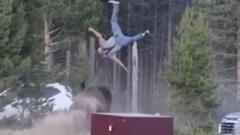
We have all seen the videos. A tourist gets way too close to a massive animal in a national park, pulls out a phone for a selfie, and pays the price. It is easy to sit behind a screen and label those people as foolish. But what happened on Friday, July 10, 2026, at Yellowstone National Park’s Bridge Bay Campground is different.
The viral footage of a 65-year-old grandfather being launched eight feet into the air by a 2,000-pound bull bison looks like another classic case of tourist negligence. It wasn't.
Carl Isom-McDaniel of Washington state did not hike off-trail to harass wildlife. He did not try to pet a woolly mammoth's modern cousin. He and his 13-year-old grandson were simply walking back to their camp after dinner. They kept a respectful distance. Yet, in a matter of seconds, McDaniel found himself airborne.
This incident exposes a scary truth about Yellowstone. Sometimes, even when you follow the rules, the wild still finds you.
The Split Second Decision at Bridge Bay Campground
McDaniel and his grandson were walking through the campground when they noticed the massive bull bison. Initially, the animal was rolling in the dirt. It seemed calm. It was not bothering anyone. They stood roughly 100 yards away, took a quick photo, and prepared to continue their walk.
That is when things went south.
A white pickup truck drove by. The driver laid on the horn, likely trying to get the bison to move off the campground road. Instead of scaring the animal away, the loud blare agitated the already tense bull.
The bison stood up. It focused its eyes on the nearest targets: McDaniel and his grandson.
Bison are deceptively fast. They can sprint at speeds up to 35 miles per hour. That is faster than Usain Bolt. Within seconds, the animal closed the distance. McDaniel had to make a choice. With the beast charging at them, he realized they could not outrun it together. He screamed at his grandson to run one way while he ran the other.
It was a textbook diversion. It worked, but it cost him.
The bull bison chased McDaniel. It hooked him near his hip with its left horn and flipped him effortlessly into the air. He did a full flip, flying eight feet up, before crashing hard onto the dirt.
When Good Distance Turns Bad in Seconds
Most park safety lectures focus on keeping a 25-yard buffer from bison. That is 75 feet. It sounds like a lot until you realize a charging bull can cross that distance in about 1.5 seconds.
Mike MacLeod, a professional photographer who witnessed and filmed the attack, noted that McDaniel was doing nothing wrong. MacLeod has a background in wildlife biology. He knows when tourists are behaving badly. In this case, the grandfather was trying to act responsibly.
The problem is that campgrounds present a false sense of security.
We see paved roads, picnic tables, and RVs, and we subconsciously assume we are in a safe zone. But wild animals do not respect human boundaries. Bridge Bay Campground is situated right near Yellowstone Lake, a heavily trafficked corridor for wildlife. To a territorial bull bison, a campground is just another patch of dirt.
When the pickup truck honked, it triggered a fight-or-flight response. The bison chose fight.
Why Bull Bison Go Wild in July
To understand why this animal was so incredibly aggressive, you have to look at the calendar. We are in the middle of July. In Yellowstone, July marks the beginning of the bison rutting season.
The rut is the annual mating season. It runs from late June through September, peaking in late July and August. During this window, male bison are pumped full of testosterone. They are constantly on edge. They fight each other for dominance, bellowing loudly and rolling in the dirt to leave their scent.
During the rut, a bull bison is basically a walking keg of dynamite.
The slightest annoyance can set them off. A passing car, a slamming camper door, or a honking horn is enough to provoke a charge. In this state of mind, they do not just defend themselves; they actively charge anything they perceive as a threat.
Earlier that same day, this particular bull had already chased a group of kids who were taking pictures from a distance. It had also squared up against a passing vehicle. The animal was highly agitated long before McDaniel walked down the road.
The Heroic Distraction You Did Not See on Camera
After throwing McDaniel into the air, the bison did not immediately run off. It stood over him.
McDaniel was on the ground, completely immobile, with a shattered leg. The 2,000-pound animal was pumping its head, pacing, and displaying severe aggression.
"I was really afraid he was going to gore the guy on the ground," MacLeod later recalled.
That is when MacLeod made a split-second decision of his own. He stopped recording. He ran toward the agitated bull, screaming at the top of his lungs, waving his arms to make himself look as big and intimidating as possible.
It was a massive risk. If the bison had turned on MacLeod, the outcome could have been fatal. But the distraction worked. Other bystanders joined in, yelling and shouting. The collective noise finally overwhelmed the bison, causing it to retreat into the trees.
Emergency medical services arrived quickly. McDaniel was transported to a hospital in Bozeman, Montana, where doctors confirmed his femur was broken in four places near his hip.
Despite the intense pain and the looming threat of physical therapy, McDaniel remained in remarkably good spirits, even joking with the paramedics. When interviewed later, he expressed gratitude that the bison did not stomp or gore him while he lay helpless. He harbor no ill will toward the animal.
How to Actually Survive an Angry 2,000 Pound Bovine
This incident is the second reported bison attack in Yellowstone this year. Earlier, on June 26, a 12-year-old was injured near the Mud Volcano area. The park sees millions of visitors, and while attacks are rare, they are highly destructive when they happen.
If you plan to visit Yellowstone, you cannot rely solely on the 25-yard rule. You need a proactive survival strategy.
- Ditch the camera first, move second. If a bison stops what it is doing and stares at you, it is already irritated. Do not pause to take a quick photo or video. Immediately back away.
- Watch for warning signs. A shaking head, raised tail, pawing the ground, and loud grunting are not cool photo opportunities. They are warnings that the animal is about to charge.
- Use vehicles and trees as shields. If a bison starts moving toward you, do not run in a straight line across open ground. Put large obstacles like thick trees, boulders, or vehicles between you and the animal.
- Carry bear spray. Many visitors do not realize that bear spray works on bison too. If an animal charges, a cloud of pepper spray can stop it in its tracks. Keep it accessible, not buried in your backpack.
- Never honk your horn at wildlife. If an animal is blocking the road, wait. Honking can startle or anger them, pushing them to attack nearby pedestrians or even charge your vehicle.
Pack your gear, keep your eyes open, and treat every large animal in Yellowstone with extreme caution, especially during the summer rut.