You think you know the mountains, and then they completely rewrite the script. That is exactly what happened over the weekend in Alberta's backcountry. If you were planning to head out West for a nice, relaxing holiday weekend, nature just threw a massive wrench into those plans.
Right now, there is extensive cleanup work underway in Kananaskis following heavy rainfall and sudden flash flooding. The deluge literally cut off entire campgrounds, washed out critical highway infrastructure, and left roughly 1,500 people stranded in the wilderness. It prompted an immediate local state of emergency for the provincial park.
This isn't just a minor road bump or a bit of mud on the trail. It's a stark reminder of how fragile our mountain corridors actually are. When a hundred millimeters of rain drops on alpine terrain in a matter of days, the ground simply can't hold it. The water has to go somewhere, and unfortunately, it chose the exact routes people use to escape city life.
The Weekend the Skies Opened Up Over K-Country
The trouble started late Friday night. Environment and Climate Change Canada tracking stations started registering intense, relentless downpours. By Monday morning, the region had swallowed more than 100 mm of rain. To put that into perspective, that is more than the entire average rainfall for the month of June dropped in a single weekend.
Mountain valleys act like giant funnels. When rain hits the high peaks, it slides down sheer rock faces and converges into tiny creeks. Those creeks turn into roaring torrents within hours. By Sunday night, small streams like Evan-Thomas Creek were transforming into destructive forces capable of tearing through concrete and asphalt.
The sheer speed of the rising water caught hundreds of campers off guard. This isn't the first time Kananaskis has faced this kind of beating, but every single time it happens, it catches people by surprise. You go to sleep listening to the rain on your tent, and you wake up to find the road out of your campground is completely gone.
Stranded Tourists and the Battle to Clear Highway 40
Imagine being one of the 1,500 visitors who suddenly found themselves trapped. Most of them were tucked away in the deep pockets of Peter Lougheed Provincial Park and along the Bow Valley corridor. By Monday morning, Highway 40, the lifeblood of Kananaskis Country, was compromised in multiple locations.
The logistical nightmare that followed required a massive, coordinated response. Emergency crews didn't just have to figure out how to rebuild roads; they had to house and feed hundreds of people who couldn't get home. Officials had to quickly set up temporary shelters at the Peter Lougheed Centre and the William Watson Lodge. Between 150 and 200 displaced campers spent Monday night in these makeshift shelters, wondering when they would see their own beds again.
Todd Loewen, the provincial minister of forestry and parks, noted that transportation engineers had to evaluate every single bridge before letting a single vehicle cross. You can't just drive over a road that looks fine on top if the water has completely hollowed out the dirt underneath it.
By Tuesday afternoon, heavy machinery managed to patch up enough of Highway 40 to allow the bulk of those 1,500 stranded travelers to safely evacuate. The road reopened from Highway 1 down to Kananaskis Village, allowing a long caravan of muddy RVs and packed SUVs to finally head home.
Mudslides on the Smith Dorrien and Broken Bridges
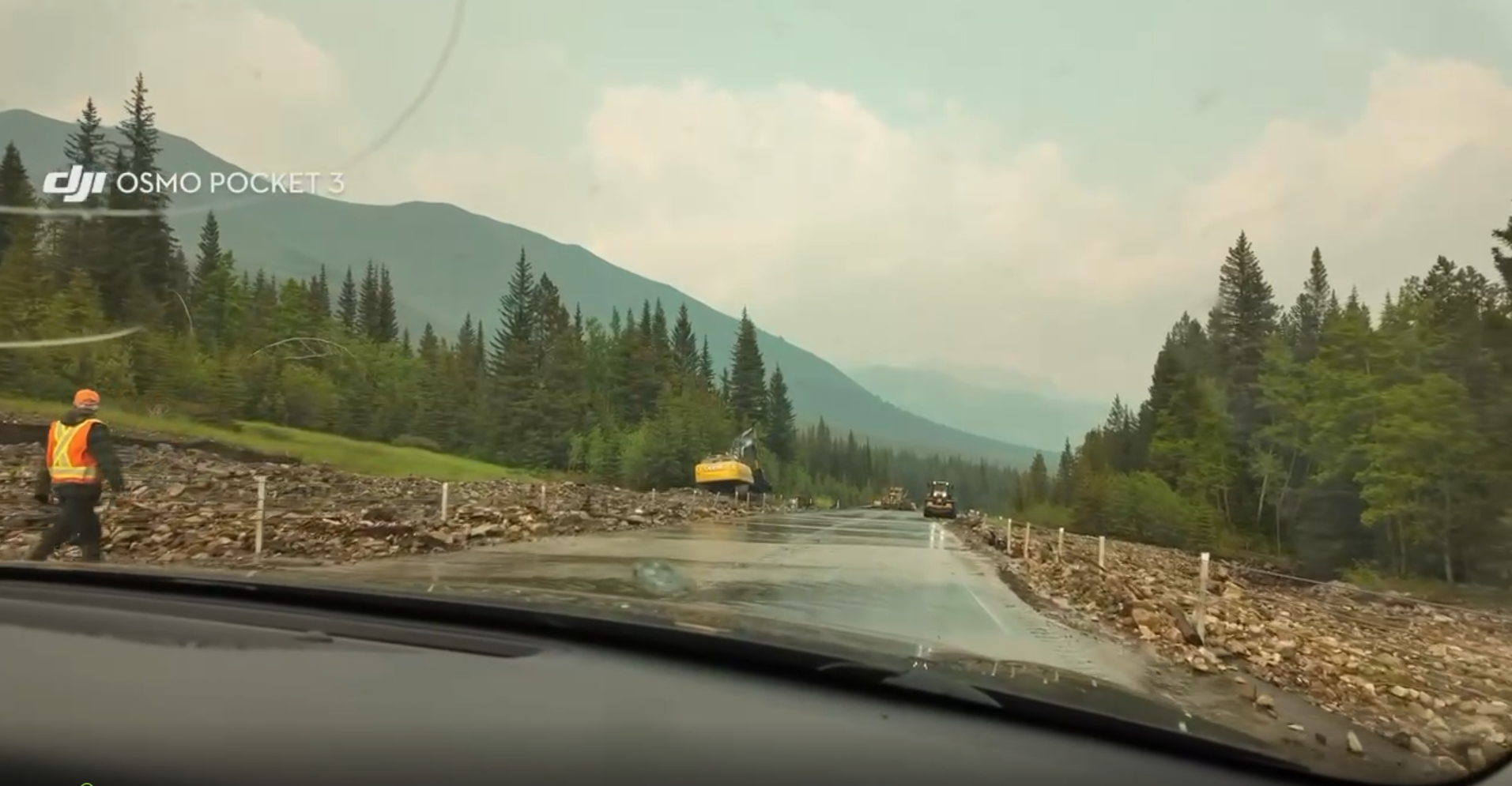
While Highway 40 is seeing some traffic again, the backcountry is nowhere near normal. The Smith Dorrien Trail, a notorious gravel route that links Canmore to the deeper sections of K-Country, became a disaster zone of mudslides and deep washouts.
About 50 people remained completely stuck near the Smith Dorrien on Tuesday. Crews are working around the clock to plow through the heavy mud and stabilization issues. It is grueling work. Heavy bulldozers and excavators are clearing tonnes of wet debris, but every time they clear a section, the ground can shift again. Water levels are dropping, which helps, but the damage left behind is extensive.
The Evan-Thomas Bridge is another major headache. The bridge got completely washed out by the raging creek beneath it. Minister Loewen admitted that fixing this particular bottleneck will take days. Until that bridge is rebuilt, travel between the northern and southern halves of the park remains completely blocked. You can reach the area from the north or the south, but you cannot cross that point. It splits the park right in two.
What This Means for Your Long Weekend Plans
The timing of this weather disaster could not be worse. With Canada Day celebrations right around the corner, local businesses were gearing up for one of the busiest weekends of the summer season.
Take the Pomeroy Kananaskis Mountain Lodge, for instance. Located right in Kananaskis Village, the resort relies heavily on holiday traffic. General manager Liz Hovey-Smith stated that they are still planning to welcome visitors since the northern stretch of Highway 40 from the Trans-Canada Highway is open. They have been working closely with Alberta Parks to ensure that staff and critical supplies can get through the checkpoints safely.
But here is the honest truth. Just because the lodge is open doesn't mean your hiking plans are salvageable.
Dozens of popular trailheads and campgrounds are completely closed. High stream flows mean that even if a trail looks dry, the bridges crossing the creeks might be unstable or entirely missing. Alberta Parks has explicitly stated that closed locations will not reopen until proper safety assessments are complete. Don't be that person who ignores the closure signs and ends up needing a helicopter rescue. It drains emergency resources that are already stretched thin.
Why Mountain Infrastructure Keeps Failing
Every time we see heavy rainfall in the Rockies, we hear the same story. Roads wash out. Bridges fail. Tourists get stuck. It makes you wonder why we haven't built tougher infrastructure out there.
The reality is that mountain geology is constantly working against engineering. The soil layer over the bedrock is incredibly thin. When a massive volume of rain falls, the soil liquefies almost instantly. It creates a lubricating layer over the solid rock, causing entire hillsides to slide down onto roads like the Smith Dorrien.
Rebuilding these roads to withstand a hundred millimeters of rain every single time would cost billions of dollars. Instead, the province is stuck playing a game of catch-up, repairing the worst damage after the clouds clear.
Your Next Steps Before Heading Out
If you have a trip booked anywhere near Kananaskis or the surrounding mountain parks over the next few weeks, you need to change your approach. Do not just pack your bags and hope for the best.
Check the official Alberta Parks advisories page before you start your car. The status of trails is changing hourly as crews assess the damage.
Look at the high streamflow advisories from Alberta Environment. If a creek is running high, stay far away from the banks. Erosion can cause the ground beneath your feet to collapse into the freezing water without warning.
Have a backup plan outside the Kananaskis valley. Places further east or different parts of the province might not have received the same beating.
If you do go, pack extra food, water, and warm clothing in your vehicle. As the 1,500 people trapped this week learned, you might go out for a day hike and end up staying for three days. Be prepared to adapt, stay out of the way of the heavy cleanup crews, and respect the closures. The mountains always win these arguments.