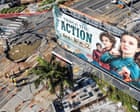
Imagine waking up at 4 AM to the sound of screaming car alarms and what sounds like a freight train outside your window. You look out, and Palm Avenue has turned into a muddy, raging river. That was the reality for West Hollywood residents on Thursday morning when a century-old trunk line decided to obliterate the pavement. The resulting sinkhole on Sunset Boulevard didn't just snarl traffic. It swallowed pedestrians, drowned a transit yard, and forced local staple Dialog Cafe to shut its doors indefinitely.
We love to talk about our forward-looking city. We build gleaming tech hubs and plan massive rail expansions. Yet beneath the glitz of the Sunset Strip lies a ticking time bomb of decaying, riveted steel. When a 36-inch water transmission main bursts, it doesn't just leak. It explodes with enough kinetic force to rip apart concrete and wash away parked SUVs.
The Los Angeles Department of Water and Power (LADWP) knows the grid is old. Everyone knows it. But seeing a Metro bus yard submerged in brown, murky water makes the abstract infrastructure crisis incredibly real. If you live or work anywhere near the Hollywood border, this isn't just a freak accident. It is a preview of the next few decades if we don't change how we fund our public utilities.
The Morning the Sunset Strip Underwater
The disaster began long before the sun came up on July 16, 2026. Around 3:55 AM, the LADWP started receiving frantic reports of water gushing down from Sunset Boulevard near Holloway Drive. A massive 36-inch trunk line had completely ruptured. The sheer volume of water immediately chose the path of least resistance, roaring downhill toward Santa Monica Boulevard.
It was fast. It was terrifying. Local business owners like RJ Holguin, who runs My 12 Step Store on Santa Monica Boulevard, reported watching the deluge pour directly into underground residential garages. Holguin barely managed to scramble and move his own car before the subterranean parking structures became concrete aquariums. For many of his neighbors, luck ran out early. Dozens of vehicles were submerged to their roofs within an hour.
The physical destruction was immediate. The pressure eroded the soil beneath the sidewalks, creating a sudden collapse on Palm Avenue just south of Sunset. Two people literally fell straight into a three-foot-deep sinkhole when the concrete gave way beneath their feet. They climbed out shaken but somehow escaped major injuries. It could have been vastly worse.
Further down the hill, the water found the Metro bus yard near San Vicente Boulevard. Aerial footage from the morning showed rows of multi-million-dollar transit vehicles sitting wheels-deep in muddy lakes. The transit authority had to scramble, detouring or delaying at least ten major bus lines including lines 2, 4, 14, and 105. For thousands of commuters, Thursday was an absolute nightmare.
Why Do These Main Breaks Keep Happening At Night
You might wonder why these massive infrastructure failures always seem to hit while the city sleeps. LADWP officials gave a very direct explanation during their Thursday afternoon press conference.
When you go to sleep, your water usage plummets. Millions of people turn off their faucets, showers, and washing machines at the exact same time. But the water system doesn't just shut down. Because fewer people draw from the system overnight, the internal pressure inside these massive transmission lines spikes dramatically.
Think of it like blowing air into a balloon that already has a structural flaw. The pressure builds and builds against the metal walls. If you have an ancient pipe with a pre-existing weak spot, that nightly pressure surge is exactly when the metal finally snaps.
The pipe that failed on Thursday was laid down in 1916. Let that sink in. Woodrow Wilson was in the White House when workers buried that riveted steel line beneath the dirt. West Hollywood wasn't even an independent city yet; it wouldn't incorporate for another 68 years. The pipe survived earthquakes, decades of heavy traffic, and the explosive growth of the Los Angeles basin. But it couldn't survive another night of high-pressure surges against centenarian steel.
The Scale of the Crisis LADWP Faces
LADWP Chief Operating Officer Anselmo Collins didn't sugarcoat things at the media briefing. The utility manages roughly 7,400 miles of water pipes crisscrossing the region. That is an astronomical amount of underground plumbing to monitor, let alone maintain.
Currently, the agency replaces roughly 45 miles of pipeline every single year. On paper, that sounds like a decent effort. In practice, do the math. At a rate of 45 miles a year, it would take well over a century to refresh the entire network. That means we are actively relying on lines built during the First World War to keep up with the demands of a 2026 metropolis.
The utility does have modern diagnostic tools. They use acoustic monitoring to listen for the signature hiss of underground leaks before they turn into full blows. But these weak spots can be completely invisible until the exact moment the metal splits wide open.
Amazingly, despite the scale of the flooding, clean drinking water remained secure for the vast majority of the neighborhood. The LADWP system uses parallel distribution networks. While the 36-inch trunk line was completely severed, an adjacent 8-inch local line managed to stay operational. Only one single customer lost direct water service on Thursday morning. The issue wasn't the supply; it was the sheer, destructive chaos of the escaping water.
The Local Economic Blow to West Hollywood Hotspots
While the water stopped flowing through the streets by 7 AM after crews methodically closed massive underground valves, the economic damage was done. The Sunset Strip relies heavily on morning foot traffic, brunch spots, and high-end retail.
The Dialog Cafe, a wildly popular local hub known for its morning crowds, took a direct hit. The restaurant sustained major water damage from the flash flood and had to post a bleak update on social media stating they have no clear timeline for when they can safely reopen. For a small business, a sudden, indefinite closure like this can be financially devastating.
Other establishments tried to make the best of a terrible situation. A few cafes right outside the hard closure zone stayed open, handing out free espresso and cold drinks to the exhausted fire crews and utility workers who spent hours in neon vests wading through the mud.
The hard road closures turned the surrounding blocks into a ghost town. Authorities completely blocked eastbound Sunset Boulevard between Larrabee Street and Sherbourne Drive, along with chunked-off sections of Holloway Drive and Palm Avenue. If you can't get cars or pedestrians to your storefront, you don't make money. It is that simple.
Political Friction and the November Infrastructure Vote
This incident rapidly became a political flashpoint, highlighting the messy reality of Southern California municipal borders. The break occurred right on the line separating the City of Los Angeles from West Hollywood.
Los Angeles Mayor Karen Bass used the disaster to make a direct, urgent pitch to voters. Two months ago, her office rolled out a sprawling, multi-billion-dollar comprehensive infrastructure plan. That measure is officially headed to the ballot this coming November.
Bass stood near the muddy crater on Thursday and pointed out the obvious. It is incredibly difficult to run piecemeal repairs on an interconnected system that spans multiple cities without a unified, overarching plan. The 1916 pipe might be owned and operated by LA's municipal utility, but its failure crippled the economy and daily life of West Hollywood.
West Hollywood Mayor John Heilman focused heavily on resident safety during his updates. He expressed relief that no one required emergency evacuation and praised the speed of the first responders. But the underlying tension remains. Smaller cities in the LA basin are completely at the mercy of the larger city's aging infrastructure decisions.
What You Need to Do If Your Property Was Damaged
If you are a resident or business owner dealing with ruined inventory, a flooded car, or structural damage from Thursday's flood, you cannot afford to wait around for help. You need to be aggressive about securing compensation.
LADWP has already set up a dedicated claims processing station under a blue tent at the intersection of Sunset Boulevard and Palm Avenue. Their representatives are actively handing out paperwork, but the burden of proof is entirely on you.
First, document everything immediately. Take hundreds of high-resolution photos and videos of the damage before you begin cleaning up the mud. If your car was in an underground garage on Palm Avenue, get a copy of the police or fire department incident report.
Second, file an official claim directly with the LADWP claims board. Do not assume your private auto or property insurance will handle it smoothly. Many standard policies have specific exclusions for surface water flooding, even if that water came from a burst city pipe rather than a rainstorm. You need to establish a paper trail with the city utility as fast as humanly possible.
Third, get professional restoration teams out to inspect your foundation if you live in a low-lying apartment building near the break. The sheer volume of water that rushed down the hills causes severe soil erosion. Even if your apartment looks fine on the surface, the earth beneath your building's parking garage might have been dangerously compromised.
The crews are still out there digging up the asphalt and pumping out the remaining water from the crater. Sunset Boulevard will eventually get patched up, the buses will be hosed down, and the traffic will return to its usual crawl. But until the city actually addresses the thousands of miles of rotting steel beneath our feet, you might want to keep an eye on where you park your car overnight.