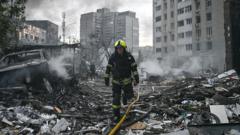
Vladimir Putin doesn't believe in coincidences, and he certainly doesn't time his major aerial assaults by accident. Just hours before Nato leaders gathered in Ankara, Turkey, for a highly anticipated alliance summit, Russian forces unleashed a brutal mix of ballistic missiles, cruise missiles, and suicide drones directly into the heart of Kyiv.
The immediate human toll is devastating. At least nine people are dead across the country, with dozens more pulled from shattered concrete and burning vehicles. In Kyiv's Podilskyi district, rescue crews spent the morning clawing through the smoking ruins of a partially collapsed nine-story apartment building. Local officials confirmed the building was hit by a "double-tap" strike—a cruel military tactic where a second missile hits the exact same spot minutes later to target first responders.
But looking past the immediate horror reveals a calculating political message. This attack wasn't a random act of aggression. It was a deliberate, high-stakes signal aimed squarely at the western leaders stepping off their planes in Turkey.
The Strategy Behind Pre-Summit Bombings
Whenever Nato meets to discuss weapons shipments, air defense, or Ukraine's long-term integration into the West, Moscow responds with fire. We saw it before previous summits, and we're seeing it again now.
Ukrainian President Volodymyr Zelenskyy actually warned his citizens about this exact scenario the night before. Ukrainian intelligence tracked the buildup, noting that Putin loves to strike right after major western holidays like America's Independence Day and directly on the eve of major diplomatic summits.
The goals here are multi-layered:
- Exposing Air Defense Gaps: While Ukraine has successfully intercepted a massive percentage of Russian drones, stopping hypersonic and ballistic missiles requires top-tier systems like the American-made Patriot. By firing dozens of complex missiles simultaneously, Russia forces Ukraine to deplete its limited stockpile of expensive interceptors.
- Psychological Domination: Crashing missiles into a capital city while the world's most powerful military alliance prepares to meet is a blatant show of defiance. Putin wants to prove that western warnings and sanctions don't deter him.
- Leverage for Stalled Talks: With the war entering a grinding phase and diplomatic backchannels constantly buzzing, Russia wants to negotiate from a position of absolute strength.
Destruction Spreads Far Beyond the Capital
While Kyiv felt the brunt of the political messaging, the physical destruction ripped through multiple Ukrainian hubs.
In the central industrial city of Dnipro, a missile tore through a local business, killing five people and wounding nearly 30 others. The injuries detailed by regional medical staff are horrific—blast traumas, severe shrapnel wounds, and open fractures. Further south in Zaporizhzhia, a drone explicitly targeted a civilian minibus, blowing out the back doors and killing three people inside. Up north in Kharkiv, a guided aerial bomb struck a residential neighborhood, instantly killing a 23-year-old woman.
This isn't just collateral damage. The Russian Foreign Ministry recently issued a chilling statement warning that it would begin "consistent and systemic strikes" on Kyiv, claiming they are targeting drone manufacturing facilities. Yet, time and again, the weapons hit kindergartens, medical clinics, and residential high-rises.
What This Means for the Nato Summit in Turkey
The Ankara summit was already expected to be tense. With the war dragging on and political shifts happening across western capitals, alliance leaders face immense pressure to define their long-term strategy. This latest bombardment completely changes the temperature of the room.
Expect Ukraine to use this tragedy to demand immediate, concrete deliverables. Vague promises of future alliance membership won't save lives in Podilskyi or Dnipro. Kyiv needs air defense hardware, and they need it yesterday. They are currently producing a massive portion of their own domestic weaponry, but they remain entirely dependent on the West for high-altitude missile defense.
Neighboring countries are already reacting. Poland scrambled its own fighter jets and activated allied air defense protocols overnight as Russian missiles flew dangerously close to Nato's eastern border. The risk of the war spilling over into alliance territory isn't a hypothetical theory—it's a weekly reality for eastern Europe.
If you want to understand where the conflict goes from here, keep your eyes on the announcements coming out of Ankara over the next 48 hours. Watch for specific commitments regarding Patriot missile batteries and long-range strike permissions. That's where the real answer to this tragedy lies.