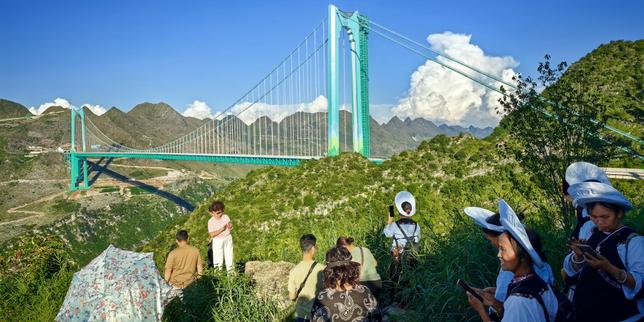
You can't understand modern China without looking at its bridges. Specifically, the jaw-dropping concrete monuments hanging over the misty valleys of Guizhou. This southwestern province is home to nearly half of the world's 100 highest bridges. Just look at the Huajiang Grand Canyon Bridge, which opened to traffic recently. It suspends drivers a staggering 625 meters above the river. That is higher than the entire Empire State Building.
It takes exactly two minutes to drive across it. Before it opened, locals spent over an hour navigating dangerous mountain switchbacks and waiting on slow ferries.
On paper, it looks like a triumph. A miracle of modern civil engineering. But if you look underneath the concrete decks, you find something far more fragile than steel cables. You find a mountain of debt that threatens to derail the region's entire economic future. Guizhou spent years borrowing money like there was no tomorrow, building world-record structures to connect isolated mountain villages. Now, the bills are due. The province has hit a financial wall, and Beijing is forced to step in before the whole system cracks.
The Trillion Dollar Mountain of Debt
For two decades, China relied on a simple formula to boost GDP. If growth slowed down, you built a new highway. If a mountain got in the way, you blasted a tunnel or built a record-breaking suspension bridge. Local officials across Guizhou embraced this approach with fanatic intensity. They used Local Government Financing Vehicles, known as LGFVs, to bypass federal borrowing limits. These state-owned entities took out massive loans from domestic commercial banks, using state land as collateral.
The numbers are terrifying. By the end of 2024, Guizhou's official outstanding debt balance ballooned to roughly 245 billion dollars. When you compare that to the province's annual GDP of around 317 billion dollars, the debt-to-GDP ratio hovers around 77 percent. That doesn't even include the billions in hidden or off-balance-sheet debt tucked away inside various municipal financing platforms.
Some estimates show that the provincial capital, Guiyang, was spending over 12 percent of its entire land sale and fund revenues just to cover interest payments. Think about that for a second. More than ten percent of the city's primary revenue stream didn't go to schools, healthcare, or public services. It went straight to paying the interest on old loans.
This is not a sustainable model. It's a classic debt trap, but one built entirely within China's own borders. The banks that hold these loans are mostly domestic, meaning the crisis won't trigger an international default, but it completely chokes off local economic vitality.
When Megaprojects Go Too Far
Bridges and expressways are essential for development. Nobody denies that. When a road cuts transit time from two hours to two minutes, it helps farmers get their produce to market before it rots. It brings high-speed 5G fiber optic cables to communities that were practically cut off from the modern world.
But there is a point where infrastructure stops generating wealth and starts destroying it.
Guizhou passed that point years ago. Once the major economic centers were connected, officials kept building anyway. They needed to hit GDP targets to secure promotions within the party. The projects grew increasingly bizarre and wasteful. Outside of the necessary transit corridors, money poured into speculative tourist attractions that failed to deliver.
Take the infamous Water Bureau Tower in Dushan County. It's a bizarre 24-story wooden structure built in a deeply impoverished area, costing nearly 28 million dollars in borrowed funds. Or look at the massive 108-hole golf course built illegally in a province where flat land is a premium. Local governments even planned a massive university town with a footprint large enough to hold nearly 14 copies of the Forbidden City.
The expected flood of tourists and tech companies never arrived in the numbers needed to service the debt. The Huajiang Canyon Bridge is trying to fix this by adding extreme sports facilities. They're planning bungee jumping platforms, glass walkways, and a cloud-top café 800 meters above the canyon floor. They want to turn a transit link into an influencer magnet. It's a clever experiment, but a few hundred thrill-seekers buying lattes won't pay off a multi-billion-yuan construction loan.
Beijing Steps In to Stop the Bleeding
The central government in Beijing finally ran out of patience. They watched local debt grow into a systemic risk that could destabilize the state banking sector. The response came down via the General Office of the State Council, which issued what insiders call Document Number 35.
This directive put an immediate freeze on the madness.
The central government designated Guizhou as one of 12 high-risk provinces. The rules changed overnight. Local governments are now banned from launching new infrastructure projects unless they have explicit approval and guaranteed, non-borrowed funding. If a project doesn't directly contribute to immediate economic productivity, it gets shelved.
Instead of building new roads, Guizhou is now forced to focus on survival. Beijing initiated massive debt swaps and restructuring programs. Stronger, state-backed financial firms are stepping in to guarantee new bonds issued by local financing vehicles. They use these new, lower-interest bonds to pay off the toxic, high-interest short-term debt held by weaker municipal entities.
This is essentially a giant shell game. It doesn't make the debt disappear. It just kicks the can down the road, lowering the immediate risk of a spectacular default while stretching the repayment timeline out over decades. The risk premium on these local bonds dropped, signaling that investors trust Beijing to prevent an open bankruptcy. But the underlying fiscal weakness remains completely unresolved.
The True Cost of the Concrete Miracle
The immediate impact of this rollback is felt on the ground. Local government power is shrinking. Salaries for civil servants face delays or cuts. Maintenance budgets for the existing, massive network of roads are getting squeezed.
Building a world-record bridge is expensive, but maintaining it over fifty years in a humid, mountainous environment is another financial beast entirely. The cables require constant monitoring via embedded fiber-optic sensors. The concrete towers face intense weather erosion. If the tolls collected from these highways can't even cover the interest on the construction loans, where will the money for structural upkeep come from?
The Chinese development model worked beautifully when the country lacked basic roads and railways. The returns on investment were massive back then. Today, the marginal returns on another bridge in Guizhou are practically zero. The province is connected, but it's also broke.
If you want to understand where China's economy is heading, stop looking at the shiny tech factories in Shenzhen. Look at the empty, breathtaking highways of Guizhou. They show a system that ran on pure momentum, building for the sake of building, until it finally ran out of other people's money.
To navigate this changing reality, closely watch the next round of local government asset sales. Indebted provinces will likely begin privatizing or leasing out operational toll roads and provincial utilities to state-backed conglomerates from wealthier coastal regions. Keep a strict eye on the domestic bond spreads for western provincial LGFVs; any sudden widening will tell you exactly when Beijing's restructuring band-aids are starting to peel off.