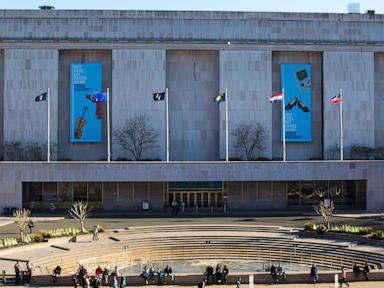
The federal government is fighting itself over who gets to tell the story of America. On July 4, 2026, the White House Domestic Policy Council dropped a massive 162-page report targeting the Smithsonian Institution. The document accuses the world's largest museum complex of pushing "extreme political activism" and serving up a "radical view of American history."
It is a direct assault on the National Museum of American History. The administration claims the museum no longer treats the nation's past as a shared inheritance to celebrate. Instead, it argues the exhibitions present the United States as a fundamentally broken country run by deeply flawed people.
This isn't a minor disagreement over museum text. It is a full-scale battle for control over public memory, funded by your tax dollars.
The Specific Exhibits in the Crosshairs
The administration didn't just issue a vague statement. They went into the galleries and took photos. The report names specific displays that it claims cross the line from education into partisan lobbying.
Take the "Many Voices, One Nation" exhibit. The White House states this display tries to force visitors into believing that illegal immigration and the push for undocumented citizenship are defining modern civil rights issues. They see it as a biased political argument rather than historical documentation.
Then there's the "Girlhood" exhibit. It features Jazz Jennings, a well-known transgender media personality. The report flags this as a blatant example of "transgender activism," explicitly complaining about the museum's "refusal to correctly identify or define what a woman is." This lines up perfectly with the executive order signed in January 2025, which mandated that federal agencies recognize only two biological sexes.
The report lumps these together under a broader umbrella of what it calls "anti-White activism." It argues that by focusing heavily on white supremacy, slavery, conquest, and exclusion, the Smithsonian completely minimizes the massive achievements of the nation's founders.
Inside the Billion Dollar Funding Paradox
Here is the real tension behind the headlines. The Smithsonian relies on over $1 billion a year in federal taxpayer cash. Because of that funding, the administration believes it has every right to dictate the ideological boundaries of the institution.
Conservative groups are already using the report to demand immediate firings. The Heritage Foundation publicly stated that Congress needs to step in and replace the current leadership at the National Museum of American History. Their argument is straightforward: if you take public money, you shouldn't teach children to be embarrassed by their own heritage.
But the museum world isn't backing down quietly.
Smithsonian Secretary Lonnie Bunch has been defending the institution's turf. He notes that the Smithsonian has survived for 180 years precisely because it relies on nonpartisan, independent academic research. The American Historical Association backed this up, arguing that the White House is merely trying to create a sanitized, politically convenient version of the past that completely ignores real historical complexities.
What This Means for Your Next Museum Visit
This political tug-of-war is already altering physical spaces. We're seeing real-world consequences right now. In Philadelphia, a recent court ruling cleared the way for the administration to alter a slavery exhibit at a historic site where George Washington held enslaved people.
As the country hits its 250th anniversary, the pressure to tell a purely celebratory story is immense. Expect to see more warning labels, more leadership shakeups, and potentially altered exhibits next time you walk into a federal museum.
If you want to understand the full scope of this cultural pivot, look beyond the political rhetoric and read the actual policy directives. You can track how these battles over public funding shape education by reading about the ongoing federal restrictions on institutional programming at the U.S. Department of Education.
Your best next step is to look at exhibit descriptions critically during your next museum visit. Notice what is highlighted and what is left out. The stories on those walls are no longer just about the past—they're actively being rewritten by the political powers of the present.

:max_bytes(150000):strip_icc()/TAL-nassau-bahamas-BEAUTCARIB0323-4fbfce903e5a4418b895e03717e3de0d.jpg)