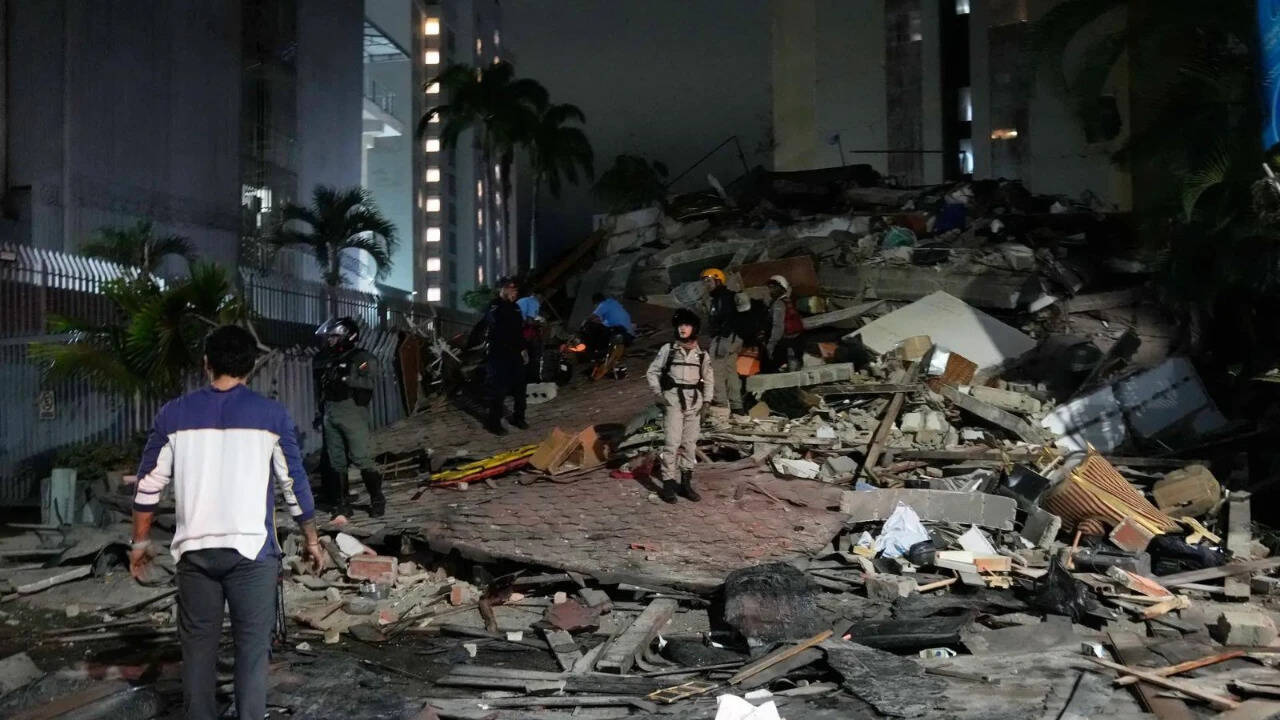
On the evening of June 24, 2026, the ground beneath northern Venezuela didn’t just shake. It ruptured twice in less than a minute. First came a massive magnitude 7.2 tremor near the coastal town of Morón. Before anyone could even process what was happening, a second, even larger magnitude 7.5 earthquake smashed the exact same region just 39 seconds later. It instantly became Venezuela's strongest earthquake sequence in more than a century, leaving hundreds dead and turning large parts of Caracas and La Guaira into disaster zones.
Most people look at a disaster like this and assume it’s just a massive mainshock followed by aftershocks. That's wrong. What happened in Venezuela was a rare, violent phenomenon called a doublet earthquake. It behaves completely differently from a standard seismic event, and that's exactly why the destruction was so sudden and severe. Understanding why these twin quakes happen changes how we look at seismic risk everywhere.
The Myth of the Mainshock and Aftershock Pattern
We're conditioned to expect a specific pattern when the earth shakes. You get a big earthquake, and then you get a series of smaller, decreasingly intense tremors over the following days or weeks. Seismologists call those aftershocks. They happen as the earth's crust settles back into place.
A doublet earthquake throws that script out the window.
Instead of one dominant shock releasing most of the stored energy, a doublet features two distinct earthquakes of comparable magnitude hitting the same general area in rapid succession. They are separate events on separate faults, but they're intimately connected. Think of it like a dangerous two-punch combination. The first punch doesn't relieve the pressure. It shifts the weight, making the second punch hit even harder.
Data from the US Geological Survey shows that the initial 7.2 quake hit at a shallow depth of about 13 kilometers. The second 7.5 quake tore through the crust just 16 kilometers away at a depth of 10 kilometers. Because the time gap was only 39 seconds, people had zero time to escape. Residents who ran out of swaying buildings in Caracas were trapped in the streets as the second wave of shockwaves hit.
How Tectonic Stress Transfers in Real Time
To understand why this happens, you have to look at the geometry of the earth's crust beneath Venezuela. The country sits right on the volatile plate boundary where the Caribbean and South American tectonic plates grind past each other. The Caribbean plate slides eastward at roughly two centimeters every single year. This constant grinding builds up an immense amount of friction and stress along complex fault networks, including the coastal faults and the well-known Boconó fault system.
When a fault finally snaps, it releases energy. You'd think that would calm things down, but it doesn't always work that way.
Mark Quigley, a professor of earthquake science at the University of Melbourne, points out that the displacement from the first fault can instantly overload a neighboring fault. The seismic waves from the first quake essentially rattle nearby rocks that are already pushed to their absolute breaking point. It speeds up the failure process in near real time. Instead of dissipating, the stress jumps across the fracture zone.
We saw a similar catastrophe play out during the Turkey-Syria earthquakes in 2023. In that disaster, a magnitude 7.8 quake was followed by a 7.6 quake nine hours later. Recent studies showed that stress had been loading on those faults for over two centuries. When the first one went, it instantly unclamped the pressure holding the second fault in place. Venezuela's doublet followed a similar mechanical chain reaction, only it happened in seconds rather than hours. Seismologists like Judith Hubbard from Cornell University are still working to piece together the exact fault geometry, but the underlying lesson is clear. Fault lines don't operate in isolation.
The Problem With Modern Seismic Hazard Models
This brings us to a major flaw in how we prepare for disasters. Most building codes and emergency response plans assume that if a structure survives the initial shock, the worst is over. Engineers design buildings to withstand a specific peak ground acceleration based on historical historical data.
Doublet earthquakes break these calculations.
When a building is hit by a 7.2 magnitude quake, its structural integrity is immediately compromised. Concrete cracks. Support beams bend. The foundation weakens. When the 7.5 quake hits 39 seconds later, it's attacking a structure that is already failing. That's why the structural damage in places like the Altamira district of Caracas was so absolute. Buildings didn't just sway; they completely Pancaked.
The Severe Economic and Human Toll in Venezuela
The timing of this doublet couldn't be worse for Venezuela. Decades of economic turmoil have gutted the country's infrastructure and emergency response capabilities. Decades ago, the country had the financial resources to enforce strict building codes and inspect older high-rises. Today, those systems are largely broken. Builders cut corners, and maintenance is non-existent in many areas.
The current death toll has climbed past 180, with more than 1,500 injured and thousands missing. Rescuers are digging through rubble with limited heavy equipment, and the US Geological Survey has warned that the final numbers could be catastrophic if remote coastal towns remain cut off. Power grids are down across northern states, gas lines have ruptured, and Caracas International Airport had to shut its doors due to severe structural damage.
When a nation is already facing a political and economic crisis, a sudden natural disaster acts as a massive multiplier. Hospitals lack basic medical supplies to treat crush injuries. Emergency vehicles can't get through because roads are choked with debris. It’s a stark reminder that the severity of an earthquake isn't just about magnitude. It's about a society's vulnerability.
What You Should Do Next
If you live in a seismically active zone, don't assume that surviving the first tremor means safety. Take these immediate steps to update your emergency mindset.
- Change your evacuation plan: If a major tremor hits, expect a second one. Do not re-enter any building immediately after the shaking stops to grab belongings. Unstable structures can collapse hours or even minutes later with minimal warning.
- Secure your immediate environment: Heavy furniture and appliances cause significant injuries during secondary shocks. Bolt bookshelves, televisions, and cabinets to wall studs today.
- Keep emergency channels clear: After a major seismic event, local phone networks get overloaded. Use text messaging instead of voice calls to keep lines open for first responders, and stay off the roads to allow emergency lanes to remain clear.

:max_bytes(150000):strip_icc()/TAL-nassau-bahamas-BEAUTCARIB0323-4fbfce903e5a4418b895e03717e3de0d.jpg)