Television screens show a predictable loop. Sweaty rescue workers in bright helmets pull a miraculous survivor from concrete dust. Distant anchors speak about international solidarity. But if you talk to the people standing on the cracked pavement of La Guaira, the story changes completely. The international response to the recent Venezuela earthquake is not a clean, coordinated operation. It is a messy, high-stakes race against time, complicated by a failing infrastructure and intense political tension.
When the twin quakes hit on June 24, 2026, they did not just break buildings. They shattered a region already struggling to maintain basic utilities. Watching from afar, it is easy to think that throwing international teams at a pile of rubble solves the problem. It does not. The reality on the ground is a chaotic scramble where global expertise constantly collides with brutal local realities.
The Doublet Nightmare That Defied Seismic Models
Most people assume an earthquake is a singular event followed by minor aftershocks. What happened in north-central Venezuela completely broke that template. Seismologists call it a doublet.
At 18:04 local time, a magnitude 7.2 earthquake tore through the San Sebastián fault system. While residents were still trying to understand what happened, a massive magnitude 7.5 mainshock struck exactly 39 seconds later. The United States Geological Survey tracked the rupture across a massive stretch of the fault line running from Morón straight toward Caracas.
Think about the physics of that for a second. The first quake weakened thousands of structures. The second quake, carrying vastly more energy, hit less than a minute later to finish them off. Buildings that might have survived a single major shock pancake-collapsed immediately.
The structural damage is staggering. Early estimates from space agencies suggest around 59,000 buildings are damaged or flat-out destroyed. This was not a localized disaster. The impact zone stretches across at least seven states, with the coastal strip of La Guaira bearing the absolute worst of it. The official death toll has climbed past 2,595, with more than 12,400 injured and tens of thousands missing. Those numbers are conservative. Local morgues in Caracas and surrounding towns are already completely overwhelmed, struggling to manage the influx of casualties.
Inside the Ruined Streets of La Guaira
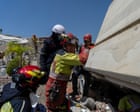
If you walk through the coastal neighborhoods of Caraballeda or Catia La Mar, the scale of destruction feels impossible. Concrete apartment complexes look like stepped-on cardboard boxes. Cars are smashed flat under pieces of fallen highway. This is where the international search and rescue teams are trying to work.
Teams from the United States, Colombia, France, and Jordan have landed on the coast. They brought high-tech listening devices, specialized search dogs, and heavy concrete-cutting gear. But technology has its limits when there is no electricity and the ground keeps shaking. More than 800 aftershocks have rattled the region since the initial disaster, making every entry into a ruined basement a gamble with life.
There have been incredible moments of survival. A Jordanian team managed to pull a two-year-old toddler named Klieber Moran out of the ruins of the Los Corales Garden building. He had been trapped for six days. French civil security personnel and US teams have been working side by side in Caraballeda, using acoustic sensors to find signs of breathing deep beneath the rubble.
But for every successful rescue, there are dozens of failures. The search window is closing. After a week, the chance of finding anyone alive drops to near zero. The focus is shifting from a rescue mission to a recovery operation, and that is a brutal psychological pivot for the volunteers on the ground.
The Administrative Obstacles Slowing the Venezuela Earthquake Response
You cannot talk about this disaster without talking about the political and logistical friction. International aid does not just appear where it is needed. It has to pass through bureaucratic checkpoints, and in a country with deep-seated institutional decay, that process is slow.
Local frustration is boiling over. While international crews are trying to dig, local police forces have faced accusations of taking advantage of the chaos. Just days ago, four Venezuelan police officers were arrested in La Guaira after being caught looting cash safes from collapsed commercial buildings. When the people supposed to guard the ruins are caught stealing from them, trust vanishes instantly.
The logistics are a complete mess. The main roads connecting the ports to the capital are cracked and partially blocked by landslides. Fuel is scarce. Water systems have completely broken down, forcing residents to queue for hours just to get a single bottle of clean drinking water.
The Pan American Health Organization has pointed out that the local health network is operating under impossible pressure. Nine major hospitals have suffered severe structural damage. Doctors are performing emergency surgeries in makeshift tents with limited antibiotics and surgical supplies.
Shifting Focus From Rubble to Disease Prevention
The media will soon pack up and leave. When the heavy machinery finishes clearing the streets, a much bigger crisis will remain. Hundreds of thousands of people are displaced, sleeping in open fields, public parks, or crowded temporary shelters.
Unicef reported that over 680,000 children need immediate humanitarian assistance. In these packed, unsanitary camps, the risk of disease outbreaks is skyrocketing. Waterborne illnesses, acute respiratory infections, and vector-borne diseases like dengue are the next major threat. The immediate goal cannot just be searching for survivors who are no longer there. The goal must be keeping the living alive.
Practical Action Items for Effective Relief
If you want to support the ongoing response without contributing to the logistical logjam, look at where the actual resources are going.
Support Verified Local and International Logistical Clusters
Do not send random physical goods. Shipments of unvetted clothes or food often sit at ports because there is no one to sort them. Direct your support to organizations with established pipelines in the country. The UN Office for the Coordination of Humanitarian Affairs and the Pan American Health Organization are currently directing the primary health and sanitation response.
Focus on Water and Medical Infrastructure
The long-term battle is about clean water and medicine. Donations directed toward field hospitals, water purification kits, and mobile clinics have the highest utility right now.
Monitor Local Accountability Initiatives
Keep pressure on international monitoring. The recent looting incidents show that aid distribution requires strict oversight. Support organizations that work directly with local community councils rather than relying solely on centralized bureaucratic channels.
The rescue phase is ending. The rebuilding of the northern coast will take years, and it requires a clear, unromantic view of the challenges ahead. Keep your eyes on the ground realities, not the polished television reports.