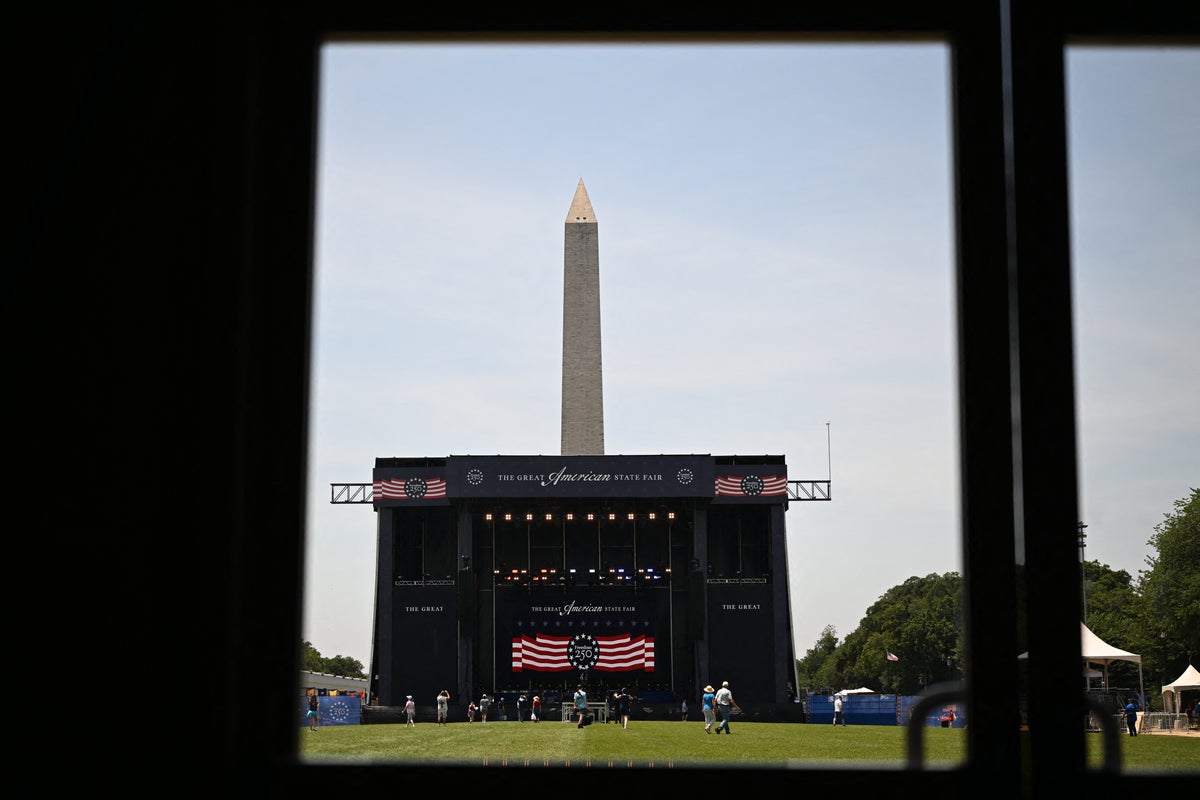
Imagine a full youth brass band giving their absolute all on a stage on the National Mall. They are tearing through a cover of Beyoncé's "Crazy in Love." The horns are crisp. The rhythm is tight. Now imagine the audience. It is not a sea of roaring fans. It is exactly five people.
That was the scene on Tuesday morning at Donald Trump's Great American State Fair. A multi-piece youth ensemble played its heart out to a virtually empty field. The musicians on stage easily outnumbered the spectators sitting on the grass. NOTUS reporter Dave Levinthal caught the moment on video and posted it to X, noting that the 11 a.m. Tuesday time slot was apparently not the most fruitful. He gave the kids credit, calling them a hell of a brass section. But the optics were brutal.
Social media did not look away. Commenters quickly turned the clip into a symbol for the entire 16-day festival, which has looked like a ghost town since it opened. Author Sowmya Krishnamurthy called it a bootleg cover playing to an empty audience, labeling it a direct reflection of a fading legacy. Others joked that the entire country must have received the wrong dates.
It is easy to laugh at the immediate embarrassment. But the real story here runs much deeper than a poorly timed morning concert. The empty plastic chairs and sprawling bare patches of grass on the National Mall expose a massive disconnect between political showmanship and actual public interest.
The Mirage of the Mega Crowd
Trump has built his entire political identity on crowd sizes. He talks about them constantly. He insists his audiences are bigger than anyone else's in history. When this fair kicked off, he immediately hopped onto Truth Social to claim his opening speech drew at least 45,000 people. He insisted the grounds were packed with happy people.
The physical evidence tells a completely different story.
Live television feeds, Associated Press photos, and overhead drone shots have revealed massive pockets of empty space. While the indoor booths celebrating all 50 states have seen some foot traffic, the outdoor spaces are barren. Representative Sean Casten, a Democrat from Illinois, pointed out how strange this is for Washington in the summer. The Mall is usually a magnet for tourists, locals on lunch breaks, and people tossing frisbees. Casten argued that there are actually fewer people on the Mall right now than there would be on a normal summer day, calling the event a tacky spectacle that actively drives people away.
Organizers are scrambling to manage the fallout. Freedom 250, the Trump-aligned group coordinating the festival to mark the upcoming American 250th anniversary, claimed that more than 150,000 people showed up during the first three days. Fox News reporters have also tried their best to spin the visuals. Reporter Kevin Corke acknowledged during a broadcast that tight camera angles showed a couple hundred people, but claimed that walking further into the venue would put you in a wash of people.
The cameras, however, do not lie. When you have to explain away the empty space behind you, you have already lost the messaging war.
When the Headliner Is Not Enough
A state fair lives and dies by its attractions and its music lineup. This event has failed on both fronts.
Before the gates even opened, a string of musical acts quietly pulled out of their scheduled performances. The cancellations left massive holes in the daily schedule. Desperate to salvage the situation, Trump decided to insert himself as the main headliner. He took the stage to deliver a massive political speech, hoping his core base would flood the National Mall and save the event from looking empty.
It did not work.
Video footage from the speech showed a humiliating reality. Attendees began growing bored during the lengthy address and started walking out in the middle of it. A steady stream of people filed toward the exits while the president was still speaking, leaving behind rows of empty white chairs. Lee Greenwood did his best to rally the crowd with a performance of "God Bless the U.S.A.," but the energy was already gone.
State Boycotts and Total Indifference
You cannot blame the low numbers entirely on the Washington heat or bad weather, though both have played a part. The real structural failure of the Great American State Fair lies in a lack of institutional support.
This was supposed to be a unifying celebration of all fifty states. Instead, it has turned into a partisan lightning rod. Pennsylvania officially announced it would not participate in the event. The state's governor confirmed that not a single Pennsylvania business expressed any interest in taking part. Pennsylvania joined eight other states that completely boycotted the fair, refusing to buy into the vision.
When nearly a fifth of the country refuses to show up to an event meant to celebrate the nation, you do not have a national fair. You have a partisan rally disguised as a festival.
Common political logic says that a major event on the National Mall should naturally draw a crowd. This failure proves that the old rules do not apply here. People are tired of the constant campaign energy. They do not want a political rally when they are looking for a summer festival. The lack of corporate and state-level backing doomed the project before the youth band ever picked up their instruments.
The Upcoming July 4th Crisis
The attendance woes are creating a logistical nightmare for the upcoming July 4th celebrations in the nation's capital. Washington is preparing for a massive influx of traditional holiday tourists, but the fair is throwing a wrench into the usual schedule.
Trump is scheduled to deliver another major speech on Saturday. Because of the heavy security footprint and the scheduling conflicts caused by the fair, city officials have been forced to delay the traditional capital fireworks show to a much later night start time.
This delay is infuriating locals and families who travel to see the fireworks. It sets up a high-stakes weekend. If the National Mall remains empty during the biggest patriotic holiday of the year, the administration will not be able to blame a Tuesday morning time slot.
To fix your own event strategy and avoid empty rooms, focus on three immediate adjustments.
- Audit your audience interest first. Never assume a brand name or a famous personality will automatically fill seats. Check for actual demand before booking massive venues.
- Build local partnerships. If local businesses and state organizations do not want to participate, your event is missing its foundational support. Secure commitments before launching.
- Keep the focus on the experience, not the ego. When an event becomes entirely about the person hosting it rather than the people attending it, the audience will walk out.