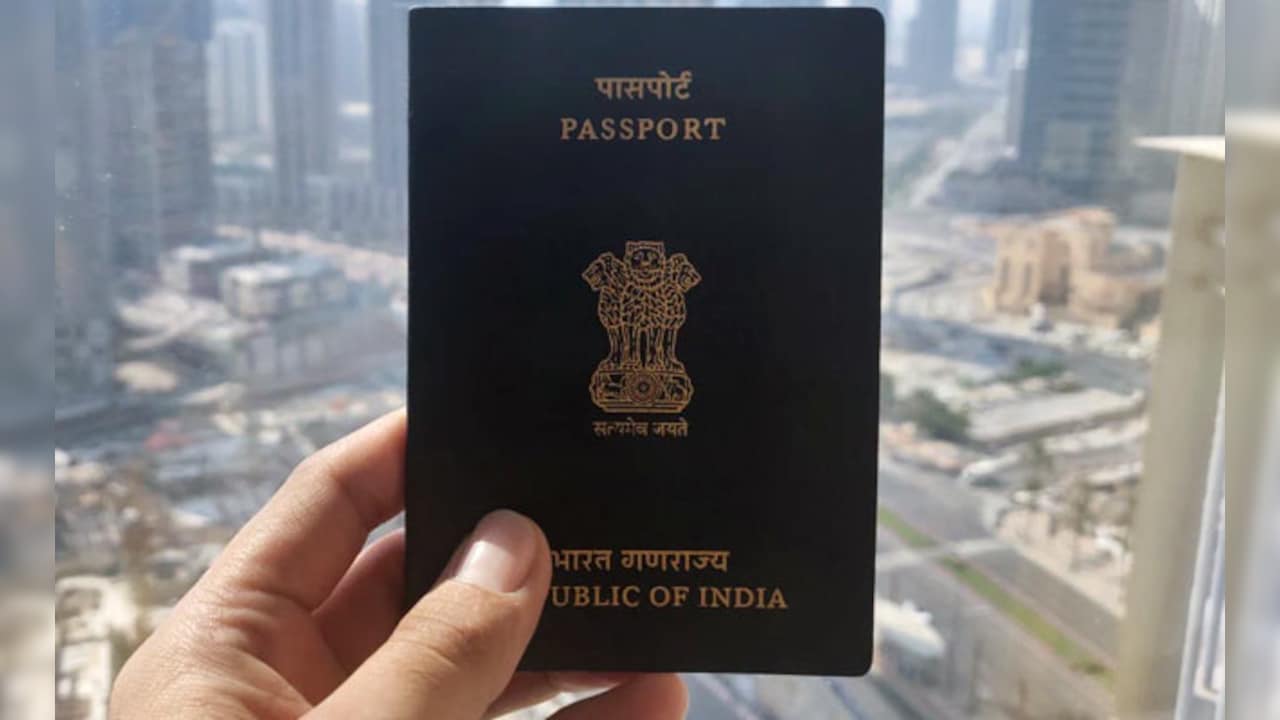
You probably think holding that little dark blue booklet with the republic emblem stamped in gold means you are undeniably, legally an Indian citizen. Most people do. You survived the brutal gauntlet of police verifications, submitted your birth certificate, dug up your parents' property papers, and waited weeks for the postman to deliver it.
Then the Ministry of External Affairs drops a bombshell on Passport Seva Divas.
The government publicly reiterated that your Indian passport is merely a travel document. It is not conclusive proof of your citizenship. It sounds like a bad bureaucratic joke, or an existential crisis wrapped in official stationery. If the very document issued after the most aggressive background check the state can muster doesn't prove you belong here, what does?
This clarification triggered an immediate wave of public panic and furious political debate. Congress MP Shashi Tharoor rightly labeled it an absurd legal paradox. He is not wrong. We have arrived at a bizarre administrative state where millions of people possess top-tier biometric data and state-backed documentation, yet technically lack a single piece of paper that says "You are a citizen" with absolute, unquestionable legal finality.
The Legal Quirk Hidden in the Passports Act of 1967
To understand why the government took this stance, you have to look at the dry legal mechanics that ordinary people never read. The Ministry of External Affairs is pointing straight at Section 20 of the Passports Act of 1967.
This specific clause gives the central government the power to issue a passport or travel document to someone who is not a citizen of India if they decide it is necessary in the public interest. Think of political asylees, specific cross-border refugees, or specialized stateless persons whom the state needs to move across borders for diplomatic reasons.
Because the law allows a non-citizen to hold an Indian passport under those rare, highly specific conditions, courts have historically ruled that the document itself cannot be treated as ironclad, standalone proof of nationality. The Bombay High Court drew this exact line in a landmark 2013 judgment, noting that passport issuance does not automatically confer or conclusively prove citizenship status, which is governed strictly by the Citizenship Act of 1955.
For the everyday citizen, this is a distinction without a operational difference. You do not care about the hyper-specific exceptions of Section 20. You care about whether the state can question your right to vote, your property ownership, or your identity during a routine administrative sweep.
The Administrative Vacuum Creeping Into Daily Life
The real problem hits when you realize how this interacts with your other primary identity document: the Aadhaar card.
For years, people treated Aadhaar as the ultimate proof of being Indian. Then the Supreme Court stepped in and made it explicitly clear that Aadhaar is strictly a proof of identity and local residence, not nationality. Anyone who resides in India for 182 days or more can legally apply for and receive an Aadhaar card, regardless of their global legal status.
So, let's look at the current board layout:
- Your Aadhaar card proves who you are and where you sleep, but not your nationality.
- Your passport lets you cross global borders, but technically does not solidify your legal status at home.
- Your voter ID card can be challenged during aggressive electoral roll revisions.
This leaves regular people in a terrible gray zone. If you have to prove your citizenship tomorrow during a localized bureaucratic dispute, a passport alone will not save you if an aggressive local official decides to pull up the technicalities of the 1967 Act. You are forced to rely on legacy documentation like ancestral birth certificates or land records from decades ago. That is an elite privilege many marginalized families simply do not have.
Shashi Tharoor and the Diagonal Red Stripe Solution
Fixing this mess does not require a massive structural collapse. It requires a basic injection of common sense into the legislative framework. Shashi Tharoor proposed a dual-document policy that solves the problem without ripping up the existing framework, and it deserves a serious look.
The logic rests entirely on fixing the loophole in how we hand out Aadhaar cards. Since the Unique Identification Authority of India already tracks the residence status of everyone in the country, they could easily introduce a visually distinct Aadhaar card for non-citizens.
Imagine a card with a bright, diagonal red stripe running across the front. If you are a foreign resident or a non-citizen living here legally, you get the red-stripe version. If you are an Indian national, you keep the standard design.
Once you separate those two groups at the biometric source, the entire legal house of cards stabilizes. The government could then formally amend the law to declare that holding a standard, non-striped Aadhaar card or a valid Indian passport serves as conclusive, legally binding proof of citizenship unless the state explicitly revokes or cancels that specific individual's document.
This small shift would instantly erase the administrative limbo. It would stop local bureaucrats from harassing citizens during routine verification checks or voter list cleanups. It gives the document back its teeth.
Practical Realities of Document Verification
Until the legislature actually gets around to fixing this legal paradox, you need to know how to navigate the current system without getting caught in a bureaucratic trap. Relying solely on your passport for domestic identity struggles is a gamble you shouldn't take.
If you are dealing with property registration, deep financial background checks, or any government process where nationality is actively scrutinized, you must maintain a secondary paper trail. Do not throw away old school-leaving certificates, domicile certificates, or parental birth records. Under the current strict interpretation of the Citizenship Act of 1955, these ancestral links carry the actual legal weight that your modern biometric passport apparently lacks.
The passport fees are climbing significantly from July 1, 2026, with a fresh 36-page booklet jumping up to 2,500 rupees. If citizens are expected to pay significantly more for state-issued identification, they should at least receive a document that carries absolute legal certainty within their own borders.
The current system asks you to trust the state completely during a grueling verification process, only for the state to tell you that its own stamp of approval means nothing concrete the moment you return home. That is a structural failure that cannot be sustained by clever legal footnotes.
Actionable Next Steps for Securing Your Legal Identity
Instead of waiting for parliament to pass a common-sense amendment, take direct control of your documentation file right now to shield your family from sudden administrative shifts.
First, compile your baseline legacy documents. Find and digitize your birth certificate, your parents' birth certificates, or any certified local land registry documents dating back several decades. These remain the primary legal anchors under the current framework.
Second, ensure absolute data alignment across your active profiles. Check that the spelling of your name, your parents' names, and your birth date match perfectly across your passport, Aadhaar card, PAN card, and voter registration. Any tiny discrepancy gives a low-level bureaucrat an excuse to reject your file or demand further historical proof.
Third, if you have lived abroad or hold overseas residency statuses, maintain a clear, authenticated log of your entry and exit stamps alongside your local tax filings. Keeping these records clear ensures that your status as a resident national remains mathematically and legally undeniable, even if the passport itself continues to face technical skepticism from the ministries.
The legal debate over Indian passport citizenship documentation continues to evolve rapidly. For an in-depth visual breakdown of how these passport laws and verification structures function across the country, check out this detailed report on the passport citizenship debate which explains the immediate impact of the MEA's recent announcements on everyday document holders.