When you think of ancient Egyptian discoveries, your mind probably jumps straight to gold-laden pharaohs, massive stone pyramids, and cursed tombs along the Nile. That's exactly why the latest massive find from the Western Desert caught everyone off guard. Archeologists just unearthed an entire, remarkably intact city dating back 1,600 years. If you think this is just another pile of broken rocks in the sand, you're missing the real story. This wasn't a city built by the pharaohs you know from movies. It belongs to a totally different era. It tells us how regular people lived, traded, and prayed when Rome's eastern successor ruled the sands.
Most news reports give you the bare minimum facts. They say a 1,600 year old city in Egypt was found, and then they repeat a couple of government quotes. Let’s look closer at what's actually happening at the Dakhla Oasis and why this completely upends our understanding of ancient desert survival. In other updates, we also covered: Why The Venezuela Earthquake Death Toll Tells Only Half The Story.
This isn't about mummies. It's about a fully functioning Byzantine-era community that survived in one of the most brutal environments on earth. The preservation is almost eerie. Because the dry desert sands swallowed the mudbrick structures whole, everything from the bread ovens to the local deacon's personal notes survived mostly intact.
The Reality of Egypt’s Newly Found 1600 Year Old Desert City
The site sits at Ain Al-Sabil in Egypt's New Valley Governorate. That's about 350 kilometers away from the Nile River. Think about that distance for a second. In the fourth century, traveling that far into the western wasteland was a massive undertaking. Yet, the Supreme Council of Antiquities uncovered a settlement that wasn't a temporary military outpost. It was a thriving, planned town. Reuters has analyzed this critical subject in extensive detail.
The layout proves these ancient developers knew exactly what they were doing. The excavation reveals clear north-south thoroughfares cut by tight east-west streets. This grid created wide open public squares where people gathered to trade, argue, and live out their days.
Why does this matter? People often assume that ancient desert settlements were chaotic, temporary clusters of tents or poorly built huts. They weren't. This city featured heavy fortification walls and watchtowers to protect the outskirts from desert raiders. The houses weren't cramped shacks either. Archeologists found spacious residences boasting vaulted roofs and formal reception halls. It looks like a slice of a major Mediterranean city transplanted directly into the brutal heat of the Dakhla Oasis.
The Secret Christian Community in the Sand
If you want to understand the true heart of this city, you have to look at its churches. This discovery provides absolute proof of how far and how fast early Christianity spread into the deep desert. Right at the head of the main streets stands a massive, basilica-style church built in the mid-fourth century.
The coolest part of the dig isn't the big church, though. It's the smaller residential structures surrounding it. Archeologists identified two specific houses that change the timeline of the town. One belonged to a resident named Tapibos. Researchers believe this specific house acted as a secret or temporary "house church" before the community grew large enough to build the main basilica.
Right nearby, they found the home of a church deacon named Tisous. Finding the home of an active, named clergy member from 1,600 years ago is rare. It tells us that this wasn't an isolated group of monks hiding in caves. This was a structured, highly organized religious community with its own established hierarchy running the town's daily operations.
What the Trash Tells Us About Daily Life
Forget about looking for golden masks. The real treasure at Ain Al-Sabil is the ancient trash. Specifically, the team found around 200 fragments of broken pottery covered in writing. Archeologists call these pieces ostraca.
Back then, papyrus was expensive. If you wanted to write a quick note, grocery list, or receipt, you didn't waste high-grade paper. You grabbed a broken piece of a ceramic jug and scratched your message into it. Diaa Zahran, a leading official in Egypt's antiquities sector, noted that these specific fragments contain texts written in both Coptic and Greek.
They don't contain grand prophecies or royal decrees. Instead, they give us the exact receipts of daily life. We see commercial transactions, personal letters between neighbors, and trade logs. Combined with the massive bread ovens, kitchens, and heavy stone grinding tools found in the houses, we can basically piece together what these people ate, how much they paid for oil, and who owed money to whom.
The team also dug up a stash of well-preserved bronze and gold coins. The gold coins bear the unmistakable face of Roman Emperor Constantius II, who held power between 337 and 361 AD. The bronze coins carry clear Christian symbols and Latin inscriptions. This puts a definitive time stamp on the city's golden age. It shows they were deeply connected to the wider imperial economy, using the exact same cash circulating in Constantinople or Rome.
Gold Tongues and Sphinxes at Alexandria
The Egyptian Ministry of Tourism and Antiquities didn't stop with the desert city. They dropped a second bomb on the archeological community by announcing massive finds down at Marina el-Alamein. This site sits along the Mediterranean coast, roughly 100 kilometers west of Alexandria. It was once the thriving Greco-Roman port city of Leukaspis.
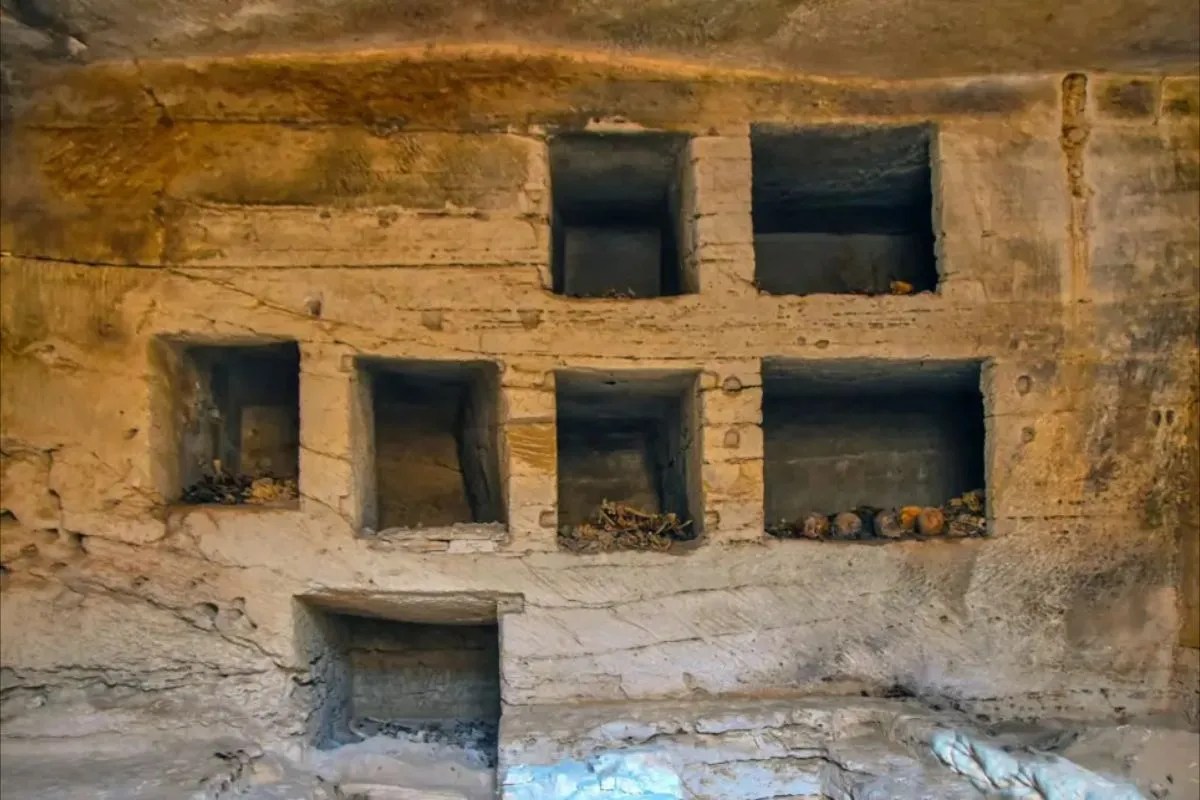
The team dug down eight meters into the earth and exposed 18 ancient tombs. This brings the total number of tombs found at this single site to 48. Inside one, they struck a 2.5-meter-long granite sarcophagus. Inside the mouths of several skeletons, they found thin sheets of gold shaped like tongues.
This "golden tongue" ritual is a known funerary practice from the Greco-Roman period. The living believed that giving the dead a tongue of pure gold allowed them to speak clearly to Osiris, the god of the underworld, without angering him during judgment. Right next to this massive granite coffin, they found a small plaster sphinx statue, alongside heaps of ancient lamps, plates, and altars.
Moving Past the Nile Centric Bias
For decades, Egyptology suffered from a massive Nile-centric bias. If a site wasn’t sitting right on the banks of the river, it barely got any funding or attention. This double discovery blows that old mindset out of the water.
Living in an oasis wasn't a desperate struggle for survival. The Dakhla discovery proves these people built an architectural footprint that rivaled mainland towns. They managed water resources perfectly, fortified their borders, and maintained elite lifestyles complete with vaulted architecture and imported Roman coins.
We need to stop viewing the Egyptian desert as an empty void that people only crossed to get somewhere else. The desert was an active, inhabited network of trading hubs.
Your Next Steps to Follow This Discovery
If you're a history buff, student, or traveler looking to keep tabs on this evolving story, don't just wait for mainstream news sites to drop clickbait articles. Do these things instead.
First, track the UNESCO Tentative List updates. The Dakhla Oasis is currently sitting on the waitlist for official World Heritage status. The addition of the Ain Al-Sabil Byzantine city will almost certainly push it over the line. Monitoring the official UNESCO portal gives you deep-dive PDF briefs that the media never publishes.
Second, check the official releases directly from the Egyptian Ministry of Tourism and Antiquities. They regularly upload high-resolution photo galleries of the newly cleaned ostraca and the gold coins of Constantius II on their official platforms.
Third, avoid the common trap of conflating different Egyptian eras. When discussing this find with others, make sure to clarify that this is a Byzantine Coptic site, not a Pharaonic one. Keeping that distinction clear shows you actually know your stuff.
The excavation is still going on right now. The Ministry has already signaled that they are training local communities in Dakhla to help run future digs and preserve the mudbrick structures. More texts are being translated every week. Expect the history books regarding fourth-century Egypt to be completely rewritten over the next couple of years.