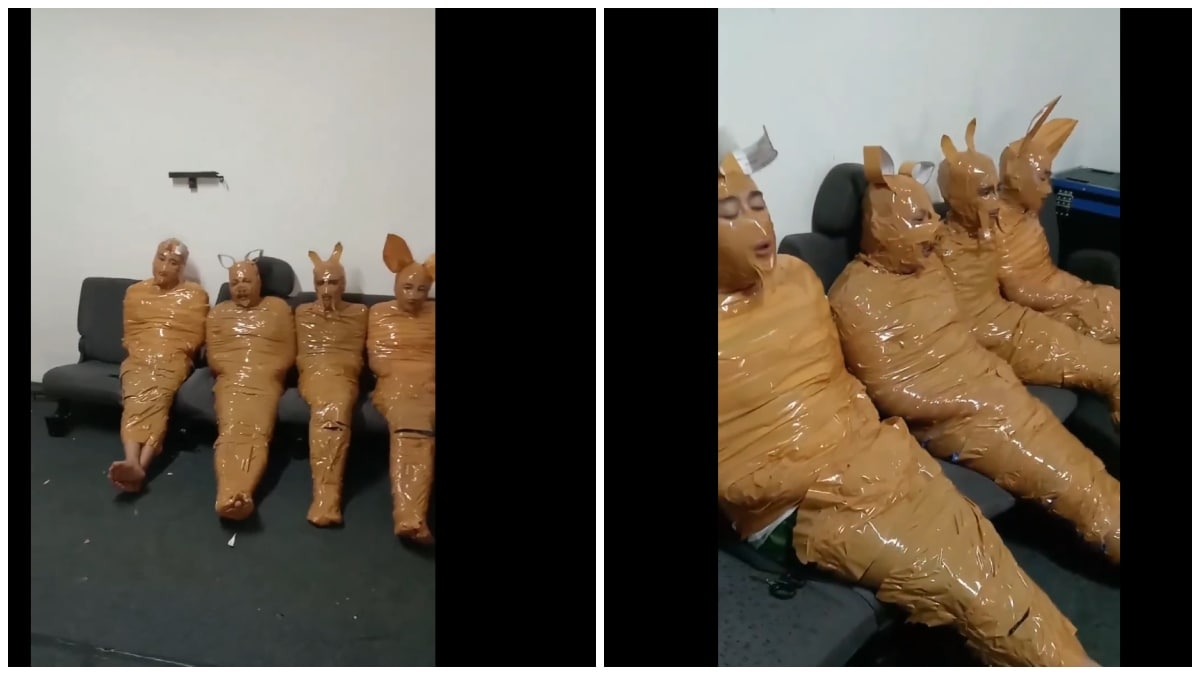
You have probably seen the footage blowing up your social media feed over the last 24 hours. A group of exhausted, visibly uncomfortable men bound tightly from head to toe in thick layers of brown duct tape. Their bodies are completely restricted, leaving only their eyes and noses exposed. On their heads sit bizarre antennas, making them look like a twisted, bootleg version of the 1990s children's television show Teletubbies.
The internet quickly did what it always does: it built a wild narrative around it.
X accounts and Instagram pages started blasting claims that the video captured a brutal vigilante punishment in Indonesia. The story alleged that an exhausted homeowner, tired of getting robbed and receiving no help from the local police, set a trap with his neighbors. They supposedly caught a gang of thieves red-handed, taped them up like Tinky Winky, and filmed them to mock them publicly before turning them over to the cops.
It sounds like a classic internet justice story. But it is completely made up.
If you are wondering whether you are looking at a horrific case of community torture or a sophisticated AI deepfake, the answer is neither. The video is real, but the context is an absolute fiction.
The Real Story Behind the Indonesian Teletubbies Video
The footage didn't come from a crime scene or a vigilante stakeout. It originated from Malang, a city in East Java, Indonesia. The men in the video are not burglars, and the person holding the camera isn't an angry homeowner.
The people wrapped in duct tape are actually online streamers who belong to a YouTube group known as Batre TV. They focus entirely on comedic stunts, pranks, and interactive live-streaming sessions where viewers control what happens by sending challenges.
During a recent live broadcast, a viewer challenged one of the creators to wrap himself entirely in duct tape while wearing the strange headgear. Wanting to keep the audience engaged and boost their viewer count, they went ahead with it. The exhausted, miserable look on the streamer's face wasn't from the terror of being captured. He later told local media outlet Detik News that he had eaten shrimp right before the stream, which triggered an allergic reaction. The tight tape combined with an itchy, swelling face caused the intense physical discomfort visible in the clip.
How a Local Stream Turned Into Global Misinformation
So, how does a goofy, slightly uncomfortable YouTube challenge turn into an international story about vigilante torture? It boils down to a coordinated pipeline of content theft and engagement farming.
After the live broadcast ended, a local Instagram aggregation account named "Harian Kampung" scraped the footage without the creators' permission. They stripped away the original comedic context, lowered the video quality to make it look like raw, gritty cellphone footage, and slapped on a fake caption about captured thieves.
[YouTube Live Stream] -> [Scraped by Aggregator] -> [Fake Justice Narrative Added] -> [Global Viral Hit]
From there, the algorithm took over. Content aggregators on X and TikTok looking for quick views grabbed the video and ran with it. Audiences love stories about street justice and creative punishments for criminals, so the post spread across international boundaries within hours. By the time it hit mainstream feeds outside Indonesia, the original creators had lost control of their own joke.
Why We Fall for Fake Street Justice
This isn't the first time a harmless or unrelated video has been rebranded as vigilante punishment, and it won't be the last. Digital audiences have a massive appetite for citizen-led justice. When people feel that official legal systems are too slow or ineffective, stories about regular citizens taking matters into their own hands hit a deep emotional chord.
That emotional trigger makes people drop their guard. They share the video immediately without checking the source because the narrative satisfies a desire for instant consequences.
You don't need to be an expert to spot these kinds of hoaxes. The next time a wild video clogs your feed, look for the warning signs:
- The source is an aggregate meme page rather than a local news outlet.
- The video quality is intentionally degraded or cropped to hide identifying watermarks.
- The caption relies heavily on emotional triggers without providing specific names, dates, or official police statements.
The Batre TV creators are currently dealing with the fallout of their stunt going global for all the wrong reasons. It's a reminder that on the modern internet, you are only one stolen clip away from being turned into a global villain or a victim of torture, even if you were just doing it for the clicks. Be careful what you share.