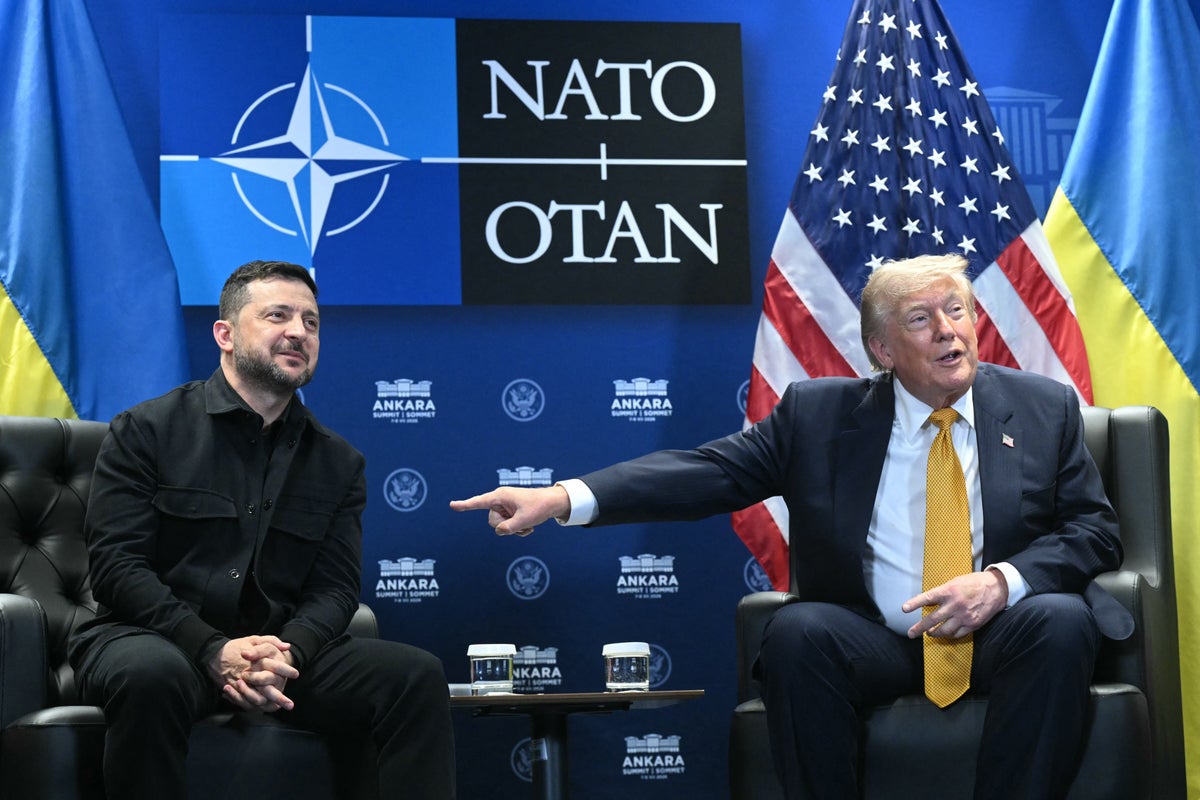
Donald Trump just rebranded one of America’s most vital East Asian allies as a Middle Eastern state. Sitting next to Ukrainian President Volodymyr Zelensky at the NATO summit in Ankara, Turkey, the president took what should have been a straightforward answer about Patriot missile defense systems and turned it into an international head-scratcher. He told reporters that a few months ago, the US military dealt with 111 missiles fired by the "Islamic Republic of Japan."
He meant Iran. Obviously.
But treating this purely as a funny viral clip misses the structural rot beneath the surface. It wasn't even his only massive slip during that single Q&A session. Moments later, Trump looked right at Zelensky—the man leading a brutal defensive war against Russian aggression—and called him "President Putin."
The internet exploded into a predictable frenzy of memes. Satirical accounts posted pictures of Godzilla wearing a turban blocking the Strait of Hormuz. People laughed. Yet beneath the late-night talk show fodder lies a messy cocktail of geopolitical confusion, exaggerated military metrics, and a glaring double standard in American political discourse that we need to talk about.
The Reality of the USS Abraham Lincoln Incident
Trump used the bizarre country mashup while trying to praise the Patriot missile defense system. He claimed that the "Islamic Republic of Japan" launched 111 missiles at the USS Abraham Lincoln over the span of an hour. He boasted that every single one was knocked down.
It's a great story. It just didn't happen that way.
If you look back at what US Central Command actually reported, the real event was vastly different. Iranian forces did claim they targeted the American aircraft carrier in the Arabian Sea. But the US military explicitly stated that the incoming threats never came close to striking the vessel. A US Navy fighter jet shot down an aggressive Iranian drone in self-defense. There was no apocalyptic barrage of 111 ballistic missiles targeting a multi-billion-dollar carrier over a sixty-minute window.
Trump loves big numbers. He regularly claims he brought down pharmaceutical prices by 600 or 700 percent without citing a single piece of legislation. Fabricating a massive, cinematic naval battle fits his communication style perfectly. He takes a grain of truth—a single drone shootdown—and inflates it into a blockbuster military victory.
The trouble happens when you mix fake military history with scrambled geography. Calling Japan an Islamic republic isn't just factually wrong. It's culturally and historically incoherent. Japan has a microscopic Muslim population. It's a secular country with deep Shinto and Buddhist roots. More importantly, Tokyo has spent the last eight decades operating as the anchor of American strategic power in the Pacific.
The Hypocrisy of the Age Debate
We've seen this movie before, but with a different leading man. Back in 2024, the entire political world obsessed over Joe Biden’s verbal stumbles. Every missed word or trailing sentence became a national security crisis. Fast forward to 2026, and Donald Trump is an 80-year-old president managing a grueling schedule of international summits and campaign rallies.
Time is undefeated. Trump’s supporters dismiss these moments as harmless quirks of an unscripted, freewheeling outsider. They say he’s just speaking off the cuff. They point to his high energy levels and his willingness to stand in front of reporters for hours as proof of his vitality.
But look at the tape. Trump has repeatedly insisted his father was born in Germany, despite public records clearly showing he was born in New York. He mixes up names, dates, and locations with absolute, unshakeable confidence.
Critics are now quietly whispering about the 25th Amendment. Some corporate commentators are wondering out loud if the criteria used to judge executive fitness in 2024 should apply right now. The political script has flipped entirely. The man who spent a decade mocking his opponents for being old and confused is now facing the exact same mirror.
Why the Ankara Gaffes Matter for Foreign Policy
Summits aren't just photo opportunities. They are highly calibrated theatrical performances designed to signal strength to adversaries like China and Russia. When an American president sits next to the leader of Ukraine and calls him Putin, it sends a wave of anxiety through every Eastern European embassy.
It signals a lack of precision. In diplomacy, precision is everything.
The Ankara summit was already tense. Trump had just declared that the interim ceasefire agreement between the United States and Iran was completely dead, calling the Iranian leadership sick and labeling further diplomacy a waste of time. When you are actively escalation-managing a conflict with a real nuclear-ambitious state like Iran, you cannot afford to casually substitute them with a pacifist ally that hosts 60,000 American troops.
Allies don't like being lumped in with the axis of adversaries. Tokyo didn't issue an official diplomatic protest over the "Islamic Republic of Japan" comment, but you can bet bureaucrats in the Japanese foreign ministry were pulling their hair out. They rely on steady, predictable American leadership to counter regional threats. A confused executive branch makes long-term defense planning incredibly difficult.
How to Parse Political Spin Moving Forward
If you want to keep your sanity while reading the news, you have to learn how to separate the signal from the noise. Do not fall into the trap of hyperventilating over every single syllable a politician drops, but do not buy the partisan clean-up crew's excuses either.
The White House staff spent the hours following the press conference defending Trump's overall performance. They highlighted his tough stance on immigration and his demands that European nations pay more for their defense infrastructure. They completely ignored the Japan and Putin remarks. That is standard political damage control.
When analyzing these events yourself, look at the systemic patterns rather than the isolated incidents. A single slip of the tongue can happen to anyone under jet lag. A repeated pattern of inflating military statistics, swapping the names of rival world leaders, and misidentifying core treaty partners points to a deeper issue of information processing.
Keep your eyes on the actual policy decisions being made behind the scenes. Watch the troop deployments, the defense budget allocations, and the real-time diplomatic cables. The rhetoric on the stage is chaotic, but the machinery of state tracking the real Iran and the real Japan is what keeps the wheels turning. Focus on the hard data, ignore the hyperbole, and don't let the memes distract you from the actual geopolitical stakes.