Planning to head down to the National Mall for the massive America 250 celebration this weekend? You might want to pack an N95 mask alongside your lawn chairs and American flags.
Leaked internal documents from the National Park Service reveal that the record-breaking July 4 fireworks display is expected to trigger a public health crisis right in the heart of Washington, DC. We aren't talking about a little bit of hazy smoke that clears out after twenty minutes. Government modeling warns of "very unhealthy" to "hazardous" air quality conditions that will blanket central DC, Arlington, and Capitol Hill for hours after the grand finale.
Here is the data the government didn't want you to see, and exactly how to protect your lungs if you are celebrating our nation's 250th birthday in the capital.
The Staggering Scale of the America 250 Fallout
This isn't your standard Independence Day celebration. To mark the semi-quincentennial, organizers are attempting to break the Guinness World Record for the largest pyrotechnic display in history.
To put this into perspective, a standard July 4 show on the National Mall fires off roughly 7,000 to 20,000 shells over 20 minutes. This year, technicians will unleash a staggering 850,000 fireworks in a massive 40-minute window. That is an absolute explosion of pyrotechnics, scaling up the usual volume by over 50 times.
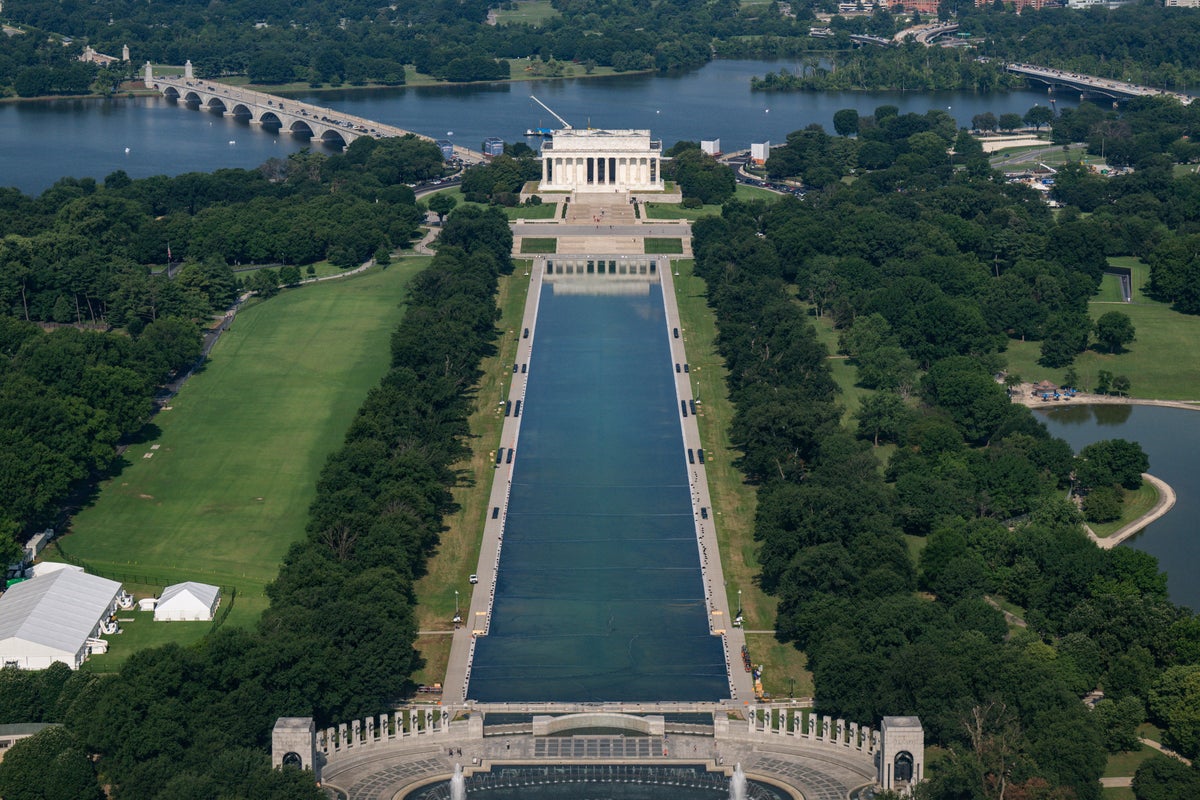
The main issue is the weather forecast and sheer chemistry. Fireworks rely on heavy metals like copper, strontium, and barium to produce vibrant reds, blues, and greens. When 850,000 shells combust simultaneously over the Potomac River, the Lincoln Memorial Reflecting Pool, and West Potomac Park, they generate an astronomical amount of fine particulate matter, known as PM2.5.
Internal National Park Service models show that the "most likely" scenario will spike PM2.5 levels to between 600 and 1,200 micrograms per cubic meter around the Mall. If the weather conditions take a turn for the worse, a worst-case scenario could skyrocket pollution past 2,000 micrograms per cubic meter. For context, George Thurston, a professor of medicine and population health at New York University, noted that a 2,000-microgram spike would exceed anything ever recorded from a pyrotechnic event anywhere on earth.
Why the DC Weather Will Trapped the Smoke
You might think the smoke will just drift away over Maryland or Virginia. Think again.
Local meteorologists are tracking a suffocating summer heatwave with temperatures pushing 102°F and a heat index soaring to 109°F. Along with the oppressive heat, wind speeds are projected to crawl at a measly 5 to 8 mph.
That is a recipe for an air quality disaster. When the air is stagnant and heavy with humidity, it acts like a lid on a pot. The heavy metal smoke from the 850,000 explosions won't lift. Instead, it will settle right over the spectators, trapped in place for three to six hours after the show concludes.
The National Park Service's internal guidance explicitly instructs staff to prepare for widespread "irritation symptoms" among the public. These tiny PM2.5 particles bypass the body's natural defense systems, lodging deep inside lung tissue and entering the bloodstream. If you suffer from asthma, cardiovascular issues, or respiratory conditions, this environment is outright dangerous.
Who Bears the Brunt of the Birthday Blast
There is a glaring environmental equity issue at play here that isn't getting enough attention. While the fireworks will be visible across the region, the actual launch sites run along the Potomac River and the Mall, right adjacent to areas like Southeast Washington.
These neighborhoods are predominantly home to lower-income and minority populations who already experience disproportionately high rates of childhood asthma and cardiovascular disease. Shifting a world-record pollution event into their backyards for a 40-minute spectacle presents a severe, localized health burden.
Furthermore, the funding for this extravagant display is drawing fierce criticism from watchdog groups. The administration is utilizing $1.6 million in national park entry fees to fund the pyrotechnics alone—five times the historical budget. Critics point out that this money is being diverted while the Department of the Interior faces an eye-watering $35.4 billion backlog in deferred maintenance and critical repairs across our national parks.
How to Stay Safe Without Missing the Fun
You don't have to skip out on the historic milestone entirely, but you do need to alter your strategy. If you insist on experiencing the event live or live inside the fallout zone, take these concrete steps to safeguard your health.
- Wear a well-fitted N95 mask: Standard cloth or surgical masks won't block microscopic PM2.5 chemical soot. If you are watching from the National Mall or Arlington, pop an N95 on as soon as the display kicks off and keep it on until you leave the area.
- Watch the digital livestream: The Trust for the National Mall is running a 24/7, high-definition feed via #MonumentCam from the very top of the Washington Monument. You will get a bird's-eye view of the history-making display without breathing in heavy metals.
- Head upwind or watch from Maryland: Check the real-time wind apps before you settle on a viewing spot. Finding an elevated spot in Maryland or tracking the perimeter away from the direct path of a southern or western drift will dramatically lower your particulate exposure.
- Seal your home: If you live in downtown DC, Capitol Hill, or central Arlington, keep your windows tightly shut. Run your air conditioner on "recirculate" mode and crank up an indoor HEPA air purifier to catch any smoke that seeps inside.