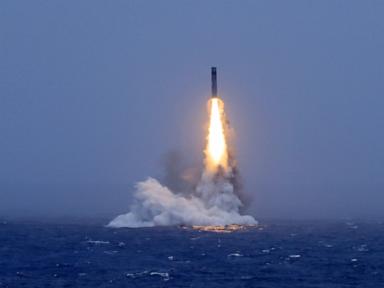
Beijing just sent a multi-ton, nuclear-capable reminder splashing into the Pacific Ocean, and the corporate media is already blowing the narrative. When the People's Liberation Army Navy dropped a strategic submarine-launched ballistic missile into international waters, the immediate headlines fixated on regional bullying or a sudden, erratic escalation.
They are missing the bigger picture. This wasn't an angry outburst. It was a cold, calculated calibration of global deterrence.
If you think this is just about intimidating small Pacific island nations or rattling Australia, you're looking at the wrong map. This test had an audience of one. The target for this message sits squarely in Washington.
By launching a long-range strategic missile from a nuclear-powered submarine deep into the Pacific, Beijing didn't just test a rocket. They officially signaled the completion of a secure, terrifyingly capable nuclear triad.
Understanding what actually happened requires stripping away the panicked rhetoric and looking at the raw strategic math.
The Illusion of a Routine Exercise
Chinese state media quickly downplayed the event. The People's Liberation Army Navy stated that the strategic missile, carrying a dummy warhead, landed precisely within designated waters as part of an annual training routine.
Don't buy the corporate spin. Nothing about this launch was routine.
Before this current wave of testing, China hadn't openly thrown an intercontinental-range ballistic missile into the deep Pacific since 1980. For over four decades, the Chinese military kept its long-range testing strictly confined within its own borders, using high-arc trajectories over Xinjiang to avoid international blowback.
That policy is dead.
This latest sea-based launch follows a massive land-based ICBM test in September 2024, where a DF-31AG traveled over 11,000 kilometers to strike waters near French Polynesia. Doing it once from land is a statement. Doing it less than two years later from a nuclear submarine is a structural shift in how Beijing intends to project supreme military power.
The Nuclear Triad is Finally Real
Major nuclear powers survive on a simple rule: if you get hit first, you must retain the ability to erase the attacker from the map. This requires a triad of delivery systems across land, air, and sea.
Land-based silos can be targeted. Heavy bombers can be shot down. But a ballistic missile submarine hiding beneath hundreds of meters of ocean water is practically invisible. It represents a guaranteed second-strike capability.
Military analysts tracking the flight path point toward the deployment of either the JL-2 or the newer, longer-range JL-3 submarine-launched ballistic missile. Let's look at what that actually means for American defense planners:
- The Range Problem: The JL-3 has an estimated operational range pushing past 12,000 kilometers.
- The Launch Geography: Fired from safe bastions near Hainan Island or the South China Sea, these missiles can comfortably strike the continental United States.
- The Tracking Reality: The flight path intentionally skirted past American missile-tracking infrastructure in Guam and the Marshall Islands.
Beijing knew the United States military would watch every second of the flight. In fact, they counted on it. During the previous 2024 land-based test, Washington received an advance heads-up, allowing the U.S. military to deploy its specialized RC-135 Cobra Ball aircraft to collect electronic and optical data on the re-entry vehicle.
This time around, Beijing kept the operational details close to its chest, forcing the Pentagon to scramble to piece together the telemetry. That lack of transparency wasn't an accident. It was a deliberate demonstration of supreme confidence. They basically told Washington: We know you are watching, and we want you to see exactly what we can do.
Why the Regional Backlash Doesn't Phase Beijing
Predictably, the political fallout across the Indo-Pacific was immediate and sharp. Australian Prime Minister Anthony Albanese labeled the test provocative. Officials from the Philippines called it a reckless display of military power. Solomon Islands Prime Minister Matthew Wale publically expressed his deep frustration, warning China not to threaten the region.
But here is what most observers get wrong: Beijing doesn't care about the regional hurt feelings.
To the Chinese high command, the diplomatic friction with Canberra or Honiara is a minor price to pay for establishing absolute strategic parity with the United States. This weapon system wasn't designed to be used against Taiwan or regional neighbors. You don't fire an multi-stage intercontinental missile at a target a few hundred miles away. This weapon exists exclusively to keep the United States from intervening in a regional conflict.
If a flashpoint erupts over the Taiwan Strait or the South China Sea, the U.S. must now factor in the terrifying reality that a Chinese nuclear submarine, completely hidden in the Pacific depths, holds the ultimate veto card.
Tracking the Secret Submarine Race
This missile launch highlights a massive, quiet naval buildup that the West is struggling to match. The International Institute for Strategic Studies noted that China has been churning out advanced nuclear-powered submarines at a pace that eclipses American manufacturing capabilities.
The expansion of the Bohai shipyard and the deployment of Type 094 and next-generation Type 096 ballistic missile submarines show that Beijing is no longer content with a minimalist nuclear deterrent. They want a dominant fleet.
The timing of the launch offers a massive clue to its political intent. The missile tore through the Pacific sky just as Australia signed a significant mutual defense pact with Fiji, and right as the U.S. spearheaded the massive RIMPAC naval exercises in Hawaii. The message was clear: no matter how many regional alliances Washington patches together, the underlying strategic math has permanently shifted.
How the West Must Respond
Western defense strategists cannot afford to view this as a one-off performance. This is the new normal. To counter this shifting strategic reality, Washington and its allies must pivot immediately away from empty diplomatic statements and focus on real capabilities.
First, the United States must drastically accelerate its own submarine production and underwater acoustic detection networks. The current pace of the Virginia-class submarine program is lagging, leaving a dangerous gap in undersea dominance. Keeping tabs on the growing Chinese sub fleet requires a dense network of autonomous underwater tracking sensors throughout the First and Second Island Chains.
Second, the U.S. and its regional allies must formalize a mandatory, ironclad launch-notification framework for the Indo-Pacific. While Beijing provided vague navigation restrictions to Japan, the lack of explicit, standardized communication creates a massive risk of miscalculation. If a strategic missile launch is mistaken for an active strike during a period of high tension, the consequences are catastrophic.
Finally, allied nations like Australia and Japan must stop treating these tests as localized diplomatic insults and start treating them as fundamental shifts in the global balance of power. Investing heavily in long-range missile defense systems, like the Aegis Ashore upgrades and advanced hypersonic interceptors, is no longer optional.
The era of uncontested American maritime supremacy in the Pacific is officially over. Beijing just wrote that reality in the sky.



.jpg)