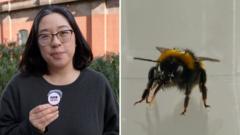
You probably think of bees as tiny, automated pollen processors. Little biological robots flying around on a pre-programmed loop, driven purely by hardwired survival instincts. That view is officially dead. New scientific data shows that the insects buzzing around your garden are dealing with something much closer to actual emotions than anyone wanted to admit.
The debate around bee feelings has taken a massive turn. We aren't just guessing based on how bees act when a spider attacks them. A study published in the journal Proceedings of the National Academy of Sciences reveals that bumblebees possess a distinct, observable inner life. Researchers captured miniature facial expressions on slow-motion video that match the exact liking and disliking responses we see in mammals. When a bee tastes something good, it literally licks its lips. When it tastes something bad, it shakes its head and wipes its mouth.
This isn't just a quirky biological fun fact. It completely flips how we define insect consciousness. For decades, the mainstream scientific community treated invertebrates as simple input-output machines. If you give them sugar, they drink. If you shock them, they run. But this new evidence shows they evaluate their world based on how it makes them feel. It proves that a brain weighing less than a single milligram can support an internal experience of pleasure and distaste.
The Slow Motion Proof of Bee Feelings
To understand why this changes everything, you have to look at how the experiment worked. A collaborative research team led by Fei Peng and Cwyn Solvi at Southern Medical University in China, along with neuroethologist Andrew Barron from Macquarie University in Australia, decided to look closer at bee mouthparts. They didn't just watch the bees eat. They used high-speed, slow-motion cameras to track the exact movements of 18 different colonies of bumblebees (Bombus terrestris).
The researchers handed the bees different drops of fluid. Some got a rich 60% sugar solution. Others got a weaker 20% sugar solution, plain water, a bitter 1 millimolar quinine solution, or a salty 5% salt solution.
The footage revealed something stunning. The bees didn't just consume the liquids or walk away. They reacted with distinct orofacial behaviors.
Lip Licking and Mouth Wiping
When a bumblebee drank the high-concentration sugar water, it showed a behavior called post-consumption glossa protrusion. The glossa is the insect tongue. Long after the bee finished drinking, it kept sticking its tongue out. It was doing the insect equivalent of a human smacking their lips after a great meal.
When the bees were given the salty or bitter drops, the reaction changed entirely. They started violently shaking their heads. They used their front legs to frantically wipe their mouths and tongues.
This matters because these behaviors mirror the exact taste-reactivity patterns used to identify emotions in mammals. If you give a rat a tiny drop of something incredibly salty or bitter, it wipes its whiskers, rubs its mouth, and shakes its head. We accept that the rat is expressing an internal state of dislike. The bumblebees did the exact same thing.
Moving Past the Robot Myth
Scientists have a strict rule against anthropomorphism. You aren't supposed to look at an animal and assume it thinks or feels like a human. For a long time, this rule forced researchers to describe all insect behavior through the lens of basic reflexes.
If a bee flies toward a flower, it's an "appetitive motivation." If it flees a threat, it's an "aversive response." This language kept the wall up between humans and bugs. It made people comfortable. It meant we didn't have to worry about the ethical choices behind how we treat insects.
Professor Andrew Barron points out that this study finally breaks down that comfort zone. There has always been a weird tension between looking at insects as animals or looking at them as mini robots. This new data pushes hard against the idea of the insect robot.
The study cleanly separated "wanting" from "liking." A reflex machine just wants food because its programming demands fuel. But the bumblebees in the experiment evaluated the quality of the food after consuming it. They contextually processed whether the experience was pleasant or unpleasant. That requires a point of view. It means there is someone home inside that tiny head.
The Growing Case for Insect Sentience
This PNAS study didn't happen in a vacuum. It builds on a stack of weird, fascinating discoveries made over the last few years that point to the same conclusion.
Consider the 2022 play study from Queen Mary University of London. Researcher Samadi Galpayage and bee-expert Lars Chittka set up an experiment where bumblebees could walk through a wooden tunnel to get food. Off to the side, they placed a bunch of small, brightly colored wooden balls.
The balls had absolutely nothing to do with food or survival. Yet, the bees repeatedly detoured into the side area just to roll the balls around. Younger bees rolled more balls than older bees. Male bees rolled them longer than female bees. They were playing. They did it simply because it was fun, showing that insects actively seek out activities that offer internal pleasure.
The Dark Side of Having Feelings
If bees can feel pleasure, the logical flip side is that they can feel down. Lars Chittka's lab proved this by setting up fake crab spiders on artificial flowers. The spiders would briefly trap a bee using soft pads, simulating a predator attack before letting it go.
The experience changed the bees completely. They didn't just fly back to work. They developed a form of anxiety. They would hover outside perfectly safe flowers for long seconds, scanning for threats, refusing to land. Even days later, they would occasionally freak out and fly away from completely empty flowers as if they were seeing ghosts.
Another major study by Gibbons in 2022 demonstrated that bees possess the neural architecture to experience genuine pain, rather than just nociception, which is the simple reflex of pulling away from a sharp object. When given pain relief medication like sucrose or hidden rewards, bees would consciously trade off physical comfort to get food, proving they actively weigh their internal suffering against their needs.
Why the Size of a Brain Doesn't Matter
The classic argument against bee feelings is brain size. A human brain has roughly 86 billion neurons. A bumblebee brain has about one million. How could something so small hold a subjective experience?
The reality is that we grossly misunderstand how much computing power it takes to generate a basic feeling. You don't need billions of neurons to feel happy or miserable. You need billions of neurons to do calculus, plan a retirement fund, or write a novel. Basic consciousness, the simple ability to feel the world instead of just processing data, appears to require a very small amount of neural wiring.
Structurally, a bee brain is organized in a remarkably similar way to a fly or even more complex organisms. The hardware is hyper-efficient. It packs massive spatial memory, human face recognition capabilities, basic counting skills, and tool-use learning into a microscopic space. Nature doesn't build a machine that complex just to have it operate in pitch-black internal darkness.
The Hard Truth About How We Treat Bees
Acknowledging that bees have an inner life forces us into some incredibly uncomfortable corners. Right now, industrialized agriculture treats bees like disposable machinery.
Take the commercial migratory beekeeping industry. Every year, millions of beehives are loaded onto the backs of flatbed trucks and shipped thousands of miles across continents to pollinate massive monoculture crops like almonds. They are exposed to intense diesel fumes, violent vibrations, constant temperature swings, and severe social disruption. We now know this psychological stress weakens their immune systems, leaving them highly vulnerable to diseases and colony collapse.
Then look at the pesticide situation. We design chemical compounds to scramble insect nervous systems. Even when these pesticides don't kill bees outright, they damage their ability to navigate, destroy their memory, and crush their capacity to learn. Imagine walking around with a chemically induced, permanent state of cognitive fog and low-level panic. That is what we are doing to wild populations daily.
Your Immediate Next Steps
Knowing that bees possess an inner world changes your relationship with the environment. You can't change global agricultural policies overnight, but you can immediately alter how you interact with the insects around your own home.
Stop using broad-spectrum chemical pesticides on your lawn or garden. If you have a pest issue, look into targeted, organic biological controls that don't collateral-damage the local pollinators.
Plant wild, native flowers in your yard to give local colonies access to varied, high-quality nutrition. Giving them a steady, clean supply of 60% sugar nectar lets them experience the insect version of joy right in your backyard.
Finally, stop swatting at them out of fear. A bee isn't an aggressive robot looking for a fight. It's an intelligent, feeling creature going about its day, evaluating its life one sweet drop at a time.