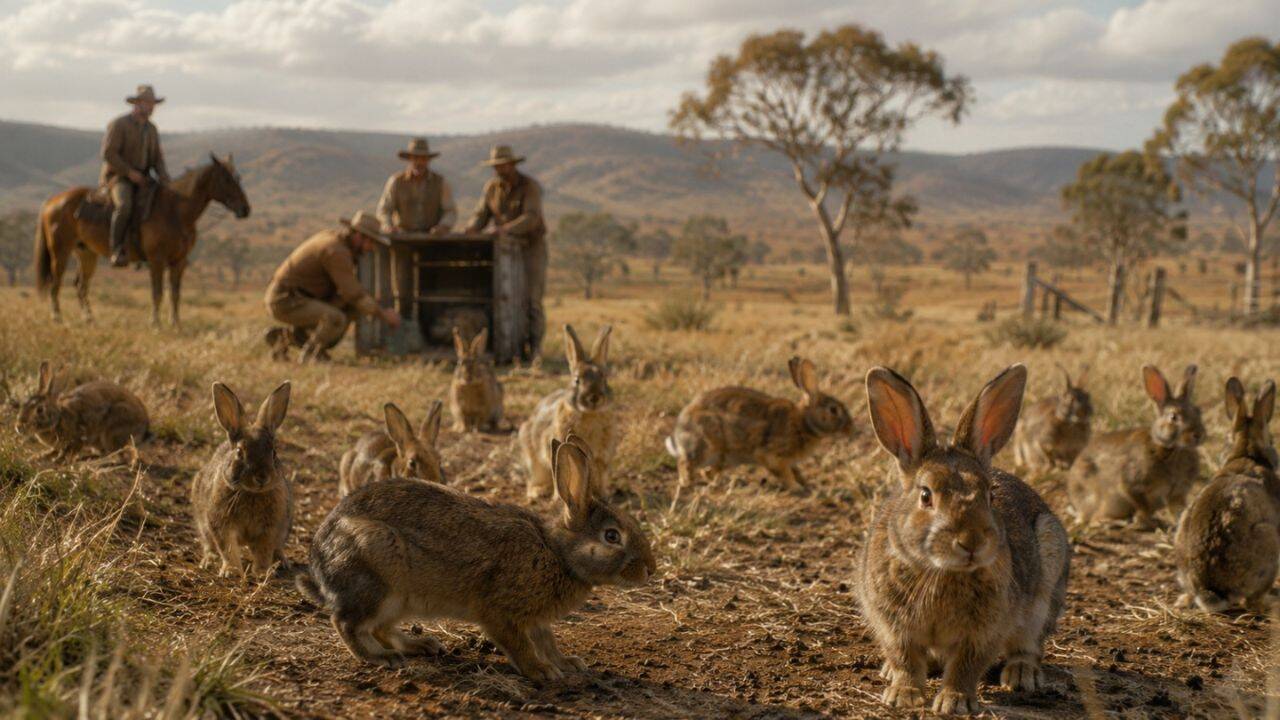
Most history books tell a deceptively simple story about how Australia became overrun by millions of fluffy, destructive pests. They blame a single wealthy English immigrant who wanted something familiar to shoot on his weekends. While that makes for a great cautionary tale about human hubris, the actual science behind the disaster is far more complex than just a few stray bunnies escaping a backyard cage.
The classic narrative claims that in October 1859, a man named Thomas Austin released a small handful of rabbits onto his massive estate in Winchelsea, Victoria. Within a few decades, those animals triggered the fastest colonization rate for any introduced mammal in recorded history.
But there is a massive detail that standard historical accounts completely miss.
Rabbits had actually been brought to Australia dozens of times before 1859. The First Fleet carried them over in 1788. Dozens of subsequent ships dropped them off at various ports. Yet, for more than 70 years, those early populations never exploded. They stayed local. They stayed manageable.
So why did Thomas Austin's specific batch turn into an unstoppable ecological nightmare? The answer lies in a groundbreaking genetic discovery that rewrites our understanding of this environmental catastrophe.
The Genetic Flaw in the Thirteen Rabbits Myth
Many articles and viral trivia posts repeat the specific claim that exactly 13 rabbits started the whole crisis. Others state he received 24. The truth comes from historical shipping logs and modern genomic tracking.
Austin originally asked his nephew back in England to send him 12 grey rabbits, five hares, 72 partridges, and some sparrows. He wanted to recreate the traditional British hunting experience on his 30,000-acre property, Barwon Park. His nephew couldn't find enough wild grey rabbits in the local Somerset area, so he bought a mix of wild caught specimens and domestic hutch rabbits to fill the order.
When the ship named Lightning docked in Melbourne on Christmas Day 1859, 24 rabbits stepped off the boat.
A 2022 genetic study led by Dr. Joel Alves and published in the Proceedings of the National Academy of Sciences (PNAS) analyzed the DNA of feral rabbits across the Australian continent. The researchers traced the lineage of the entire invasive population directly back to that single 1859 shipment from Southwest England.
The previous introductions failed to take over the continent because they were thoroughly domesticated animals. Those early rabbits had floppy ears, fancy coat colors, and a distinct lack of survival instincts. They were fat, tame, and perfectly adapted to life in a hutch. When they escaped into the harsh Australian bush, native predators like dingoes, birds of prey, and feral cats ate them almost immediately.
Austin's rabbits were entirely different. Because his nephew mixed genuine wild-caught rabbits with domestic ones, the animals interbred during the long 80-day sea voyage. This created a hybrid population with a lethal combination of traits. They possessed the aggressive survival instincts, predator awareness, and agile bodies of wild European rabbits, combined with the reduced fear of human-altered environments found in domestic strains.
This specific genetic cocktail gave them an unprecedented advantage. They weren't just lucky. They were genetically engineered by accident to conquer a new continent.
How Fast Did the Crisis Spread
The speed of the invasion caught everyone off guard. Austin himself was thrilled at first. He noted that the rabbits were breeding beautifully. By 1865, just six years after their release, Austin told local newspapers that he had already killed 20,000 rabbits on his property.
His estate became a premier hunting destination. In 1867, Queen Victoria's second son, Prince Alfred, visited Barwon Park for a grand shooting party. The Prince and his entourage shot thousands of rabbits in a single afternoon. The guns grew so hot from continuous firing that loaders could barely hold them.
The local press praised the abundance of game. Nobody realized they were witnessing the early stages of an ecological collapse.
The rabbits didn't stay on Austin's property. They moved fast. They traveled outward at a rate of roughly 100 kilometers per year.
- By 1880, they crossed the Murray River into New South Wales.
- By 1886, they breached the borders of Queensland.
- By 1894, they traversed the arid Nullarbor Plain into Western Australia.
To put this geographical conquest into perspective, it took rabbits roughly 700 years to spread across the entire island of Britain after being introduced by the Normans. In Australia, they colonized an area 25 times the size of Britain in just 50 years. It stands as the swiftest mammalian invasion ever recorded.
The Hidden Ecological Scars
When people think of pest damage, they usually think of ruined farm crops. Rabbits certainly did that. They devoured millions of acres of pasture, driving sheep and cattle farmers to bankruptcy. But the true horror of the Australian rabbit crisis was what it did to the underlying soil and native wildlife.
Australia is an ancient, fragile continent with thin topsoil. Native marsupials like kangaroos and wallabies graze on vegetation, but their soft paws and specific feeding habits don't destroy the root systems. Rabbits are different. They dig extensively, creating massive underground warrens that destabilize the earth.
They also practice a destructive feeding habit known as ringbarking. When grass runs low during dry seasons, rabbits strip the bark off the bases of young trees and shrubs to eat the moist tissue underneath. This kills the plants entirely. Without roots to hold the dirt together, the brutal Australian winds and seasonal rains washed millions of tons of topsoil away. Vast tracts of fertile land turned into literal deserts.
The rabbits also starved out native animals. Smaller marsupials like the bilby and the burrowing bettong found themselves competing with millions of ravenous invaders for the exact same food and shelter. The rabbits simply bred faster and ate everything in sight, pushing several native species to the brink of extinction.
Desperate Measures and Biological Warfare
By the turn of the 20th century, the Australian government realized that traditional hunting, trapping, and ferreting were completely useless. It was like trying to empty the ocean with a teaspoon. They needed radical solutions.
Their first massive attempt was structural engineering on a continental scale. Between 1901 and 1907, Western Australia constructed the State Barrier Fence, often referred to as the Rabbit-Proof Fence. It was a massive network of three interconnected fences stretching over 3,250 kilometers from the southern coast all the way to the north.
It was a monumental feat of human labor. Boundary riders patrolled the fences on camels and bicycles, clearing away debris and checking for holes.
The project failed. The fences were built too late. The rabbits had already crossed into the western territories before workers could finish the posts. Even where the fence stood secure, the animals managed to dig underneath or find gaps caused by flash floods and shifting sands.
Realizing physical barriers were useless, scientists turned to biological warfare.
In 1950, researchers released the Myxoma virus into the wild population. This virus, which causes myxomatosis, is native to South American rabbits and is spread by mosquitoes and fleas. The effect was immediate and devastating. The virus caused blindness, severe swelling, and eventual death.
The rabbit population, which had peaked at an estimated 600 million, plummeted by roughly 90 percent in just a few years. Farmers rejoiced as pastures greened up for the first time in generations.
But evolution never stops. The surviving ten percent of the rabbits possessed a natural genetic resistance to the virus. They bred, passed that resistance down to their offspring, and the population began to climb right back up.
In response, Australia introduced a second biological weapon in 1995: Rabbit Hemorrhagic Disease Virus (RHDV), commonly known as calicivirus. This virus causes rapid internal bleeding and quick death. Like the Myxoma virus before it, RHDV worked brilliantly at first, knocking down populations by significant margins. Yet over time, rabbits began developing resistance to this strain too.
The Reality of the Struggle Today
The battle against the invasive rabbit is not a historical event that ended in the 1900s. It remains an active, multi-million dollar annual operational expense for Australian conservationists and agricultural agencies.
The current strategy relies on a dynamic rotation of different viral strains combined with traditional land management practices. Relying on viruses alone is a guaranteed recipe for evolutionary failure.
Instead, land managers use a coordinated approach. They deploy specific biocontrol agents during peak seasonal windows when vectors like flies and mosquitoes are most active. Once the viral outbreak thins the population, property owners immediately follow up with physical destruction of the underground warrens using heavy machinery, a process known as ripping. Destroying the physical shelters prevents surviving rabbits or new migrants from re-establishing colonies.
The story of the 1859 release teaches us that ecosystems are highly sensitive webs, not playgrounds for homesick immigrants. A single introduces species, backed by the right genetic traits, can permanently alter the geography, economy, and biodiversity of an entire continent.
Actionable Steps for Modern Land Stewardship
If you manage land or work in conservation anywhere in the world, the Australian rabbit crisis offers critical takeaways for stopping invasive species before they get out of hand.
- Prioritize Genetic Screening: Never assume a species is safe to introduce or manage based solely on how domesticated varieties behave. Wild genetic strains carry hidden survival advantages that manifest unpredictably in new environments.
- Act on the First Sighting: The moment an introduced species is observed breeding in the wild, eradication protocols must begin immediately. Waiting until a population is noticeable means you are already decades too late.
- Use Integrated Management: Never rely on a single solution like a fence or a specific virus. Effective pest control requires combining biological, physical, and chemical tools in a continuous, rotating cycle to prevent the target species from developing evolutionary resistance.
:max_bytes(150000):strip_icc()/TAL-nassau-bahamas-BEAUTCARIB0323-4fbfce903e5a4418b895e03717e3de0d.jpg)