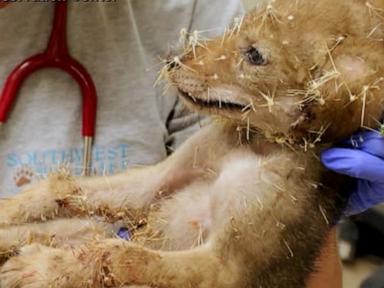
A tiny, three-pound ball of fur stumbled into the worst nightmare any desert dweller can face. People across the country watched the video footage of the coyote pup cactus rescue in shock, wondering how a wild animal could make such a brutal mistake. The four-week-old coyote pup was found in a residential yard in Surprise, Arizona, completely pinned down by hundreds of barbed cholla cactus spines. It wasn't just a few needles in its paw. The pup had piercing spikes protruding from its nose, its eyelids, inside its mouth, through its ears, and across its entire back.
Many people look at a story like this and think it's just a freak accident or a goofy mistake by an uncoordinated baby animal. That completely misses the point. This rescue highlights a much bigger, harsher reality about desert wildlife survival, urban encroachment, and the extreme mechanics of desert flora. Surviving the desert isn't about being born with perfect instincts. It's a brutal trial-and-error process that many young animals don't survive.
The Brutal Mechanics of the Cholla Cactus
To understand why this coyote pup cactus rescue was a life-or-death situation, you have to understand the specific plant involved. This wasn't a standard saguaro or a prickly pear. The culprit was a jumping cholla.
Cholla cacti don't actually jump, but they might as well. The segments of a cholla attach to one another via incredibly weak joints. The slightest brush from a passing animal detaches the segment instantly. The plant transfers its barbed spikes into the flesh of the victim with terrifying efficiency.
The structure of these spines makes them uniquely destructive.
- Microscopic Barbs: Unlike a standard thorn that acts like a smooth needle, cholla spines have backward-facing barbs. They act like tiny fishhooks. When they puncture skin, they lock into the tissue.
- Tissue Expansion: Trying to pull a spine straight out causes the barbs to catch, tearing muscle and skin.
- Sheathed Tips: The spines are covered in a thin paper-like sheath. When you try to pull them out, the sheath often slides off, leaving the barbed tip firmly embedded deep in the flesh.
When that little coyote pup rolled or stumbled into that patch of cholla in Surprise, every single movement he made to break free only hammered more segments into his skin. By the time a local homeowner spotted him, he wasn't moving. He couldn't. He was in a state of profound shock.
Inside the Two Hour Rescue Operation
When the homeowner called the Southwest Wildlife Conservation Center in Scottsdale, volunteers rushed to the scene. Berkeley Martineau, a skilled veterinary technician at the center, took charge of the medical response. Martineau noted right away that the animal was completely lethargic. When a wild coyote doesn't fight back or snap when handled, it means its body is shutting down from pain and stress.
The extraction process wasn't as simple as grabbing a pair of tweezers and pulling. It required a methodical, highly technical medical approach to ensure the pup didn't die on the table from cardiac arrest induced by sheer pain.
Step 1: Deep Sedation
The team immediately administered a controlled sedative. Without sedation, the pup's thrashing would have forced the barbs deeper into his internal organs and torn his eyes.
Step 2: Systematic Extraction
Martineau and his colleague used specialized metal clamps to grasp each individual spine at the exact base. They had to pull with a swift, straight motion to minimize tissue tearing. They worked continuously for two and a half hours.
Step 3: Assessing Hidden Damage
Spines had punctured all the way through the cartilage of the pup's ears. The team had to carefully check inside the mouth and down the throat, clearing barbs from the tongue that would have prevented the animal from ever eating or drinking again.
Step 4: Rehydration and Shock Management
Once the thousands of spines were removed, the pup was placed in a specialized warmed incubator. He received subcutaneous fluids to combat severe dehydration and medications to prevent systemic infection from the dirty cactus needles.
Why Urban Coyotes Face Higher Risks
This incident brings to light a major issue that wildlife biologists face in states like Arizona and California. Urban expansion means housing developments are built directly into the natural hunting grounds of native species.
Coyote parents frequently raise their litters in the small patches of desert left between suburban neighborhoods. In a completely wild environment, an experienced mother coyote teaches her pups to navigate the local flora over several months. In suburban settings, packs face frequent disruptions from traffic, construction, and human interference.
When a mother coyote gets scared off by a dog or a vehicle, her pups are left to explore the terrain entirely unguided. They don't know that a fuzzy-looking jumping cholla is a trap. They run into them while playing, escaping predators, or seeking shade. The pup rescued in Surprise was an orphan, meaning he had no adult guidance to steer him away from the deadliest plants in the valley.
The Long Road to Rehabilitation
The removal of the spines was just the first phase of a long process. The Southwest Wildlife Conservation Center doesn't just patch an animal up and throw it back into the desert. A common mistake people make is assuming a wild animal is ready for release the moment its wounds close.
The pup is currently undergoing a strict multi-month rehabilitation program.
- Infection Monitoring: Cactus spines carry bacteria and fungal spores. Every puncture wound must be monitored for deep-tissue abscesses.
- Socialization: Because this pup is an orphan, he cannot be raised alone. Isolating a young coyote causes it to imprint on humans, which is a death sentence in the wild. The center immediately introduced him to a surrogate pack of other orphaned coyote pups.
- Survival Training: Over the next few months, the pups will grow together in large outdoor enclosures that mimic the natural desert. They will learn to hunt live prey, avoid humans, and recognize dangerous plants.
The goal is a full release into a protected wildlife area once the pups reach adulthood in a few months.
What to Do If You Find an Injured Animal Covered in Spines
If you live in the Southwest, you will likely encounter wildlife tangled with desert plants at some point. Knowing how to handle the situation can save the animal's life and protect you from severe injury.
- Never attempt to pull the spines out yourself. Without heavy sedation, a wild animal will bite, scratch, and potentially transmit rabies or cause severe lacerations.
- Do not throw a blanket directly over a cholla-covered animal. The blanket will catch on the spines, and when the animal struggles, it will pull the needles even deeper into its flesh.
- Keep your distance and secure the area. Keep domestic pets away. Loud noises and barking dogs will cause the injured animal to thrash, exacerbating its injuries.
- Call a professional immediately. Contact an organization like the Southwest Wildlife Conservation Center (480-433-5656) or your local state department of fish and wildlife. They have the proper transport kennels, thick leather gloves, and medical equipment to handle the crisis safely.
The Surprise coyote pup survived because a homeowner chose to call the experts instead of trying a risky DIY rescue. He's currently recovering well, gaining weight, and learning how to be a real coyote alongside his new pack mates.
If you want to help support the ongoing medical care and feeding of this pup and other orphaned desert animals, visit the Southwest Wildlife Conservation Center to see how you can contribute directly to their rescue operations.