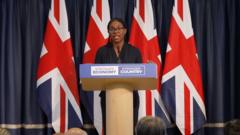
The British political chessboard just got completely upended. Sir Keir Starmer has announced his resignation, clearing the runway for Andy Burnham to take the keys to Number 10 by the end of June 2026. After a quick victory lap in the Makerfield by-election, the former King of the North is marching straight back into Westminster.
The political right is already panicking. You can see it in how Kemi Badenoch launched her latest rhetorical missile, claiming Burnham needs to act like a real leader instead of using regional devolution to dodge hard answers. She even mocked his media-ready persona at Prime Minister's Questions, calling him a pair of eyelashes and a black shirt.
Burnham clapped back with a five-second video pointing out his shirt was actually dark blue. It was funny, fast, and completely outmaneuvered the traditional Tory attack machine.
But behind the silly wardrobe bickering lies a brutal ideological conflict. Badenoch says Burnham is prime minister in everything but name right now, yet accuses him of needing a whole summer holiday just to figure out what he actually believes. She thinks his obsession with shifting power away from London is a coward's play to pass the buck when things go wrong.
She's wrong. She misunderstands why Burnham works, and she's misreading how the public's appetite for politics has shifted since the pandemic.
The Fallacy of the Strongman Leader
Westminster has an obsession with top-down control. For decades, the dominant theory of British governance has been that a strong prime minister sits in Downing Street, barks orders down Whitehall, and magically fixes the country. Badenoch is a product of this school of thought. She values ideological clarity, sharp debate, and absolute central authority.
When she tells Burnham to act like a leader, she means he should stop talking about councils and regional assemblies and start acting like an old-school boss.
That model is completely broken. Look at the state of the UK after years of over-centralized management. Local government is threadbare. Councils can barely afford to fix potholes, let alone kickstart massive regeneration projects. National government has grown bloated and disconnected from the communities it supposed to serve.
Burnham understands this because he lived it. He spent a decade outside the Westminster bubble running Greater Manchester. He knows that when you try to run an entire country from a few blocks in southwest London, you end up with an overheated economy in the southeast and total stagnation everywhere else.
His major policy speech in Manchester laid it bare. Growth can't be ordered from the top down by a bunch of civil servants who have never set foot in Lancashire or Yorkshire. It has to be nurtured from the bottom up. Shifting power to local regions isn't dodging responsibility. It's admitting that a room full of people in London shouldn't be making decisions for a community three hundred miles away.
Why the Eyelashes Insult Backfired
The Conservative strategy against Burnham is already showing its flaws. Trying to paint him as a lightweight who cares more about his social media image than real policy is lazy. It worked against Starmer because Starmer struggled to think on his feet. Starmer would have responded to a personal dig with a long, defensive essay about his background.
Burnham didn't get defensive. He leaned into it.
Political communication has fundamentally changed. The modern public doesn't want rigid politicians reading pre-approved scripts from a podium. They want something nimbler and more authentic. When Burnham shrugged off the criticism with a quick joke about the color of his shirt, he showed a level of media savvy that Badenoch wasn't prepared for.
It reveals a broader truth about his appeal. People who worked closely with Burnham during his time as mayor say his biggest strength is his emotional responsiveness. He genuinely listens to people, feels their frustration, and decides to act on it. His critics call it showboating or opportunism. His supporters call it empathy.
In a political climate where voters feel completely ignored by the political class, that personal connection is incredibly powerful. You can't defeat that kind of political appeal by making fun of someone's clothes. It makes the attacker look small and out of touch.
The Massive Battle Ahead for Social Care
If Badenoch wants to attack Burnham on substance, she should look at his plans for adult social care. This is where the real policy war will be fought, and it's a minefield for both sides.
Burnham has made it clear that reforming the care system is his top priority when he takes over. He wants to resurrect an old idea he floated back when he was health secretary before 2010. A national levy, possibly tied to inheritance, to fund social care for everyone.
The Tories killed that idea over fifteen years ago by branding it a death tax. It was a wildly successful political campaign that terrified all major parties into ignoring the social care crisis for a generation.
But things are different now. The system is on the verge of total collapse. Hospitals are blocked because elderly patients have nowhere safe to go. Families are burning through their life savings to pay for basic care. Burnham is betting that the public is finally ready for a grown-up conversation about funding.
This will be the first real test of his leadership. Is he going to fold the moment the right-wing press starts shouting about new taxes, or will he use his regional popularity to build a coalition for genuine change?
Badenoch claims he doesn't have answers. If he pushes through a comprehensive social care levy, that argument evaporates. It requires immense political courage to touch this issue. If he succeeds, he solves a problem that has broken multiple prime ministers before him.
Breaking the Iron Grip of the Whip System
One of the most surprising elements of Burnham's return is his critique of Westminster culture itself. He openly admitted he was worried about what he found when he walked back into parliament last week. He described it as a fragmented, unhappier place than the one he left more than a decade ago.
His solution is to dismantle the culture of fear that governs British politics. He wants to let members of parliament act as authentic representatives for their areas rather than mindless vote-bots for the party leadership.
The whipping system in British politics is notoriously brutal. MPs who step out of line are threatened, stripped of promotions, and frozen out. It ensures party unity, but it also destroys independent thought. It creates a parliament full of clones who care more about pleasing the party bosses than helping their constituents.
Burnham promises to lead from the front by changing that culture. He wants an inclusive team at the top that reflects the entire country.
Of course, this is easier said than done. Every prime minister enters office promising a new era of transparency and kindness. Then the first major backbench rebellion happens, the government's majority is threatened, and they immediately bring back the heavy-handed tactics.
If Burnham actually manages to loosen the grip of the whips, it will change how laws are made in the UK. It will give regional MPs far more leverage to demand resources for their communities. But it also means his government will be messy, loud, and prone to internal arguments. Badenoch will be waiting to exploit every single crack in that foundation.
The Ideological Trap of the Right
The Conservative attack strategy is stuck in a loop. They keep arguing that Burnham represents the same failed ideas about public spending and welfare that have dragged down the British economy. They want to frame the upcoming transition as a mere changing of the guard within a broken Labour system.
They are missing the point. Burnham isn't just a continuation of Starmer's platform. His political identity is built on a rejection of the neoliberal policies that have governed the UK for the last forty years. He wants public control over utilities, heavy investment in regional infrastructure, and a massive shift in economic resources.
By dismissing him as a lightweight or a hypocrite who just wants to pass problems down to local councils, the opposition is failing to engage with the actual substance of his platform.
Devolution isn't an escape hatch for a lazy politician. It's a fundamental restructuring of how a nation manages its wealth. When you give local mayors control over transport, housing, and skills training, you cut out the bureaucratic middle management of Whitehall. You get things built faster and cheaper.
If the Tories spend the next two years making jokes about blue t-shirts and accusing Burnham of being an empty suit, they are going to get blown away at the next election. They need to find a way to counter the argument that regional decision-making is inherently better than central control. Right now, they don't have an answer to that.
Your Move
The transition of power is happening right now. If you want to understand how this shift impacts your community, you need to look beyond the daily drama in the House of Commons. Take these three steps to see where the real changes are landing:
- Check your local devolution deal. Find out exactly what powers your local council or metro mayor currently holds over transport, housing, and budget allocation.
- Track the social care debate. Watch how the proposed inheritance care levy is received by local MPs in your area. This will tell you exactly how much stomach the government has for radical financial reform.
- Monitor local infrastructure spending. Keep tabs on whether new funding initiatives are actually leaving London or if they are getting trapped in Whitehall bureaucracy.

:max_bytes(150000):strip_icc()/TAL-nassau-bahamas-BEAUTCARIB0323-4fbfce903e5a4418b895e03717e3de0d.jpg)