A horrific discovery near a quiet railway line in Pattaya has sent shockwaves through both Australia and Thailand. An Australian man is charged with murder in Thailand after a teenage girl's body was found in a suitcase. This isn't just another tabloid headline from a nightlife resort. It is a grim, highly documented criminal investigation that unfolded in a matter of hours, ending with a tense arrest at Bangkok's international airport.
The case highlights the brutal reality of what happens when a holiday completely derails. The rapid response of the Thai authorities shows how tightly monitored modern tourist zones have become. If you think international borders can shield a suspect from local justice, this case proves otherwise.
The Grim Discovery by the Railway Track
The nightmare started on Friday evening in Pattaya, a coastal resort city about 150 kilometers east of Bangkok. Police received a frantic missing person's report from a 19-year-old Thai woman. Her friend, 17-year-old Tunchanok Donhomla, had vanished. She was last seen the previous day walking along Beach Road with a foreign tourist.
Pattaya investigators didn't wait around. They traced the girl's final known steps to a high-rise residential complex located on Jomtien Second Road. What they found inside the 15th-floor room was a scene of violence. There were clear signs of a struggle. Blood and chaotic disarray pointed to a major altercation.
By midnight, the search took a dark turn. Police officers tracking a specific route found a large black suitcase dumped in a grassy area near the local railway tracks, roughly four kilometers away from the condo. Inside was the naked body of Tunchanok. Forensic teams noted severe facial injuries, widespread bruising, and bleeding from her nose and mouth. She had fought for her life.
Trapped by a Network of Security Cameras
The suspect didn't realize how closely his movements were being logged. Pattaya is blanketed by surveillance systems, and those cameras became the primary tool for the police.
The timeline compiled by investigators leaves very little room for interpretation. Digital evidence shows the sequence of events with chilling clarity.
- Thursday at 3.34 AM — CCTV captures Simon Peter Carman, a 46-year-old Australian national from Ballarat, Victoria, walking into the Jomtien condominium complex. He is holding hands with Tunchanok Donhomla.
- Thursday Evening — Roughly 18 hours later, the same security camera records Carman leaving the residential building alone. He is struggling with a heavy, large black suitcase.
- The Getaway Route — Street cameras show Carman lifting the heavy piece of luggage onto the back of a motorcycle. He drives out toward Sukhumvit Road, then turns onto Chaiyaphruek Soi 2, navigating against the flow of traffic alongside the railway tracks.
- The Nine Minute Gap — The motorcycle disappears from camera coverage for precisely nine minutes. When it emerges back into view, Carman is riding the same route back to his room. The suitcase is gone.
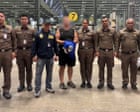
When police swarmed the condominium on Friday night, Carman had already checked out. A nationwide manhunt sparked an immediate airport watch notice. It didn't take long to find him. Within hours, immigration officials intercepted Carman at Bangkok's Suvarnabhumi International Airport. He was standing in line, attempting to purchase a ticket for a Jetstar flight back to Perth.
When officers grabbed him, they immediately noticed fresh, deep scratch marks across his neck and arms. The marks were entirely consistent with fingernail scratches from someone trying to break a hold.
Inside the Interrogation Room
Carman was taken back to Pattaya City Police Station in handcuffs. Confronted with video evidence and his own physical injuries, his story began to shift. Initially, he denied any involvement. He even filmed a short video message intended for the victim's grieving family.
"I feel bad for what happened to your daughter," Carman said to the camera. "It was out of my control. It shouldn't happen. Please tell other girls just to be careful."
That defensive stance cracked during deeper interrogation by senior detectives. According to local police reports, Carman eventually claimed he acted in self-defense. He told investigators that an argument over money escalated inside the 15th-floor room. He alleged that the 17-year-old threatened him with a kitchen knife. He admitted to grabbing her by the neck to restrain her but insisted he never intended to cause her death.
Thai police aren't buying the self-defense angle. Pattaya Police Superintendent Colonel Anek Sarathongyu confirmed that the Australian has been hit with four severe criminal charges. He faces counts of premeditated murder, concealment of a body, moving or destroying a carcase to hide a crime, and taking a minor under the age of 18 for indecent or sexual purposes.
A Broken Family Demands Ultimate Justice
Back in the rural province of Kalasin, where Tunchanok originally grew up, her family is dealing with pure devastation. Her father, Thongchai Donhomla, spoke about the harsh financial realities that often drive young women from the provinces into tourist hubs like Pattaya.
"My daughter had no mother," Thongchai said. "Whenever she wanted anything, she would find a way herself. She always helped me out too."
The family wants blood. In Thailand, murder convictions can carry the ultimate price. The victim's stepmother, Oradee Bussarakum, made her expectations perfectly clear to local reporters outside the police station. She stated she explicitly told the investigators that the family expects the death penalty. They want him executed for what happened in that room.
The Reality of the Thai Legal System
Many Westerners mistakenly believe that a foreign passport provides a safety net when things go wrong overseas. It doesn't. The Australian Department of Foreign Affairs and Trade confirmed they are providing consular assistance to a citizen detained in Thailand, but their powers are incredibly limited. They cannot get him out of jail, they cannot provide legal advice, and they cannot intervene in Thai judicial proceedings.
Carman is entering a legal system that handles violent crime with immense severity. Thailand still retains the death penalty for aggravated murder, typically executed via lethal injection. While executions are rare in recent years, courts routinely hand down death sentences or life imprisonment with zero eligibility for early parole.
A self-defense plea in a Thai court requires an incredibly high burden of proof. If a defendant hides a body, flees the scene, and attempts to board an international flight to escape the country, judges almost universally view that behavior as consciousness of guilt. Packing a victim into a suitcase and dumping them by a railroad track completely destroys the credibility of a self-defense argument in the eyes of local magistrates.
Staying Safe When Navigating Vulnerable Situations Abroad
This tragedy serves as a brutal lesson about the underlying risks of international travel and the absolute necessity of situational awareness. Whether you are traveling through Southeast Asia or anywhere else in the world, certain protective measures can keep you from falling into dangerous scenarios.
Keep a Digital Lifeline Open
Never go to a secondary location or a private room with someone you just met without alerting a trusted contact. Send a quick text with the name of the venue, the room number, or a live GPS pin. It takes five seconds and provides an immediate starting point if you lose contact.
Respect the Local Laws and Jurisdiction
If you find yourself in an escalating dispute or an emergency situation overseas, do not try to fix it through panic or illegal actions. Fleeing a scene or tampering with evidence converts a potential manslaughter or accident investigation into a capital murder case instantly. Contact local emergency services or your national embassy immediately.
Vet Your Accommodations and Environments
Stick to well-lit, heavily trafficked areas when moving around unfamiliar cities late at night. Choose reputable lodging with controlled entry points and visible security staff. Criminals thrive in isolation, and avoiding vulnerable, unmonitored spaces remains your best defense.
The Pattaya case will wind its way through the Thai courts over the coming months. Simon Peter Carman remains behind bars, denied bail due to the extreme flight risk he poses. He faces a highly professional prosecution team armed with high-definition video data, forensic evidence, and a clear timeline of his movements. There are no easy exits from this situation.