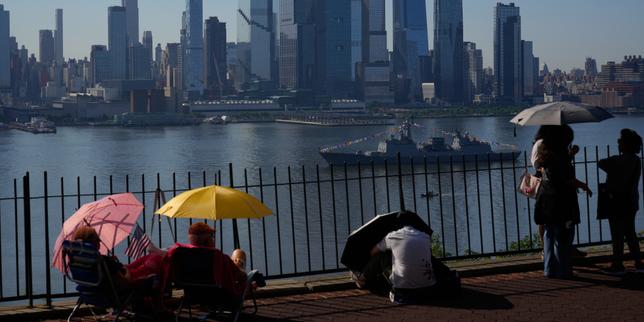
The numbers coming out of the Mid-Atlantic are devastating, but they don't tell the whole story. While millions of Americans tried to celebrate the July 4th holiday weekend, an invisible crisis settled over the region. The recent New Jersey heat wave has officially claimed at least 19 lives across the state, with local health departments warning that the preliminary death toll could climb as medical examiners finish their reviews.
This wasn't just a couple of uncomfortable summer days. It was a compounding disaster. New Jersey Health Commissioner Dr. Raynard Washington shocked the public when he revealed where the victims were found. Most didn't collapse from heat stroke on a hiking trail or at a beach. They died quietly inside their own homes, trapped without air conditioning. Others were found on city streets or inside parked cars.
When Governor Mikie Sherrill called this the most intense stretch of heat the state has seen in over 14 years, she wasn't exaggerating. The sheer speed and relentless nature of this weather event caught cities off guard, exposing massive vulnerabilities in our infrastructure and how we protect our most vulnerable neighbors.
The mechanics of a heat dome
To understand why this New Jersey heat wave turned so deadly, you have to look at the meteorology behind it. A massive high-pressure system parked itself directly over the central and eastern United States. Meteorologists call this a heat dome. It basically acts like a giant pot lid, trapping hot air underneath it and baking the ground with continuous sunshine.
Atlantic City broke historical records by hitting 105 degrees Fahrenheit on Friday and an astonishing 106 degrees Fahrenheit on Saturday. But the daytime highs are only half the problem. The real danger lies in what happens when the sun goes down.
During a typical summer pattern, temperatures drop at night, allowing the human body to cool down, regulate its internal temperature, and recover from the day's strain. During this crisis, the overnight low in Atlantic City barely dipped to 80 degrees Fahrenheit. When it stays that hot and humid through the night, the physical stress accumulates. Your heart pumps harder to cool your skin, your fluid levels drop, and if you can't find a cooled environment, your internal systems begin to fail. It's a cumulative toll that builds up over three or four days until it becomes fatal.
The grid failure that made it worse
High temperatures are dangerous enough on their own. But this disaster became significantly worse due to a brutal secondary factor: violent summer storms.
Just as the heat dome reached its peak intensity, severe thunderstorms ripped through the region. High winds gusting up to 70 miles per hour tore down trees and snapped power lines. In New Jersey alone, more than 250,000 customers lost power in the blink of an eye.
Think about that scenario for a second. You're an elderly resident living alone in a brick apartment building. The outdoor temperature is triple digits. Suddenly, the sky turns black, the wind howls, and the power grid goes dark. Your fans stop spinning. Your air conditioner shuts off. The brick walls start absorbing the heat, turning the apartment into an oven.
This is exactly why so many people died indoors. The US Department of Energy had to declare an emergency for the PJM Interconnection, which operates the region's electric grid, just to scramble enough energy resources to keep essential services running. Wholesale power prices spiked from a normal $40 per megawatt-hour to an insane $1,600 as the system buckled under the strain.
Public transportation fell apart right when people needed it most. Amtrak had to slash train speeds along the Northeast Corridor because the extreme heat was literally buckling the steel tracks and sagging the overhead power lines. NJ Transit faced cascading suspensions and delays, leaving commuters stranded on hot platforms or trapped in stalled trains. If you didn't have a car, escaping the heat became almost impossible.
The stark divide in climate survival
Honestly, events like this highlight a growing inequality. For wealthy residents, a heat wave means turning up the central air conditioning, staying inside a climate-controlled home, or driving to an air-conditioned mall. It's an inconvenience, sure, but it isn't life-threatening.
For lower-income families, elderly individuals living on fixed incomes, and marginalized communities, the reality is entirely different. Many older homes and apartment complexes lack proper insulation. A lot of residents can't afford the sky-high electric bills that come with running an air conditioner all day long, so they rely on window fans that do nothing but push boiling air around the room.
Emergency rooms across New Jersey reported massive spikes in heat-related admissions over the holiday weekend. The vast majority of these patients came from neighborhoods with less tree cover, older housing stock, and limited access to immediate cooling centers.
Actionable steps to survive extreme urban heat
We have to stop treating these events as freak anomalies. They are happening more frequently, lasting longer, and hitting harder. You need to know exactly how to protect yourself and your family when the next heat dome settles in.
Audit your home cooling setup now
Don't wait until the thermostat hits 100 degrees to check your gear. If you rely on window units, clean the filters before the summer peak. If you don't have air conditioning, identify the coolest room in your living space—usually on the lowest floor, away from direct sunlight. Cover your windows with thermal curtains, cardboard, or reflective foil to block the sun's rays during peak daylight hours.
Understand the limits of fans
Electric fans are great for airflow, but they are deceptive. When the indoor temperature rises above 95 degrees Fahrenheit, blowing air across your body will not prevent heat illness. In fact, it can actually accelerate dehydration by drying out your sweat faster than your body can produce it. If it's that hot, you need actual cooling, not just airflow.
Map out your local cooling sanctuaries
Know exactly where you can go if your power fails or if your home becomes unlivable. Public libraries, community centers, malls, and designated municipal cooling centers are free options. Make a list of these locations, note their operating hours, and plan a transit route that doesn't rely entirely on trains that might get delayed by warped tracks.
Check on high-risk neighbors
This is the most critical step. The data shows that isolation kills during a heat wave. Make a list of elderly relatives, neighbors who live alone, and friends with chronic health conditions. Call them or knock on their doors twice a day when temperatures skyrocket. Don't just ask if they're okay—physically step inside their home to feel the temperature yourself. Many older adults lose their ability to accurately sense how hot they are, or they might be too proud to admit they need help.
Master the signs of heat emergencies
You must know the difference between heat exhaustion and heat stroke. Heat exhaustion involves heavy sweating, a rapid pulse, dizziness, nausea, and cool, clammy skin. You can treat this by moving to a cool place, drinking water, and applying cool cloths.
Heat stroke is a medical emergency. The body's temperature control system shuts down. Symptoms include hot, red, dry skin (or sometimes heavy sweating), a throbbing headache, confusion, fainting, and a body temperature above 103 degrees Fahrenheit. If you see someone exhibiting these signs, call 911 immediately and move them to the shade or AC. Cool them down with ice packs or cold water while waiting for paramedics.