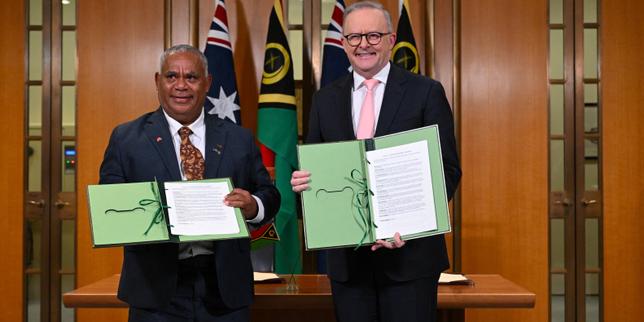
Geopolitics in the South Pacific just took a massive turn. On Monday, June 29, 2026, Australian Prime Minister Anthony Albanese and Vanuatu Prime Minister Jotham Napat signed a long-delayed, critical agreement in Canberra. Known as the Nakamal Agreement, it officially locks out the possibility of any foreign military base on Vanuatu territory.
If you've been watching the chess match between Western allies and Beijing over regional influence, this is a major play. But if you think this completely shuts China out of Vanuatu, you're missing the real story.
Let's break down what's actually in this pact, what it took to get it signed, and why it doesn't give Australia total control.
The Push for Certainty in a Crowded Ocean
For Canberra, the main goal of this deal was simple. Certainty. For years, rumors have swirled about China wanting to establish a permanent military foothold in the South Pacific. Vanuatu, located roughly 1,750 kilometers off Australia's northeast coast, sits right in a vital strategic corridor.
The core of the Nakamal Agreement delivers exactly what Australia wanted. Under its terms, Vanuatu explicitly pledges not to allow its territory or critical infrastructure to be used for any foreign military base.
Strategic Corridor: Australia <--- 1,750 km ---> Vanuatu
Result of Deal: Zero foreign military bases permitted on the archipelago.
The pact ensures that essential local hubs like deep-water ports, communication systems, and airports must stay free from militarization and foreign interference. Furthermore, Vanuatu has committed to turning to Australia, New Zealand, or France first if a major natural disaster strikes, anchoring its emergency response deep within the traditional regional family.
Why the First Attempt Failed Nine Months Ago
To understand why this current deal matters, we have to look at what happened in September 2025. Back then, Anthony Albanese was literally hours away from boarding a flight to Vanuatu to sign an earlier version of this pact when the deal suddenly imploded.
Vanuatu pulled out.
The original draft had sparked a political firestorm in Port Vila. Local lawmakers feared that the security terms were so restrictive they would undermine Vanuatu's sovereignty. They worried it would kill off infrastructure investments from other global players, specifically China. In that first version, Canberra pushed for what was essentially a veto right over major infrastructure projects.
Port Vila said no.
The text signed today is a classic diplomatic compromise. It's watered down, but effective enough for both sides. Vanuatu will consult Australia on any proposed third-party investments in critical infrastructure, but Canberra does not get a veto. It's a subtle distinction, but a crucial one for Vanuatu's independence.
The Geopolitical Balancing Act is Far from Over
Don't assume this deal means Vanuatu is picking a side. Prime Minister Jotham Napat is playing a careful, highly strategic game of balance.
While signing the Nakamal Agreement with Australia, Napat openly confirmed that Vanuatu is simultaneously negotiating a separate bilateral deal with China, known as the Namele Agreement.
Canberra won't have a permanent Chinese naval base on its doorstep, but Beijing isn't leaving the room. Here is how the influence is currently split:
- Security & Policing: The new treaty locks in Australia as Vanuatu's primary policing and security partner. Vanuatu has agreed to prioritize members of the Pacific Islands Forum for local policing needs.
- The Chinese Loophole: The deal doesn't ban Chinese police from visiting. China already established policing ties with Vanuatu back in 2023, donating patrol boats, vehicles, and drones. Chinese police personnel will still rotate through the island for training and joint exercises.
- Economic Infrastructure: China has poured massive amounts of money into Vanuatu via loans and construction projects under its Belt and Road initiative. Chinese contractors built local government buildings, paved highways, and expanded a massive wharf in Luganville. While the West initially panicked that the Luganville wharf would become a naval outpost, the new treaty ensures it stays strictly civilian.
The True Cost and the Golden Passport Problem
Diplomacy isn't free. The original 10-year draft of this agreement carried a price tag of 500 million Australian dollars ($344.5 million USD) in development and security aid. Albanese has noted that the final funding details for this revised version will be made public during Australia's year-end budget update.
The deal also includes a fascinating, highly specific clause regarding visas. Australia will offer enhanced mobility arrangements for Vanuatu citizens, but it comes with a strict catch. Vanuatu must tighten its internal mechanisms to vet its controversial "citizenship by investment" scheme.
For years, Vanuatu has sold "golden passports" for roughly $130,000 USD, allowing foreign buyers to acquire citizenship with very few questions asked. The program has drawn intense international criticism, especially after high-profile, self-described misogynist influencer Andrew Tate managed to secure a passport through the program. Australia's new deal forces Vanuatu to differentiate between natural-born citizens and those who simply bought their way in before accessing Australian travel privileges.
What Happens Next
This treaty is officially ratified on the Vanuatu side, and it's now heading through the parliamentary process in Australia. Expect intense debate in Canberra as opposition leaders analyze the compromises made to get this over the finish line.
If you want to track how this power dynamic evolves over the next few weeks, watch these two next steps:
- Watch the Solomon Islands and Fiji: Prime Minister Albanese is scheduled to travel to Fiji and the Solomon Islands in July 2026. He wants to secure a similar treaty with Honiara and finalize a deal with Suva. This is a broader, systematic push to encircle the region in Western-aligned security pacts.
- Wait for the Namele Agreement Text: Prime Minister Napat promised to publicly release the text of Vanuatu's new pact with China as soon as it gets clearance from Beijing. Reviewing that document will reveal exactly how much economic and developmental leverage China managed to keep despite Australia's big win today.