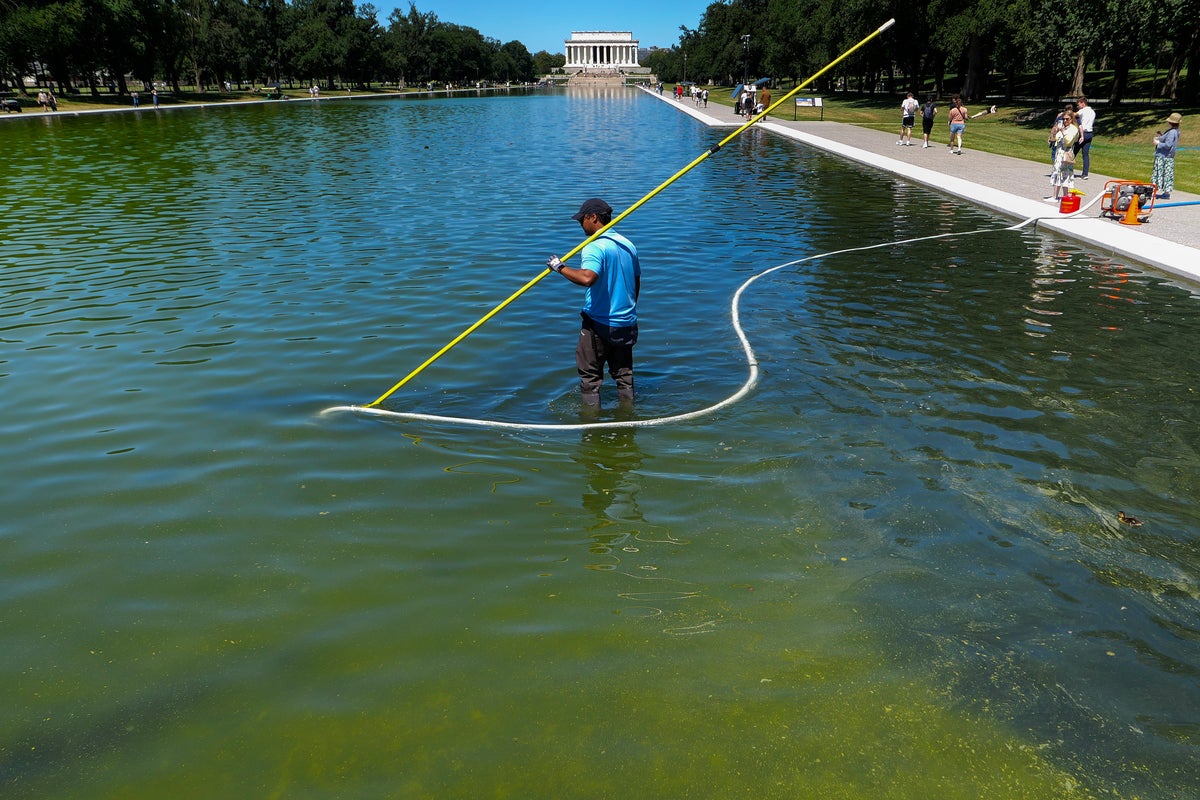
You have probably seen the photos. The iconic Lincoln Memorial Reflecting Pool, usually a crisp mirror reflecting the sky and stone monuments, turned into a thick, pea-soup nightmare. The vibrant green explosion of Desmodesmus algae happened almost immediately after a massive $15 million renovation in the spring of 2026.
The response from officials was predictable. They panicked. They brought out heavy vacuums, dumped in massive amounts of hydrogen peroxide, and even commissioned a staggering $1.7 million contract for high-tech nanobubble ozone equipment to blast the water clean. Park administrators even blamed "saboteurs" when the fresh blue paint began peeling off the bottom, sending in police to arrest people nearby.
It's a classic example of heavy-handed management failing to understand basic biology. While politicians engage in finger-pointing and conspiracy theories, freshwater ecologists are shaking their heads. The solution isn't more expensive chemical warfare or high-tech gadgetry. The real answer lies in something much smaller, cheaper, and infinitely more effective: water fleas.
The Chemistry Set Mentality is Failing Our Public Waters
When a community pond or a national monument turns green, our first instinct is to kill it. We treat water like a sterile swimming pool rather than a living ecosystem. The National Park Service treated the Reflecting Pool with hydrogen peroxide, an aggressive oxidizer that rips apart plant cells.
Here is the problem with that approach. It's temporary. Chemical treatments knock back the visible bloom but leave the underlying issue completely untouched. When you kill millions of algae cells with chemicals, they sink to the bottom, decay, and release their stored nutrients right back into the water column. You're effectively fertilizing the next generation of the bloom.
Worse, these harsh interventions destroy the very organisms that could help. Draining the pool or poisoning it wipes out the entire biological community, creating an ecological vacuum. The moment you refill the pool, the algae—which reproduces at a blistering pace—returns with a vengeance because it has absolutely zero competition.
How a Dumb Design Decision Created the Perfect Algae Storm
To understand why the Reflecting Pool failed so spectacularly in 2026, you have to look at the physical environment. The pool is huge, stretching more than a third of a mile long and 165 feet wide. But it is incredibly shallow. Shallow water heats up rapidly under the summer sun, and warm water is rocket fuel for algal growth.
During the recent spring renovation, workers repainted the pool bottom a deep "American flag blue." It looks striking in photos, but it was a catastrophic blunder from a thermodynamic perspective. Dark colors absorb solar radiation. By darkening the bottom, the renovation inadvertently turned the entire structure into a massive solar water heater.
To top it off, managers filled the pool using water from the Potomac River's tidal basin. The Potomac is notoriously rich in agricultural and urban nutrient runoff, packed with phosphorus and nitrogen. When you mix nutrient-dense water with soaring temperatures and a dark, shallow basin, you aren't just getting an algal bloom. You're practically manufacturing one.
The Secret Weapon: Tiny Crustaceans with an Appetite
Limnologists—scientists who study inland waters—have been trying to tell city planners for decades that nature already built a perfect cleanup crew. Enter Daphnia, commonly known as water fleas due to the jerky, hopping way they swim through the water column.
Daphnia aren't actually insects; they are tiny, translucent crustaceans. They also happen to be voracious filter feeders. A healthy population of water fleas acts like thousands of microscopic vacuums, constantly straining the water and consuming single-celled green algae before it can clump into an unsightly, thick mat.
"Rather than battling against nature, these alternatives work with nature for long-term solutions." - Eric Palkovacs, Freshwater Ecologist
A thriving community of Daphnia can keep a body of water crystal clear even when nutrient levels are incredibly high. They provide a dynamic, self-regulating buffer. When the algae population spikes, the water fleas eat more, breed faster, and multiply to meet the food supply. When the algae drops, their population naturally scales back.
The Evolutionary Superpower of the Water Flea
The real tragedy of using chemicals like hydrogen peroxide or ozone to clean urban pools is that it destroys generations of rapid evolutionary adaptation. Urban water features are brutal places for aquatic life. They suffer from wild temperature swings, low dissolved oxygen levels, and heavy chemical pollution from urban runoff.
But Daphnia have a genetic superpower: they evolve at breakneck speed. Studies show that when a population of water fleas is exposed to harsh conditions or toxic cyanobacteria, they can adapt within just a few generations. They develop tolerances to high heat and low oxygen that would kill off laboratory strains.
When the government continually drains a pool or nixes it with chemicals, they erase that hard-won genetic progress. They reset the evolutionary clock to zero. If managers instead allowed a resident population of Daphnia to establish themselves, those tiny crustaceans would quickly adapt to the specific heat and chemical profile of the Reflecting Pool, providing free, permanent filtration.
Rethinking Urban Architecture from the Ground Up
If we want our public monuments and community parks to feature clean water, we have to stop designing them as giant, sterile concrete bathtubs. The internet had a field day with memes about the green pool, but botanical groups pointed out a glaringly obvious fix: emergent aquatic vegetation.
Rooted aquatic plants act as natural nutrient sinks. They compete directly with algae for the phosphorus and nitrogen dissolved in the water. By planting native reeds, water lilies, or submerged grasses in dedicated zones or floating wetlands within urban water features, you lock up the nutrients before the algae can ever touch them.
Combining rooted plants with a healthy population of grazing zooplankton creates a stable, self-sustaining ecosystem. It completely eliminates the need for million-dollar nanobubble contracts or chemical dumps that degrade structural paint and cause PR disasters.
Your Immediate Next Steps for Algae Management
If you manage a community pond, an HOA water feature, or even a large backyard pond, stop repeating the mistakes of the National Mall. Shift from a chemical mindset to an ecological one.
- Ditch the copper sulfate and peroxide: Stop using harsh chemical algecides that cause rapid nutrient recycling and kill off beneficial zooplankton.
- Seed your water naturally: Introduce local, wild strains of Daphnia and other micro-crustaceans. Sourcing them from nearby natural ponds ensures they already possess the adaptations needed for your local climate.
- Plant aggressively: Dedicate at least 15-20% of your pond's surface area to native aquatic plants to starve the algae of nutrients.
- Create shade: Use floating plants or structural shading to keep water temperatures down, especially if your pond has a dark liner or bottom.