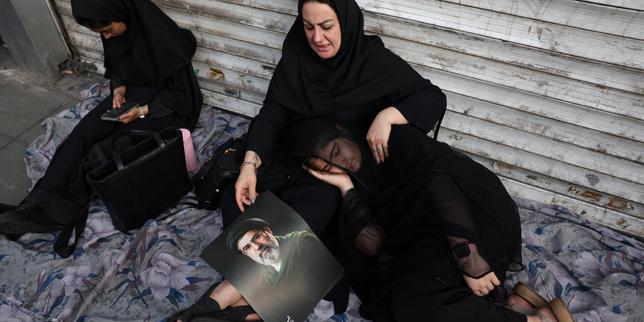
You can orchestrate days of state-sponsored mourning, line the streets of Tehran with black banners, and broadcast weeping crowds on loop. But you can't hide an empty chair.
As Iran began its massive, week-long funeral procession for former Supreme Leader Ali Khamenei, the political theater couldn't mask a glaring void. The dead leader's son, and the newly minted third Supreme Leader, Mojtaba Khamenei, didn't show up.
When the coffin rolled into Tehran’s Imam Khomeini Grand Mosalla, it was surrounded by high-ranking political faces like President Masoud Pezeshkian, Parliament Speaker Mohammad Baqer Qalibaf, and top military brass. State television prominently displayed three of Ali Khamenei's other sons—Mostafa, Meysam, and Masoud—leading prayers. But Mojtaba? Nowhere to be found.
For a regime that survives on the optics of absolute power and continuity, this isn't just an awkward family absence. It's a flashing neon sign pointing to a deeper crisis within the Islamic Republic. People searching for answers about Iran's transition of power want to know one thing: where is the new boss, and can he actually run the country?
The short answer is a mix of severe physical trauma and crippling paranoia.
The Physical and Psychological Shrapnel of February 28
To understand why the new Supreme Leader is missing his own father's multi-city funeral arrangements, you have to look back to the daylight decapitation strike on February 28, 2026. That joint U.S.-Israeli bombardment didn't just end Ali Khamenei's 40-year rule. It tore Mojtaba's immediate world apart.
The strike on the elder Khamenei's compound killed Mojtaba’s wife, his son, his sister, and his brother-in-law. Mojtaba himself barely survived. Reports tracking his inner circle indicate he suffered severe facial injuries and significant wounds to one or both legs.
He hasn’t been seen in public since that day. He even missed a private memorial for his own wife in Tehran.
But physical healing is only half the battle. The security apparatus surrounding Mojtaba is utterly terrified. According to intelligence leaks, Mojtaba desperately wanted to perform the final burial rites for his father at the Imam Reza shrine in Mashhad on July 9. Security officials, specifically top members of the Islamic Revolutionary Guard Corps (IRGC), flatly nixed the idea.
The fear is brutally pragmatic. They believe Israeli intelligence is waiting for Mojtaba to break cover. A single public appearance could either hand Israel a clean shot at a second decapitation strike or allow foreign intelligence agencies to track him back to his deep underground hiding spot.
Instead of the Supreme Leader leading the nation in prayer, state media quietly announced that senior Shiite clerics like Ja'far Sobhani in Tehran, Naser Makarem Shirazi in Qom, and Hossein Nouri Hamedani in Mashhad would step in.
A Ghost on the Throne Fuels Conservative Infighting
Governing from a bunker doesn't work long-term, especially in a system as cutthroat as Iran's. Mojtaba's total public vanishing act is rapidly undermining his authority, creating a dangerous power vacuum that hardline factions are already exploiting.
The regime is currently split over how to handle the fallout of the war. An official statement bearing Mojtaba's name recently gave the green light to pursue ceasefire and diplomatic talks with the United States. But here's the catch: hardline Iranian conservatives don't believe the letter is real.
These factions are openly resisting any diplomatic pivot. They argue that until Mojtaba appears on camera, or at the very least produces a verified voice recording, they won't accept his decrees. They smell weakness. For them, a leader who can't even stand beside his father's coffin is a leader who can't defend the Islamic Republic.
What most outside observers miss is that this funeral was supposed to be Mojtaba's grand coronation. It was designed to prove that despite a devastating war, the line of succession was secure. Instead, the choreography is falling apart.
What Happens Next
The true test of Mojtaba's grip on power won't happen in the funeral lines, but in the immediate aftermath. Once the mourning period ends, the new Supreme Leader is scheduled to make a series of senior political and military appointments.
Keep your eyes on those appointments. They will tell you exactly who holds the cards in Tehran. If Mojtaba stacks the deck with pragmatic allies open to stabilizing the country, it means he is slowly clawing back control. If hardline IRGC veterans dominate the new roster, it's a sign that the shadow ruler is effectively a hostage to his own security state.
Watch the state media channels closely over the coming days as the coffin moves through Qom, Iraq's holy cities of Najaf and Karbala, and finally Mashhad. If Mojtaba fails to provide even a pre-recorded audio message by July 9, expect the conservative infighting in Tehran to spill out into the open.

:max_bytes(150000):strip_icc()/TAL-nassau-bahamas-BEAUTCARIB0323-4fbfce903e5a4418b895e03717e3de0d.jpg)