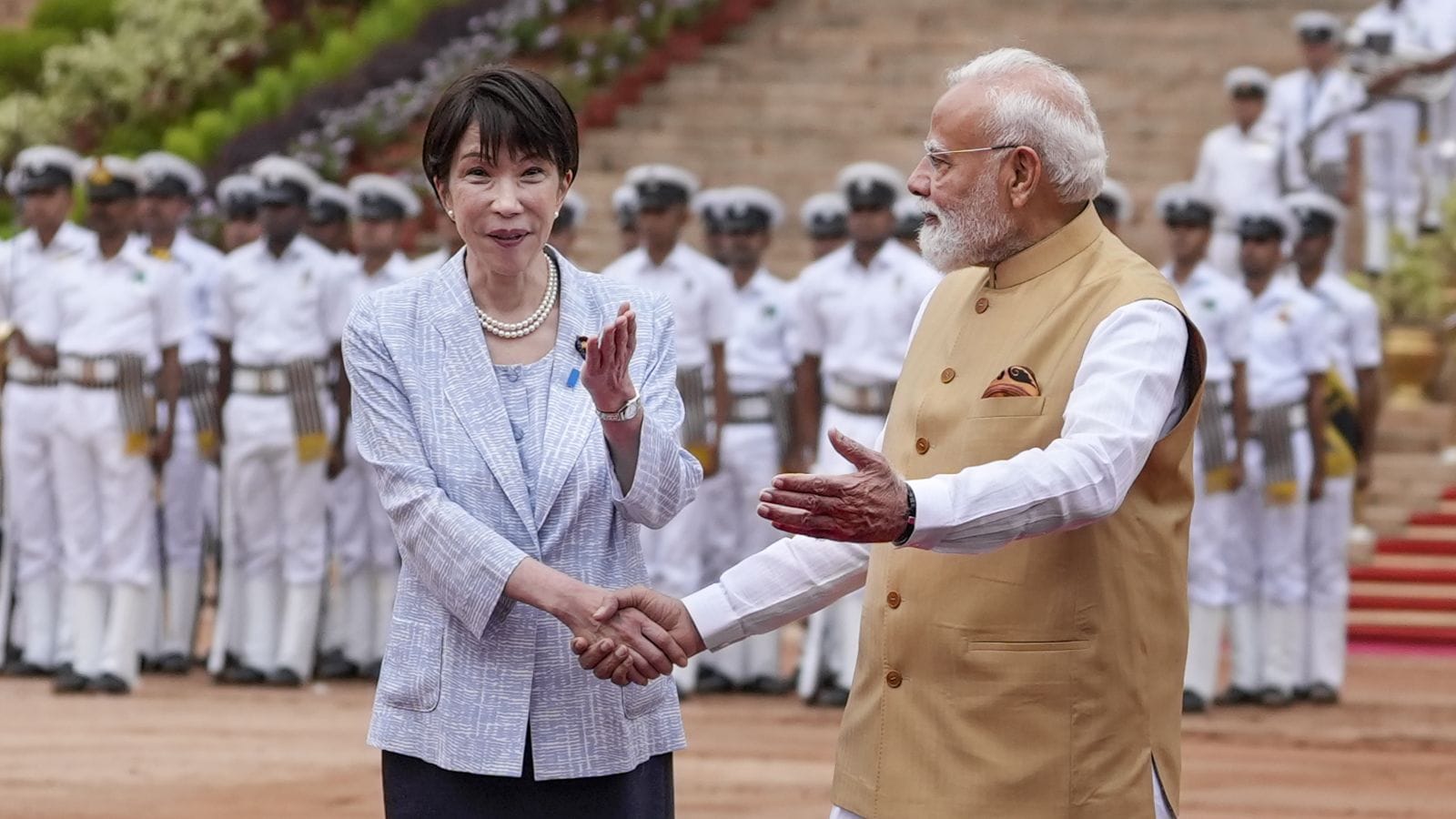
Beijing isn't hiding its nerves anymore. Right after Indian Prime Minister Narendra Modi and Japanese Prime Minister Sanae Takaichi wrapped up their high-stakes annual summit in New Delhi, China issued a sharp warning about "exclusive cliques." Chinese Foreign Ministry spokesperson Guo Jiakun went on the defensive, claiming that international cooperation shouldn't target third parties or stoke confrontation. But if you look closely at what actually went down in New Delhi, it's easy to see why China feels targeted. This wasn't just a routine diplomatic meet-and-greet. It was a calculated economic and strategic pushback against Chinese dominance in Asia.
When China reacts to Modi Takaichi summit announcements with this much anxiety, it's because the ground is shifting beneath its feet. India and Japan just signed off on 120 memorandums of cooperation, unlocking a massive 2 trillion yen ($12.4 billion) in private-sector investments. They aren't just talking about trade anymore. They're rebuilding the core infrastructure of the Asian economy, focusing heavily on semiconductors, critical minerals, and artificial intelligence. For a long time, Beijing relied on its monopoly over supply chains to lean on its neighbors. That strategy is rapidly losing its teeth.
Decoding the Real Reason China Reacts to Modi Takaichi Summit Agreements
The official statement from Beijing tried to frame the India-Japan partnership as divisive. Guo Jiakun told reporters that nations need to safeguard global industrial chains rather than building small groupings. That's rich coming from Beijing, considering China has spent the last several months tightening export controls on rare earth minerals. They've used these restrictions as a political cudgel against Japan, the US, and India.
The New Delhi summit hit China exactly where it hurts by calling out "economic coercion and nonmarket policies." India and Japan didn't use China's name in that specific sentence, but they didn't have to. Everyone in the room knew who they were talking about.
Japan's reliance on Chinese rare earths has been a huge vulnerability. By locking in a massive exploration and technical collaboration framework with India, Tokyo is actively trying to break that dependence. India has the raw materials and the workforce, while Japan has the precision engineering and capital. It's a natural match that makes Beijing incredibly uncomfortable.
The Taiwan Factor and the Breaking Point in Tokyo Beijing Relations
You can't understand China's bitter reaction without looking at the baggage Sanae Takaichi brought to the table. Since taking office, the Japanese Prime Minister has been a thorn in Beijing's side. Back in November 2025, she caused a massive diplomatic storm by suggesting that a Chinese attack on Taiwan could trigger a direct defensive response from the Japan Self-Defense Forces alongside the United States.
Beijing went ballistic. They retaliated by slapping strict export controls on 40 Japanese entities. Relations between Tokyo and Beijing have been in a tailspin ever since.
When Takaichi landed in New Delhi for her first official visit to India, China was already watching her every move. Seeing her stand shoulder-to-shoulder with Modi only confirmed Beijing's worst fears. They see an encirclement strategy forming, stretching from the waters of the Japanese archipelago down to the Indian Ocean.
Straight Talk on Maritime Chokepoints
The joint statement issued by Modi and Takaichi went far beyond economic cooperation. They explicitly called out the situation in both the East China Sea and the South China Sea. They noted serious concerns over the militarization of disputed features and unilateral attempts to change the status quo by force.
For India, this represents a increasingly bold stance on East Asian maritime security. For Japan, it's a validation of its security anxieties. The two leaders also threw their weight behind securing freedom of navigation through the Strait of Hormuz. Both economies run on energy imported through these tight maritime chokepoints. A blockade or conflict anywhere along this route would ruin their domestic economies, so they are signaling that they will protect these waters together.
The Mini Lateral Reality Replacing Broad Alliances
Global politics is moving away from giant, slow-moving alliances like the UN. Instead, we're seeing the rise of fast, focused groupings often called mini-laterals. The Quad, which includes India, Japan, Australia, and the US, is the prime example.
During the summit, Modi and Takaichi pushed for an early convening of the next Quad Leaders' Summit. While regional politics can sometimes slow down these meetings, the bilateral momentum between New Delhi and Tokyo keeps the engine running. They aren't waiting for a green light from Western capitals to secure their own backyard.
What Most Analysts Get Wrong About India's Position
A lot of commentators assume India is fully jumping into a Western-led alliance to isolate China. That's a misunderstanding of how New Delhi operates. India shares a long, tense Himalayan border with China and has engaged in serious military standoffs there. Yet, India has also kept lines of communication open with Beijing because their economic ties remain deeply intertwined.
India isn't looking for a war. It's looking for leverage. By binding its tech sector to Japan's manufacturing empire, India gets the economic muscle it needs to stand its ground against Chinese pressure. It's about building a credible deterrent. If China knows that squeezing India economically or militarily will trigger a unified economic response from Japan, Beijing has to think twice.
Breaking Down the Tech Architecture
The technical collaboration outlined in the summit isn't just paperwork. It targets five highly specific sectors:
- Advanced semiconductor manufacturing and supply chain localization
- Critical mineral exploration to bypass Chinese export bans
- Joint development of artificial intelligence software and hardware
- Clean energy infrastructure, including strategic petroleum reserves
- Pharmaceutical supply chain security to prevent drug shortages
Modi summarized this perfectly during the press event, pointing out that combining Japan's hardware precision with India's software capability creates an incredibly potent alternative to China's tech ecosystem.
The Immediate Steps for Regional Businesses and Investors
If you're running a business that relies on electronics, automotive parts, or green energy tech, you can't ignore this shift. The supply chain diversification is actually happening now, backed by $12.4 billion in hard cash.
Don't wait for your current suppliers to get caught in the crossfire of the next round of export controls. Start looking at the corporate ventures setting up shop under this new India-Japan economic framework. Suzuki's expansion in India, including the massive Maruti Suzuki plant at Kharkhoda, is a prime example of how Japanese capital is embedding itself into the Indian industrial base.
Keep a close eye on joint projects involving critical minerals and semiconductor fabrication plants. Diversifying your supply footprint into these newly formed economic corridors is the smartest way to protect your operations from the escalating trade wars in Asia.
The India-Japan Annual Summit Highlights video provides a direct, on-the-ground look at the joint declarations made by Prime Minister Modi and Prime Minister Takaichi, helping to illustrate the scale of the strategic shift that has caused such a strong reaction from Beijing.