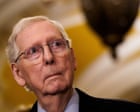
Why is the establishment so terrified of a vacuum?
If you want to understand the current civil war tearing through the Republican party, look no further than the eerie silence surrounding an 84-year-old man in a Washington hospital room. Mitch McConnell was admitted to the hospital on June 14, 2026. For weeks, his office has offered nothing but vague, copy-pasted reassurances that he is "recovering" and "improving." No medical details. No diagnosis. No timelines. If you liked this post, you should look at: this related article.
That wall of secrecy just backfired spectacularly.
By treating a public official’s prolonged medical crisis like a state secret, the Republican establishment didn't protect McConnell. They just opened the floodgates for wild speculation, internet rumors, and a full-blown political rebellion from the MAGA base. For another look on this story, check out the recent update from NPR.
When leadership refuses to provide basic transparency, people look for answers elsewhere. In this case, those answers came from emergency dispatcher audio leaking online. The audio revealed that on the day of his admission, paramedics performed CPR on an unconscious individual at McConnell's residence. Instead of clearing the air, his inner circle clamped down. That strategic mistake transformed a sensitive health issue into a massive liability for the party.
The Price of Political Secrets
You can't spend years attacking political opponents for hiding cognitive decline and then expect your own base to accept total radio silence when your most influential institutionalist vanishes from the Senate floor. The double standard is exactly what ignited the fury of conservative commentators and populist activists.
Take Glenn Beck, who went after the lack of transparency directly on social media. He asked a blunt question: What is the actual difference between this level of secrecy and how foreign autocracies handle the failing health of their aging rulers? He noted the hypocrisy of a party that spent four years picking apart every stumble from Joe Biden, only to go completely mute when it came to McConnell.
The frustration isn't just about hypocrisy. It's about raw power. For the populist wing of the GOP, McConnell represents the old guard—the institutionalist machine they’ve been trying to dismantle for a decade. The idea that his staff might be running a shadow operation from a hospital room while he remains incapacitated isn't just a conspiracy theory to them; it's exactly how they expect the establishment to behave.
To make matters worse, far-right internet influencers filled the information void by pushing unverified claims that the senator was completely brain-dead. His staff's refusal to answer direct questions about those specific diagnoses only poured gasoline on the fire.
The Flawed Damage Control Campaign
Sensing a rapidly growing mutiny, Senate Republican leader John Thune and other prominent allies launched a coordinated "proof of life" campaign. The strategy was simple: tell the public that everything is fine because they talked to him on the phone.
Thune’s office released a statement claiming the two had a lengthy, substantive phone call covering heavy topics like national security, the upcoming July work period, and the Supreme Court ruling on coordinated spending limits. They even threw in a detail about discussing the ongoing scandal surrounding Democrat Graham Platner in the Maine Senate race to prove McConnell was tracking current events. Soon after, political commentator Scott Jennings posted that he too had a 20-minute chat with McConnell about Ukraine, Iran, and Senate history, claiming the senator was eager to get back to work.
But in 2026, simply saying "trust us, we talked to him" doesn't cut it anymore.
Without audio recordings, photos, or a clear briefing from an actual physician, these statements felt entirely manufactured to the populist wing. Former congresswoman Marjorie Taylor Greene voiced that exact skepticism, immediately blasting Jennings on social media as an establishment hack delivering scripted damage control.
When the base completely distrusts the people delivering the message, the message fails.
What Happens if the Seat Opens Early
Let’s look at the actual chess board. McConnell isn't running for reelection, and his historic career is already scheduled to end this coming January. So why is there such an intense, desperate scramble to keep him in that seat for the next few months?
It comes down to a crucial safety net McConnell quietly built in his home state. If a senator dies or resigns early, many states allow the governor to simply appoint a temporary replacement from their own party. Kentucky, however, has a Democratic governor, Andy Beshear. To prevent Beshear from sending a Democrat to Washington and disrupting a razor-thin Senate map, Kentucky Republicans previously overhauled state law.
Because of those legal changes, if McConnell leaves office before January, Kentucky must hold a special election to fill the vacancy.
[McConnell Vacates Seat]
       │
       ▼
[No Governor Appointment] (Blocked by Kentucky Law)
       │
       ▼
[Mandatory Special Election] ➔ (Creates a highly unpredictable, expensive campaign during midterms)
A sudden special election in the middle of an already chaotic midterm cycle is an absolute nightmare scenario for Senate leadership. It means diverting millions of dollars, navigating an unpredictable primary, and risking a crucial seat when every single vote matters.
Beyond the numbers, McConnell's physical presence acts as a buffer. Institutional Republicans know that the second he is officially off the board, Donald Trump and the populist movement will move to fully consolidate power over the Senate apparatus. Without McConnell's institutional weight, leadership is left far more vulnerable to aggressive pressure from the populist right.
Actionable Next Steps for Party Leadership
The current strategy of deflection and vague statements is actively damaging the party's credibility. If leadership wants to kill the rumors and end the rebellion, they need to change their playbook immediately.
- Provide a Certified Medical Briefing: Stop relying on political staff to issue updates. A clear, objective statement from the attending physicians at the hospital detailing his actual recovery status is the only way to silence the worst rumors.
- Establish a Clear Timeline: If McConnell is genuinely recovering and planning a return for the July session, state the target date clearly. If his return is indefinite, acknowledge it transparently so the party can plan openly.
- Abandon the Proxy Battles: Using surrogates to tell the media that McConnell is chatting about foreign policy isn't working. Shift the focus to concrete legislative updates and clear up the procedural plan for his absence.
The lesson here is simple. In modern politics, a total lack of transparency will always be interpreted as a cover-up. By attempting to manage a severe health crisis with absolute secrecy, the establishment didn't buy themselves time—they just triggered a rebellion they are now struggling to control.