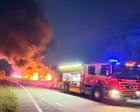
A routine winter morning haul turned into an absolute inferno on the Hume Highway today. Just after 5am on Tuesday, June 30, 2026, a multi-vehicle collision near Breadalbane transformed a quiet roadside rest stop into a ticking time bomb. The sheer volume of explosive materials involved should have resulted in a tragedy. Instead, we are looking at an unbelievable escape that police are calling nothing short of a miracle.
Six truck drivers walked away from a crash that completely vaporized their rigs. If you know anything about heavy transport logistics in Australia, you know how quickly these situations turn fatal. When thousands of liters of fuel combine with volatile freight, the outcome is usually devastating. This time, luck was on their side, but the incident raises major questions about rest stop safety and freight hazards.
The Chaos at Windmills Rest Area
The crash went down at the Windmills Rest Area on the Hume Highway, about 30 kilometers southwest of Goulburn in the New South Wales Southern Tablelands. Early reports from emergency services were chaotic. First responders initially feared that seven semi-trailers were involved and that one driver was completely unaccounted for in the blaze.
Hours later, the NSW Police Crash Investigation Unit cleared up the confusion. Six trucks were involved, not seven. Every single driver had managed to pull themselves from the wreckage before the flames swallowed the entire scene.
According to initial police inquiries, two moving trucks collided as they attempted to enter the rest area. One truck slammed directly into the rear of another, shunting it forward with immense force. The kinetic energy propelled the vehicles straight into four other heavy rigs that were legally parked at the rest stop, where their drivers were asleep or resting.
Within minutes, a chain reaction of fire and explosions ripped through the parking bay.
When Freight Becomes Fuel
The intense speed at which the fire spread wasn't an accident. It was the direct result of a highly volatile mix of commercial cargo. Trucking across Australia means moving everything from household goods to industrial chemical compounds. On this particular morning, the combination of freight was catastrophic.
One of the trucks entering the rest stop carried eight tonnes of butane cans. Butane is highly flammable and pressurized. The moment the impact punctured those canisters, they turned into missiles. Fire and Rescue NSW crews arrived to a barrage of small explosions echoing across the Southern Tablelands.
The fire quickly spread to the neighboring rigs, each carrying materials that acted as perfect fuel accelerants.
- A second truck was transporting commercial resin, which burns extremely hot and produces thick, toxic smoke.
- A third vehicle was packed tightly with memory foam mattresses, a polyurethane product that releases intense chemical energy when ignited.
- A fourth rig was loaded with alcohol, adding liquid fuel to the growing firestorm.
When you combine pressurized gas, chemical resins, synthetic foam, and alcohol, you get an industrial furnace. The fire subsided after several hours but left behind a charred wasteland of twisted steel and melted asphalt.
The Anatomy of an Emergency Response
Managing a disaster of this scale requires immediate coordination. Fire and Rescue NSW deployed 40 firefighters and seven fire trucks to the scene, including two specialized Hazardous Materials vehicles. Because of the volatile cargo and the constant threat of further butane explosions, the NSW Rural Fire Service quickly established a strict 300-meter exclusion zone around the rest area.
Ambulance crews assessed all six male drivers at the scene. Remarkably, they only treated minor injuries. Two drivers were transported to Goulburn Hospital, but this was strictly for mandatory blood and urine testing, which is standard procedure under NSW law for any major transport accident.
The physical cleanup of the highway is a nightmare for transport authorities. The Hume Highway is the main economic artery connecting Sydney and Melbourne. Shutting it down blocks millions of dollars of freight. Yet, Transport for NSW had no choice but to close the highway in both directions for most of the day.
The heat from the burning resin and memory foam damages the underlying road structure. Debris from exploded butane cans was scattered across hundreds of meters. Investigators from the Crash Investigation Unit had to document every piece of physical evidence before heavy tow vehicles could even attempt to clear the burnt-out shells of the semi-trailers.
The Long Detour Around Canberra
For everyday motorists and B-double operators, the crash caused immediate logistics issues. Authorities had to divert all northbound and southbound traffic away from the Gunning and Breadalbane sector.
The official detour takes vehicles off the Hume Highway and sends them through Canberra via the Federal Highway and the Barton Highway. For a standard interstate run, this detour adds roughly 80 minutes of extra travel time. For heavy vehicle operators managing strict logbooks and fatigue management systems, an extra hour and twenty minutes throws a massive wrench into their legal driving limits.
Heavy transport operators face rigid regulations regarding how many hours they can spend behind the wheel before taking mandatory rest breaks. A massive delay like this forces drivers to find alternative parking spots, which are already in short supply along major highways.
Why Rest Stop Safety Needs a Closer Look
This crash brings an ongoing issue in the Australian transport industry straight to the forefront. Why are moving trucks colliding at the entrance of designated rest areas?
Rest stops like the Windmills site are meant to be safe havens. They are where exhausted drivers pull over to comply with heavy vehicle fatigue laws. When a moving truck crashes into stationary vehicles inside a rest bay, it points to a few distinct possibilities that investigators will look at.
Fatigue is the most obvious factor. The crash occurred at 5am, which is right at the end of the notorious "graveyard shift." This is the time when the human body's circadian rhythm is at its lowest point, and micro-sleeps are incredibly common. If a driver experiences a micro-sleep while preparing to exit the highway into a rest stop, they can easily misjudge distances or fail to brake entirely.
Mechanical failure is another avenue. A sudden loss of braking capability or a steering malfunction on a heavily loaded B-double can turn a routine exit maneuver into an uncontrollable slide.
Design and visibility also play a role. Many older rest areas along regional highways have short deceleration lanes. If a rest area is full, trucks sometimes park dangerously close to the entry or exit ramps, leaving very little room for error if another vehicle enters the bay too quickly.
What Happens Next for the Freight Industry
This incident will trigger a comprehensive investigation by the National Heavy Vehicle Regulator and NSW Police. They will look into the logs of the drivers, the maintenance records of the vehicles, and the packing manifests of the hazardous cargo.
The fact that nobody died is an exceptional stroke of luck, but the transport industry cannot rely on luck. We need to look at how hazardous materials are segregated on major routes and whether rest areas have adequate infrastructure to protect parked drivers from highway traffic.
If you are currently traveling between Sydney and Melbourne, avoid the Breadalbane area entirely and follow the signage toward Canberra. Expect major delays for the rest of the day as road crews assess the structural integrity of the highway surface. Keep an eye on live traffic updates, and if you are driving a heavy rig, make sure you calculate your fatigue management hours with the 80-minute detour in mind. Stay safe out there.