Guam is a sitting duck without a single, unified nervous system. Right now, America's most critical outpost in the Western Pacific is guarded by a patchwork of brilliant but isolated weapons systems. The Army has its Terminal High Altitude Area Defense (THAAD) and Patriot batteries. The Navy floats Aegis destroyers offshore. The Marine Corps is bringing in fresh mobile interceptors. The problem is they don't talk to each other nearly well enough to stop a coordinated, multi-axis barrage from China.
If a conflict breaks out, hundreds of hypersonic gliders, low-flying cruise missiles, and swarming drones will rain down from multiple directions at the same time. Having separate command chains for separate weapons is a recipe for catastrophe. You can't fight a unified threat with fragmented tools.
The Pentagon knows this. It's why military planners are frantically working to install a single digital brain over the entire island's network. The goal is simple. They want any sensor on or around Guam to instantly feed tracking data to any available launcher, creating a unified defensive shield. It sounds basic, but in the world of military procurement, making different branches of service share a single tactical picture is an uphill battle.
The Chaos of a Fragmented Defense System
To understand why the Pentagon is obsessed with building a single command system, look at how Guam is currently defended. The island is small, roughly 30 miles long. Yet it features an astonishing mix of military hardware scattered across 16 different planned sites.
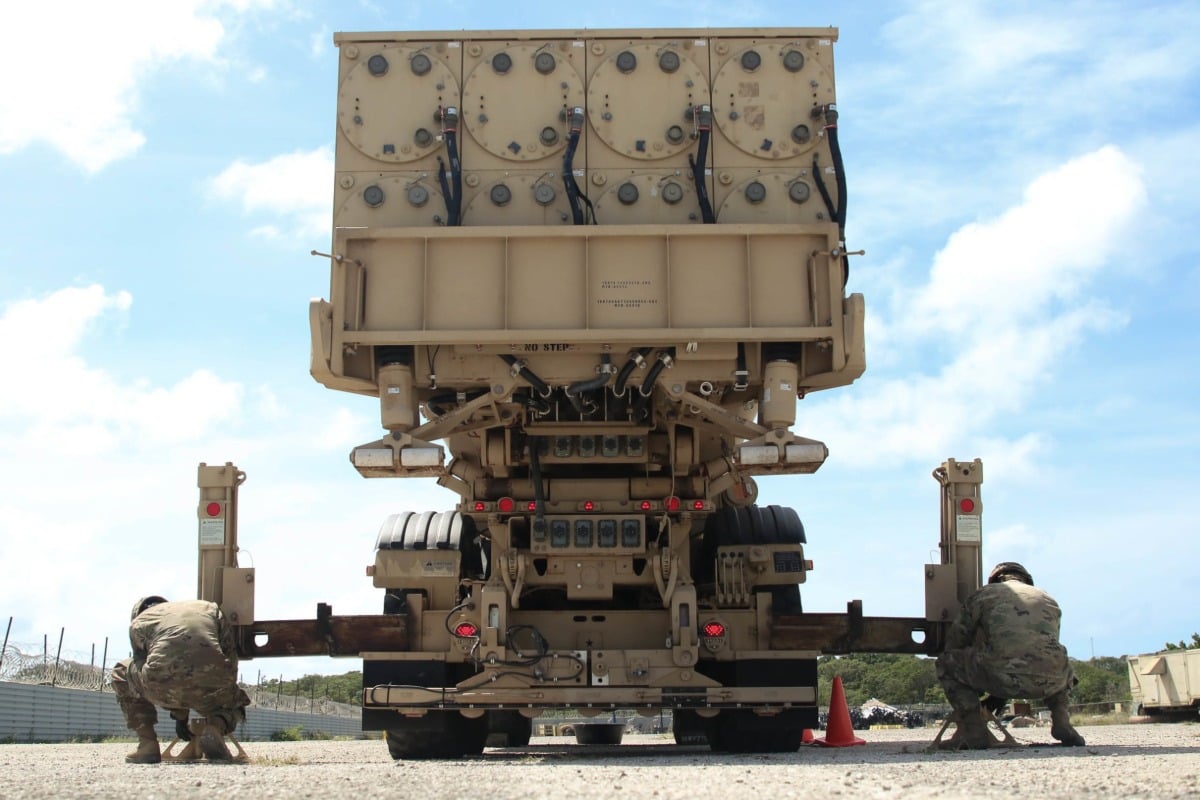
Task Force Talon, the Army unit permanently stationed on the island, operates a THAAD battery to catch high-altitude ballistic threats. Nearby, Patriot missile batteries sit ready to intercept lower-altitude aircraft and missiles. Out at sea, Navy destroyers utilize the Aegis combat system to track and shoot down incoming targets. Lately, the Marines have entered the mix with their new Medium-Range Intercept Capability, which relies on Israeli-engineered Iron Dome components.
Every single one of these systems is exceptional at its specific job. But they were built by different companies, funded by different budgets, and designed for different missions. They operate on separate software networks.
Imagine an incoming wave of supersonic cruise missiles. The Navy's radar might spot them first. But if that tracking data can't transfer to an Army Patriot launcher in real-time without human operators manually relaying the information, those seconds lost mean empty craters on an American runway.
Military commanders call this the integration gap. In real combat, a gap like that is lethal. The current setup forces individual units to fight their own isolated battles rather than operating as a collective organism.
Inside the Hunt for the Single Brain
The Pentagon's fix for this mess involves a quiet, high-stakes technology race led by Lockheed Martin's Skunk Works. Engineers are deploying a unified command-and-control software architecture designed to bridge the gaps between the Army, Navy, and Marine Corps systems.
This isn't just about plugging cables together. It means creating an intelligent network that dynamically calculates the best sensor-to-shooter combination. If an Air Force radar miles away detects a target, the software automatically assigns the closest, cheapest, or most effective missile to take it down, whether that's an Army Patriot or a Marine interceptor.
This initiative heavily impacts what the military calls the Joint Tactical Integrated Fire Control bridge. This software mechanism binds the separate architectures together. The Pentagon previously canceled a multi-million dollar dedicated radar program for Guam, the AN/TPY-6, specifically to divert funds into making this joint software bridge work faster. Deputy Secretary of Defense Kathleen Hicks directed the military to prioritize these command-and-control upgrades, aiming for full operational fluidity by 2029.
By dumping the specialized radar, the military signaled that software, not more hardware, is the true bottleneck. The focus has shifted to making sure the existing AN/TPY-2 radars and the Army's new Lower Tier Air and Missile Defense Sensor can pass tracking data directly to Navy Standard Missile 6 interceptors.
Real Testing on the Mason Range
This software brain isn't just a theoretical concept written on whiteboards in Virginia. It's being tested under intense conditions right now in the Pacific.
During Exercise Valiant Shield 2026, which ran through late June and early July, the military put these connections to the test. The III Marine Expeditionary Force deployed an operational battery of the Medium-Range Intercept Capability to the Mason Range on Guam.
This was the first time this specific system, which uses trailer-mounted launchers packed with 20 SkyHunter interceptor missiles, was tested outside the continental United States. The Marines used the system to simulate intercepting complex cruise missile salvos attacking the island's infrastructure.
Crucially, the Skunk Works-developed command software was running in the background. It fused the Marine radar feeds with broader airspace data, giving operators a single, clear picture of the sky. Instead of looking at three different screens showing three different versions of the truth, commanders had one definitive tracking map.
The testing is expanding beyond Guam as well. The military is taking these same communication tools to Palau for Exercise Tenacious Archer 2026. There, they'll push the system even further by integrating short-range Marine Air Defense Integrated System variants into the broader network.
Restructuring the Local Commands
You can't just change the software; you have to change the human organizations running it. The Pentagon is shifting its command structures on the ground to match this new reality.
In October 2026, Task Force Talon will be officially redesignated as the 3rd Battalion, 43rd Air Defense Artillery Regiment. This change signals a move away from an ad-hoc, temporary defensive posture toward a permanent, deeply structured military presence.
The Army's Portfolio Acquisition Executive for Fires is driving the Guam Defense System Joint Project Office through a grueling series of anti-missile evaluations. These evaluations are meant to establish an initial operating capability very soon. The Pentagon intends to use this unified Guam model as a blueprint for wider defense initiatives across the entire Pacific theater.
The Friction with the Island Community
While Washington views Guam as a strategic asset that must be fortified at all costs, the people living on the island see a different reality. The massive military buildup is causing significant political and social friction.
The Pentagon requested 29 million dollars in the defense spending bill to acquire over 100 acres of local land for missile defense infrastructure. However, the House Armed Services Committee recently stripped that funding out of its version of the Fiscal Year 2027 National Defense Authorization Act. Guam’s non-voting congressional delegate, James Moylan, fought hard to remove the land acquisition clause.
The problem stems from a broken promise. Years ago, the military committed to a net-negative land posture on Guam. This meant the federal government promised to eventually control less land on the island than it did before the buildup began. Pushing for another 100 acres flies directly in the face of that commitment.
Local leaders are also furious about being left in the dark. The Governor of Guam and the local legislature recently learned through media reports, rather than official military briefings, that the U.S. Pacific Command submitted a massive 67.4 billion dollar funding request for new regional capabilities. This request includes 909 million dollars earmarked specifically for offensive strike weapons to be hosted on Guam.
This shift changes the equation for the island's residents. It means Guam isn't just a defensive shield protecting American interests; it's a launching pad for offensive strikes. Local advocates point out that this transition transforms the island from a potential target into an absolute certainty in a future conflict.
What This Means for Future Operations
If the Pentagon successfully installs this single command brain, it changes how regional deterrence works. A fully integrated Guam makes an adversary's strike planning infinitely more complicated.
Instead of trying to overwhelm specific, isolated radars, an attacking force would have to face a resilient network. If they knock out one radar site, three others instantly fill the gap, feeding data to the remaining missile launchers across the island.
The immediate next steps for the defense network involve refining the software before the 2029 deadline. Engineers must ensure the Army’s Integrated Battle Command System can seamlessly absorb data from Navy vessels passing through the region. Military contractors are also working to harden the physical command bunkers on Guam, moving critical servers underground to protect the single brain from initial missile strikes.
For the people of Guam, the next steps involve demanding formal consultation mechanisms from Washington. Local leaders are pushing for a permanent seat at the table so they aren't forced to read about the militarization of their own backyards in the morning news. The defense of Guam is moving forward rapidly, but the Pentagon is discovering that connecting missile launchers is often easier than managing the human partnerships required to keep those launchers on the ground.