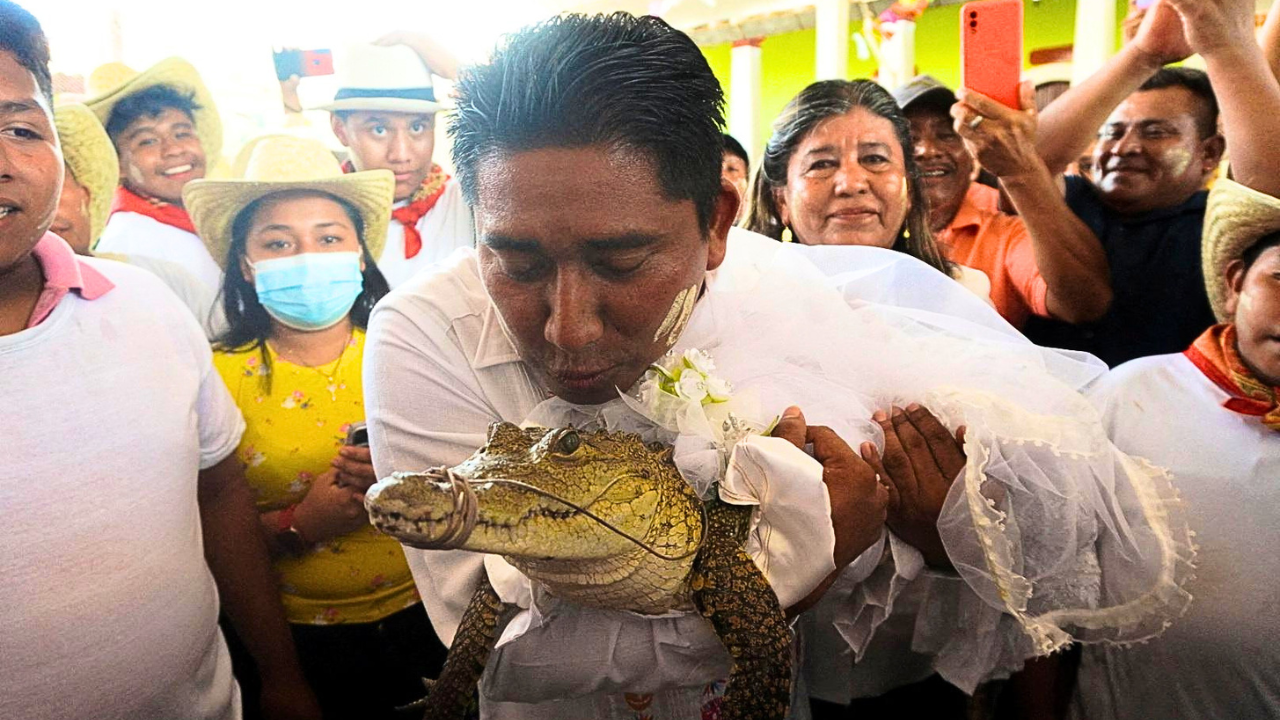
The internet loves a bizarre headline. Every summer, a fresh wave of viral videos hits social media showing a Mexican mayor in a crisp white shirt kissing a small reptile wearing a custom wedding dress. The comments section goes exactly how you would expect. People call it crazy. They make jokes about bad divorces or demanding in-laws.
They completely miss the point.
This isn't some weird internet stunt or a politician losing his mind. It is a sacred ritual that has kept the peace and kept people fed for more than two centuries. If you look past the clickbait, the annual crocodile wedding in San Pedro Huamelula reveals something deep about human survival, indigenous history, and our relationship with the planet.
The Real Story Behind the Crocodile Wedding
To understand why this happens, you have to look at the map. San Pedro Huamelula is a small town tucked away in the southern Mexican state of Oaxaca, specifically in the Isthmus of Tehuantepec. It is a place where old ways do not just survive. They run the show.
The town belongs to the indigenous Chontal people. For generations, their lives have depended entirely on what the earth and the sea decide to give them. If the rains do not come, the corn dies. If the ocean acts up, the fishing boats stay docked and families go hungry.
That is where the reptile comes in.
Locals do not see a dangerous predator when they look at the caiman, which is a smaller relative of the alligator and crocodile. They see a living representation of Mother Earth. They call her the Princess Girl. When the town mayor marries this reptile, he is not doing it as an individual. He is acting as a living stand-in for his entire community. The wedding is a formal, binding contract between humanity and nature.
By marrying the princess, the town promises to respect the environment. In return, they ask the natural world for a few basic things. They want just enough rain. They want seeds to sprout. They want the rivers and the Pacific coast to fill with fish. It is a literal plea for survival wrapped in a wedding celebration.
A Centuries-Old Treaty Sealed with a Ribbon
The ritual dates back at least 230 years, to 1789, though local historians will tell you the cultural memory goes back much further into pre-Hispanic times. It is a historical reenactment of a peace treaty between two distinct indigenous groups who used to be bitter enemies: the Chontal and the Huave, who are also known as the Ikoots.
Centuries ago, these two groups fought constantly over territory and control of the coastal fishing rights. The Chontal lived slightly further inland, while the Huave controlled the wealthy coastal waters. The war was brutal and ruined the livelihoods of both tribes.
According to local lore, the conflict only ended when a Chontal king fell in love with and married a Huave princess. The marriage did more than just stop the fighting. It blended their cultures and allowed both communities to share the resources of the land and the sea in peace.
Today, the mayor steps into the shoes of that ancient Chontal king. The female caiman represents the Huave princess. When they stand together at the altar, the town is remembering a moment of historic diplomacy. It is a reminder that cooperation works a lot better than conflict.
Inside the Three Day Celebration
This is not a quick photo op. The ceremony is a massive three-day festival that combines pre-Columbian indigenous spirituality with Catholic traditions, aligning perfectly with the feast of Saint Peter the Apostle, the town’s patron saint.
It takes a village to get a reptile ready for her big day. A local woman takes on the revered role of the godmother, taking charge of the bride's extensive wardrobe. The caiman does not just wear one dress. She gets multiple outfit changes.
First, she is baptized. This step blends the ancient pagan rite with Catholic tradition. After her baptism, she is dressed in colorful, traditional indigenous clothing. Local women dress her in a bright green skirt, a hand-embroidered tunic, and a headpiece made of ribbons and shiny sequins.
Then the parade begins.
Fishermen and locals carry the reptile bride from house to house across the entire town. It is a raucous, joyful procession. Musicians blast traditional songs on brass instruments and drums. Dancers in elaborate costumes fill the dusty streets. At each home, residents take the caiman into their arms and dance with her. They treat her with the utmost reverence.
You might notice in the videos that the animal's snout is carefully tied shut with a strip of cloth. It is a practical safety measure. Organizers are quick to point out that this keeps both the frantic reptile and the hundreds of eager townspeople safe from any accidental premarital bites.
Once the neighborhood tour is complete, the caiman changes into her final outfit: a white bridal gown complete with a white veil. She is carried straight to the local town hall where the formal vows take place.
The Vows and the Famous Kiss
The current and past mayors of San Pedro Huamelula, including recent leaders like Daniel Gutiérrez Peña and Victor Hugo Sosa, take this duty incredibly seriously. They do not joke around during the ceremony.
During a recent iteration of the ritual, Mayor Sosa stood before his community, looked at the reptile, and spoke his vows clearly. He stated that he accepted the responsibility because love is what matters in a marriage, yielding completely to his union with the princess girl.
After the vows are made, the town chronicler or a local elder seals the spiritual contract. A local fisherman named Joel Vasquez traditionally takes part by tossing a large fishing net across the floor, chanting prayers for a bountiful catch, peace, and equilibrium.
Then comes the moment the global media waits for. The mayor leans down and plants a symbolic kiss right on the caiman’s bound snout. The crowd erupts into cheers, applause, and traditional dancing. The mayor dances with his new bride in his arms while the community celebrates a renewed pact with the earth.
Why This Tradition Persists Today
It is easy for outsiders to dismiss this as an outdated superstition. That is a lazy way to look at it. In an age where global climate change makes weather patterns unpredictable, the core message of San Pedro Huamelula makes more sense than ever.
Western culture tends to view nature as something to conquer, exploit, and extract profit from. The Chontal people view nature as a partner you have to negotiate with. They understand a fundamental truth that many modern societies have forgotten. If you do not take care of the ecosystem, it will stop taking care of you.
The wedding is an annual corporate performance review for humanity's relationship with the local environment. It forces the community to slow down, look at their fields, look at their ocean, and pledge to maintain a healthy balance.
What We Can Learn From San Pedro Huamelula
You do not need to find a local reptile and buy a miniature wedding dress to practice the philosophy behind this festival. The real-world application of this tradition is simple. Look at your local environment through a lens of partnership instead of ownership.
Start by paying attention to the seasonal rhythms of where you live. Support local agricultural setups that respect the soil instead of stripping it bare. Understand where your water and food come from, and acknowledge the environmental cost of getting those resources to your table.
If you ever find yourself traveling through Oaxaca at the end of June, skip the generic tourist resorts and head toward the Isthmus of Tehuantepec. Witnessing the festival in person requires an open mind and a respect for indigenous sovereignty. Watch the dancers, listen to the brass bands, and appreciate the fact that some communities still know exactly how to say thank you to the earth that keeps them alive.
:max_bytes(150000):strip_icc()/TAL-nassau-bahamas-BEAUTCARIB0323-4fbfce903e5a4418b895e03717e3de0d.jpg)