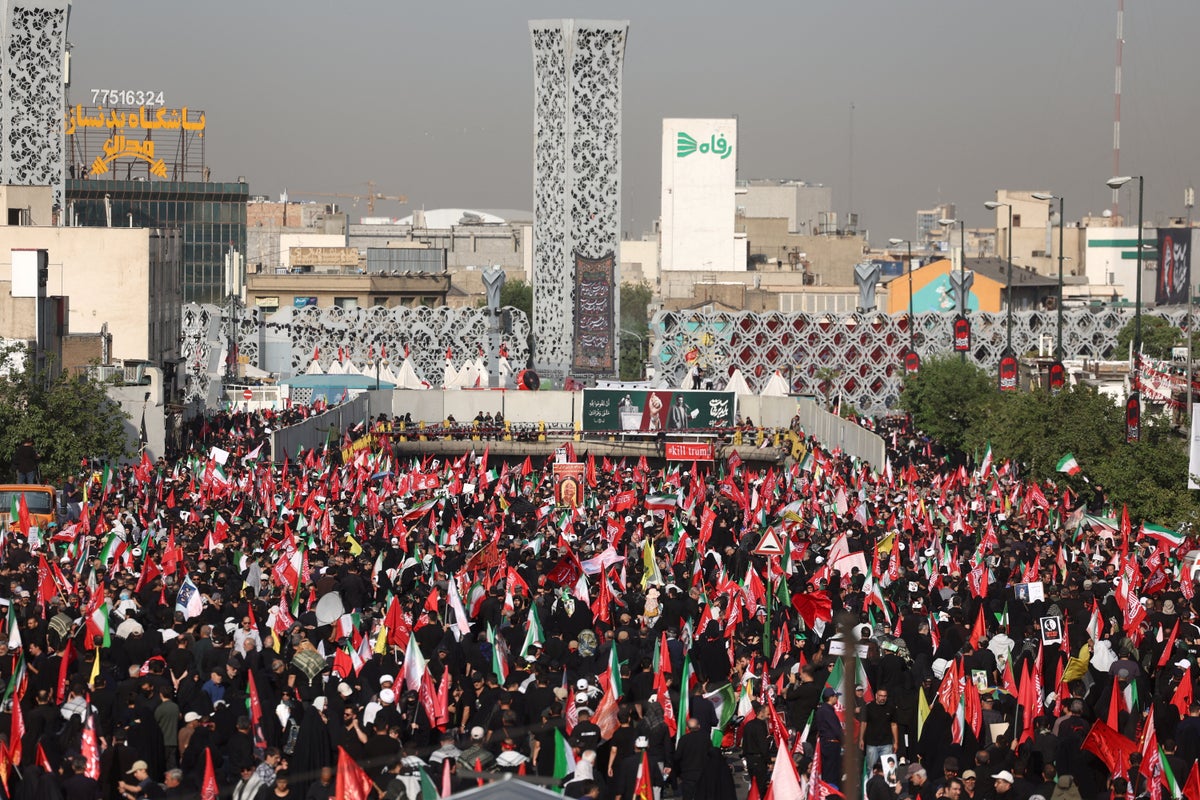
Tehran is completely shut down. The airspace is dead silent, regular commercial flights at Mehrabad International Airport are grounded, and the streets are choked with millions of people dressed in black. On paper, the Islamic Republic is staging the ultimate show of defiance. The state-mandated narrative is simple: a massive, multi-day funeral procession for the late Supreme Leader Ayatollah Ali Khamenei to prove that the regime survived a four-month existential war with the United States and Israel.
But if you look past the carefully staged television angles and the standard anti-Trump chants echoing through the Grand Mosalla, a much more chaotic reality emerges. The regime claims this turnout is a successful popular referendum. It isn't. It's a massive, desperate exercise in state-controlled optics designed to paper over massive structural fractures that might actually bring down the system from within. For an alternative perspective, check out: this related article.
The Western media is largely hyper-focusing on the surface details. They're reporting on the angry crowds issuing death threats against Donald Trump after his recent boast that "one shot" could eliminate the remaining leadership. They're tracking the trucks carrying the flag-draped caskets of Khamenei and his family members who died in the February 28 airstrike. What they're missing is the deafening silence surrounding the succession crisis, the physical absence of the man supposed to take the reins, and the deep domestic exhaustion of a population that just endured months of intense bombardment.
The Empty Chair and the Successor in Hiding
The most telling detail of the entire multi-day spectacle didn't involve the millions of people lining the streets. It was an empty chair. Similar insight regarding this has been published by TIME.
When Khamenei’s three sons—Mostafa, Meysam, and Masoud—stood praying beside their father’s coffin, the designated heir to the supreme leadership was nowhere to be found. Mojtaba Khamenei, the late leader’s second son and the man long groomed to take over the theological dictatorship, skipped the most important state event in modern Iranian history.
State media tried to ignore the absence, but everyone in Tehran knows exactly why he wasn't there. Mojtaba was severely injured in the very same February 28 joint US-Israeli airstrike that killed his father. Reports filtering out of high-level intelligence circles indicate he suffered severe facial disfigurement and debilitating leg injuries. He isn't just physically incapacitated; he is hidden away to protect whatever shred of mystique the regime has left.
You can't project absolute revolutionary strength when your new leader is wrapped in bandages and unable to stand. By keeping Mojtaba out of the public eye, the clerical establishment is trying to buy time. But time is the one thing they don't have. The Assembly of Experts is currently locked in a bitter, behind-the-scenes power struggle. Without a clear, physically capable figurehead to rally around, the various factions within the Islamic Revolutionary Guard Corps (IRGC) are starting to look out for their own survival rather than the preservation of the clerical elite.
Why the Ceasefire is a Illusion of Victory
Iranian state television is spinning the recent interim truce as a monumental triumph. They claim the four-month conflict ended because Washington and Tel Aviv blinked first. They're promising the public that the reopening of the Strait of Hormuz will immediately kickstart the economy and bring unprecedented relief to a battered middle class.
Don't believe the hype. This ceasefire is nothing more than a temporary pause button that both sides needed for entirely tactical reasons.
For Iran, the ruling system was on the verge of structural collapse. The military infrastructure took a massive beating over the spring. Refineries were hit, supply lines to regional proxies were shattered, and the economic isolation reached an existential tipping point. The clerics didn't sign the truce because they won; they signed it because they needed to bury their dead and reorganize their shattered command structure without getting blown up in the process.
On the other side, Trump is playing a classic transactional game. He openly admitted to giving the Iranian regime a week off for the funeral, casually adding that he did it "because we're nice." It's classic Trumpian bravado, but the underlying strategy is clear. The White House wants to see how the succession shakes out before deciding whether to permanently dismantle the regime's nuclear apparatus or press for a broader diplomatic reset. The negotiations to permanently reopen the critical maritime chokepoints are completely frozen until Khamenei is buried in Mashhad, meaning the economic relief Iranians are praying for is still miles away.
The Logistics of Orchestrated Grief
To understand how the regime managed to get millions of people onto the streets of Tehran, Qom, and Mashhad, you have to look at the massive state apparatus deployed to manufacture this turnout. This isn't a spontaneous outpouring of grief. It's a highly organized, subsidized logistical operation.
- Subsidized Travel: The government ordered hotels across the country to cut prices by 50% for anyone traveling to the funeral hubs.
- Infrastructure Reallocation: Public school buildings, state-run mosques, and municipal sports complexes were stripped of their usual functions and turned into massive, free dormitories for rural citizens bussed into the capital.
- Transit Dictatorship: The entire national rail and bus network was forcibly diverted to funnel people directly into the Tehran Grand Mosalla.
If you control the food, the transport, the housing, and the employment of millions of state workers, pulling off a massive crowd scene isn't actually that difficult. For many impoverished citizens from the provinces, the trip to Tehran was a rare chance to get subsidized meals and free transport.
For the hardcore base—the Basij militia and IRGC families—it’s a mandatory show of employment. They know their government checks depend on their presence in those crowds, waving banners and shouting the approved slogans against the West.
Trump and the Dictate of One Shot Diplomacy
The rhetoric coming out of Washington hasn't helped cool the temperature. Trump's boast that a single military strike could wipe out the entire top tier of the Iranian state structure has given the hardliners exactly what they needed: a powerful external threat to unite against.
During the procession, commanders like Ali Abdollahi of the Khatam al-Anbiya Central Headquarters warned that any western miscalculation during the mourning period would trigger an immediate, devastating retaliation. The crowds picked up the cue, turning a religious funeral into a heavily militarized political rally.
But the threats ring hollow when you look at the reality on the ground. The IRGC spent the last few weeks pulling its top generals out of hiding just to stand by the casket for photo opportunities. General Ahmad Vahidi, the powerful paramilitary leader who spent months deep underground to avoid targeted assassinations, finally surfaced just to sit beside Khamenei’s coffin. This public re-emergence isn't a sign of safety; it's a calculated gamble. The regime knows Trump won't strike during a state funeral attended by foreign dignitaries from Russia, China, and Pakistan, so they're using this temporary immunity shield to show they still exist.
The Shadow of Regional Proxy Decline
The funeral itinerary reveals a deeper geopolitical anxiety. After the body leaves Tehran and moves through the religious seminary city of Qom, the caskets are scheduled to be flown into Iraq. Processions are planned for the holy Shia cities of Najaf and Karbala.
This Iraqi leg of the tour isn't just about religious piety. It's a desperate attempt to assert dominance over a regional proxy network that is rapidly slipping out of Tehran's control.
The four-month war hit the Axis of Resistance incredibly hard. With the primary source of funding and command in Tehran preoccupied with basic survival, proxy groups in Iraq, Syria, and Lebanon have had to fend for themselves. Many of these groups are realizing that relying on an unstable, economically ruined patron state is a bad long-term bet. By bringing Khamenei’s body to Iraq, the clerics are trying to visually bind the Iraqi Shia establishment to the survival of the Iranian revolutionary model.
It's highly unlikely to work. Top Iraqi clerics in Najaf have historically resisted the Iranian concept of Velayat-e Faqih (Guardianship of the Islamic Jurist), preferring to keep a distance from Tehran's political radicalism. The presence of the late leader's casket in Iraq is more likely to highlight the deep theological and political rifts between the two countries rather than heal them.
What Happens Next
The state funeral officially ends when Ayatollah Khamenei is buried at the Imam Reza shrine in Mashhad. Once the dirt settles, the illusion of unity will vanish almost instantly. If you are watching this situation develop, look for these specific trigger points over the coming weeks:
- The Assembly of Experts Vote: Watch for leaks regarding the internal selection of the next Supreme Leader. If Mojtaba Khamenei's health prevents him from taking the throne, a weak council of senior clerics might try to share power, creating a massive vacuum that the IRGC will inevitably fill through a quiet military coup.
- The Resumption of Nuclear Talks: The ceasefire is contingent on renegotiating the nuclear boundaries and maritime access. If Iran uses the post-funeral period to secretly accelerate enrichment as a hedge against future strikes, the truce will collapse before the summer ends.
- Domestic Labor Strikes: The state cannot afford to keep subsidizing the public forever. Once the free transport and discounted hotels stop, the reality of triple-digit inflation and damaged infrastructure will hit the working class again, likely sparking a new wave of leaderless domestic protests.


.jpg)