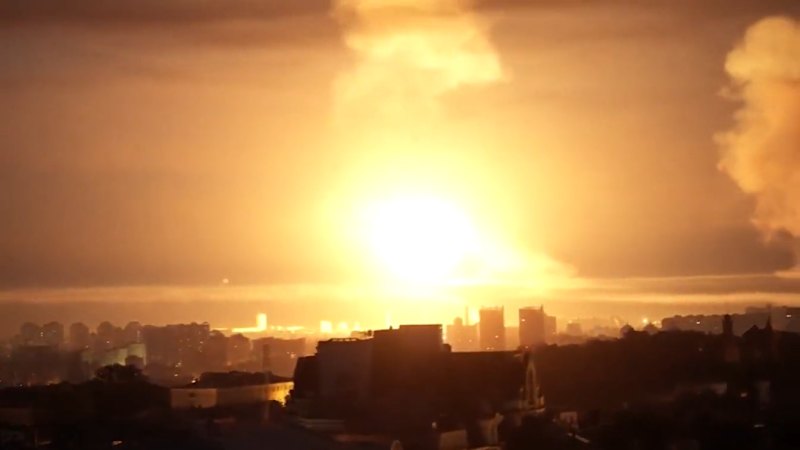
The sirens in Kyiv didn't just warn people; they shook the ground for hours. Overnight on July 2, 2026, Russia launched a coordinated, overwhelming aerial barrage against the Ukrainian capital. It wasn't a standard strike. This was a massive, calculated attempt to saturate and break the city's air defense network.
When the sun came up, the scale of the destruction became clear. Ripped-open apartment complexes, smoking ruins of a hotel, a damaged research institute, and a smashed ambulance station dotted the city. The Kyiv City Military Administration, led by Tymur Tkachenko, confirmed that at least 27 people lost their lives, and more than 90 others suffered injuries. Rescue crews are still clawing through the concrete rubble of a collapsed multi-story residential building in the Darnytskyi district. The death toll is expected to climb.
Kyiv Mayor Vitali Klitschko explicitly called this the most massive attack on the capital since the full-scale invasion began. The city declared July 3 a formal day of mourning.
People are searching for the real reason behind this sudden, terrifying escalation. The truth lies in a dangerous mix of Russian stockpiling strategies, a critical shortage of Western ammunition, and a brutal tit-for-tat air war that has reached a boiling point.
The Raw Math of the Sky Bombardment
To understand how this happened, you have to look at the numbers. The Ukrainian Air Force reported that Russia deployed 496 strike drones and 74 missiles of various types. It was a combined, synchronized wave designed to overwhelm radar systems and deplete interceptor stockpiles.
Ukrainian air defenses managed an incredible feat under pressure. They brought down 476 of the drones and 48 of the missiles. On paper, that sounds like a victory. In reality, it means 26 missiles slipped through the net.
When dealing with supersonic cruise missiles and ballistic projectiles, 26 hits cause absolute devastation. Military analysis outlet Defense Express pointed out an ominous pattern in Russia's tactics. This strike follows similar heavy attacks on June 2 and June 15. Experts note that Russia now requires roughly two weeks to manufacture, assemble, and position enough ammunition for these massive, coordinated runs. They wait, they build up a stock, and then they attempt to punch a hole through the defense network.
Where the Air Defenses Failed and Why
The core issue isn't a lack of skill or resolve from Ukrainian operators. It's a simple, brutal math problem involving interceptor inventory.
President Volodymyr Zelenskyy cut short an official visit to Ireland to return to the burning capital. Standing near a destroyed building in the Darnytskyi district, he didn't hold back his frustration with international partners. He noted that to counter an attack involving dozens of ballistic missiles, Ukraine needs a continuous supply of heavy air defense systems.
Specifically, Zelenskyy stated that Ukraine needs a minimum of 140 Patriot missiles to reliably intercept an offensive of this specific magnitude. The low interception rate for the ballistic variants during this attack shows that the capital's defense umbrella is running dangerously thin. Kyiv isn't begging for new, unpromised weapons. They're asking for the delivery of supplies that allies already committed to sending months ago. Delays translate directly into civilian casualties.
Destruction Across Every Single District
This wasn't a localized incident. The barrage targeted locations across all ten administrative districts of Kyiv, proving that the intent was to terrorize the entire civilian population.
In the Darnytskyi district, six floors of a nine-story residential building completely collapsed. Firefighters faced intense heat while trying to pull survivors from the lower levels. Over in the Desnianskyi district, residents found themselves trapped inside a damaged nine-story structure as smoke blocked the stairwells.
The historical Pecherskyi district, which houses government offices and administrative buildings, saw major fires break out near residential blocks. In the Holosiivskyi district, a missile strike ignited the roof of a 16-story high-rise. Meanwhile, emergency workers in the Sviatoshynskyi district had to dig out families trapped in their own private homes after debris brought down roofs and walls.
Even critical medical services weren't spared. An ambulance station was hit, injuring six emergency medical workers who were preparing to head out and save others.
The Retaliation Narrative and Real Strategic Targets
The Kremlin, through spokesperson Dmitry Peskov, claimed that Russian forces only struck military or quasi-military objectives. This is a standard line that flies in the face of the smoldering apartment blocks visible to any observer on the ground.
Moscow frames these brutal strikes as direct retaliation. Ukraine has run an aggressive, highly successful long-range drone campaign targeting Russian energy infrastructure, oil refineries, and military supply depots. These Ukrainian strikes have caused genuine fuel shortages and logistical headaches inside Russia.
Ukrainian Foreign Minister Andrii Sybiha completely rejected the idea that Russia’s behavior is a justified response to Ukrainian actions. He emphasized that Ukraine is exercising its legal right to self-defense under Article 51 of the UN Charter. Russia remains the sole aggressor that brought war to Ukrainian soil. Framing the slaughter of civilians in Kyiv as a mere counter-punch is a diplomatic distortion.
What Needs to Happen Next
The situation in Kyiv demonstrates that passive defense is no longer enough to protect civilian lives. If you want to understand where this conflict goes next, watch for these concrete shifts.
First, the political pressure on the United States and European allies to grant production licenses will intensify. Zelenskyy is now shifting focus from asking for completed missile systems to demanding the licenses to manufacture Patriot missiles directly inside Ukraine. This would eliminate the shipping bottlenecks and political red tape that stall emergency deliveries.
Second, expect Ukraine to double down on its deep-striking capabilities. Since defensive interceptors are scarce, the most effective way to stop future two-week strike cycles is to destroy the Russian bombers, missile launchers, and drone factories before they can launch.
Air raid sirens will continue to sound in Kyiv. Residents will continue to spend sleepless nights on concrete metro platforms. But the political fallout from July 2 will reshape how Ukraine and its allies handle the skies.