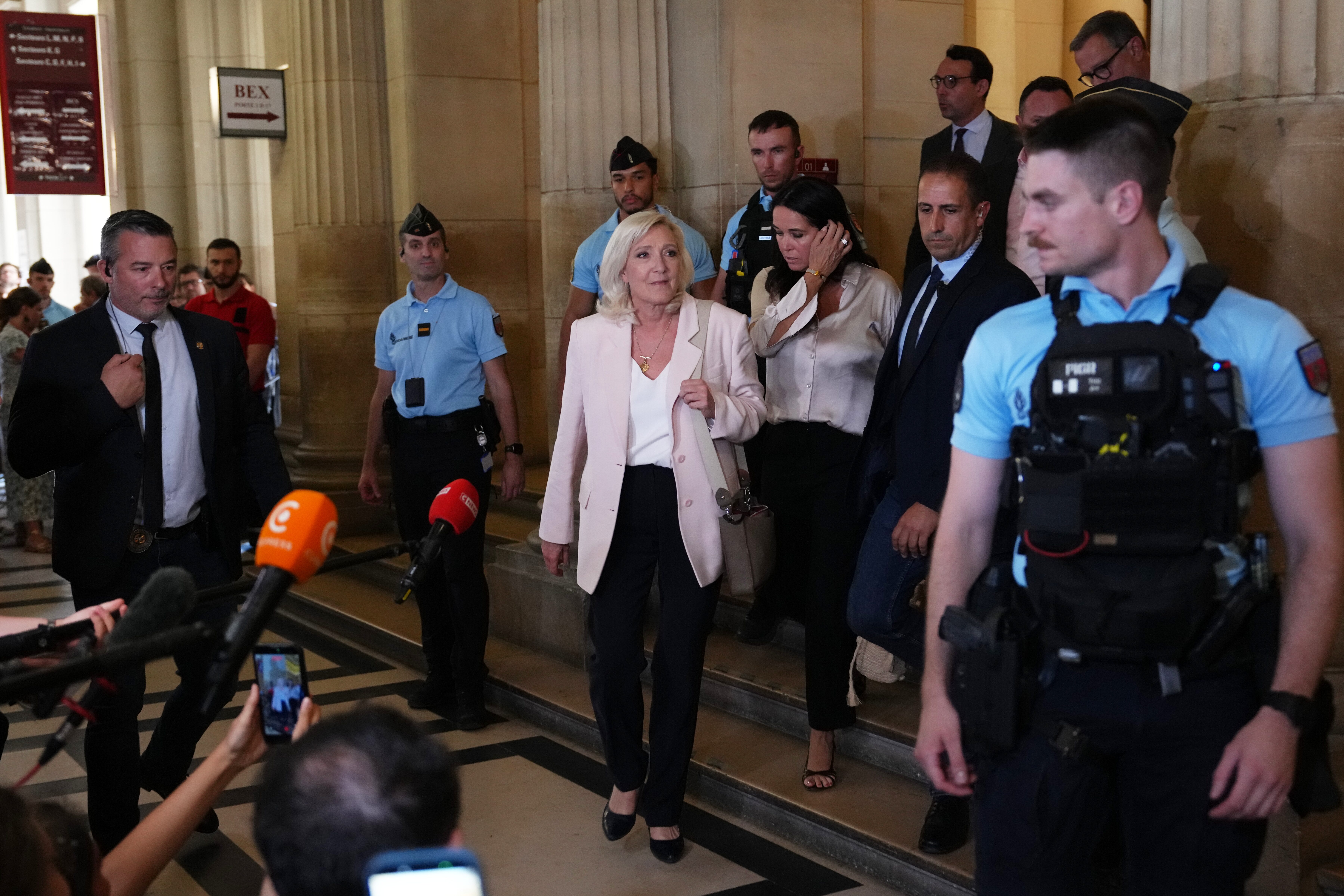
Marine Le Pen isn't backing down. Just hours after a Paris appeals court upheld her conviction for embezzling European Union funds, the 57-year-old far-right icon looked straight into a television camera and declared her fourth run for the French presidency.
"Tonight, I am a candidate," she told TF1 television.
It's a dizzying political pivot. For months, the narrative surrounding the National Rally leader pointed toward a forced retirement. A lower court in March 2025 handed her a strict five-year ban from public office, a penalty that would have killed her chances for the upcoming April election. But the appeals court threw her a lifeline, rewriting the rules of the race. While the court confirmed her guilt, it slashed her immediate ban to 15 months—time she's already served since last year's verdict.
The catch? She's supposed to wear a court-ordered electronic ankle monitor for a year.
If you think a criminal conviction and home detention would derail a major political campaign, you don't know French politics. Le Pen isn't just surviving the legal onslaught; she's using the system's own complexities to launch an unprecedented bid for power.
The Legal Loophole Keeping Le Pen Unbound
The biggest question people are asking right now is simple. How can someone sentenced to wear an ankle monitor go on a national campaign trail?
The answer lies in a calculated legal maneuver. Le Pen immediately announced an appeal to the Cour de Cassation, France’s highest judicial authority. Under French law, lodging this appeal automatically suspends the execution of her sentence.
"The appeal to the court of cassation suspends the effects of the judgment, so I will campaign without an electronic ankle bracelet," Le Pen announced.
She's gambling on timing. Normally, the high court takes anywhere from a year to 18 months to review a case. Because the presidential election rounds are locked in for April and May, Le Pen expects to cross the finish line before a final ruling lands. However, the high court previously noted it might expedite its review to rule before voters head to the polls. If they rule against her early, she faces a chaotic reality: campaigning under strict curfews set by a judge.
What the Embezzlement Case Was Actually About
Critics argue that Le Pen's defiance ignores a massive multi-million-euro fraud. The Paris appeals court found Le Pen and 10 other National Rally members guilty of running a highly organized, "industrial" system to siphon money from the European Parliament.
Between 2004 and 2016, the party used €2.8 million ($3.2 million) meant for European legislative assistants to pay the salaries of party staff working directly for the National Rally in Paris. Essentially, they used EU taxpayer money to fund their domestic political machine. Le Pen denied criminal intent, chalking the ordeal up to a minor administrative "mistake." The judges didn't buy it, noting the gravity of the systemic deception.
Yet, the court deliberately chose not to bar her from the ballot box. Chief Judge Michèle Agi explained that while the facts were serious, completely stripping Le Pen of her eligibility would step on democratic principles. The court argued that the 15 months of political ban Le Pen already endured sufficiently repaired the harm to public integrity. Denying her the right to run now, the court stated, would directly undermine the "voter's freedom of choice."
Can You Really Run a Campaign from House Arrest?
Before her dramatic TV appearance, Le Pen insisted that running for president with an electronic monitor was out of the question. "I can't depend on a magistrate to allow me to go to a rally," she said earlier.
She has a point. French electronic monitoring requires a convict to stay at a designated residence during hours authorized by a sentence enforcement judge. If the high court rejects her appeal before May, her campaign stops being about policy and starts being about curfews.
But history shows it's possible. Former French President Nicolas Sarkozy wore a similar electronic ankle monitor following a corruption conviction. He was spotted jogging outside and maintained a surprisingly flexible schedule. Sarkozy secured court permission to leave his home between 8 a.m. and 8 p.m., with extensions up to 9:30 p.m. on certain days to attend legal proceedings.
Le Pen's legal team knows the law allows for significant flexibility. Sentence enforcement judges can grant structural adjustments, allowing up to six months of sentence reductions for good behavior and compliance with fines. If forced into the monitor, Le Pen would have to beg a magistrate for permission to attend late-night rallies, travel across departments, or debate opponents on live television.
The National Rally Strategy and the Bardella Factor
The ruling forces a fascinating dynamic within the National Rally. Up until the verdict, the party was quietly prepping a backup plan: elevating her 30-year-old protégé, Jordan Bardella, to the top of the ticket.
Bardella is young, fiercely popular, and carries none of the legal baggage weighing down his mentor. Current polling shows that either Le Pen or Bardella would comfortably cruise through the first round of the presidential election. The real battle is the second-round runoff, where centrist figures like former Prime Minister Édouard Philippe aim to build a coalition to block the far-right from taking the Élysée Palace.
By jumping back into the race immediately, Le Pen reasserted her absolute dominance over the party her father founded in 1972. She has spent fifteen years scrubbing the party's image, moving it away from her father’s overt extremism into mainstream respectability. Stepping aside for Bardella would have signaled weakness. Instead, she chose defiance.
Green party leader Marine Tondelier blasted the move, stating that in a normal world with a shred of morality, a candidate convicted of misappropriating public funds would step down. But Le Pen's base doesn't view this as a moral failing; they see it as a deep-state hit job meant to keep an anti-immigration populist out of power.
What Happens Next
The French presidential race is now a race against the judicial clock. If you want to track how this volatile situation unfolds, keep your eyes on these specific markers:
- Watch the Cour de Cassation docket: The ultimate trajectory of the election depends on whether the high court fast-tracks its review or lets the standard 12-to-18-month timeline play out.
- Monitor early polling shifts: Look closely at whether centrist voters rally behind a single opposition candidate like Édouard Philippe now that Le Pen's conviction is set in stone.
- Track the fine payments: Le Pen’s ability to secure future sentence reductions depends heavily on her party starting to pay back the massive €100 million criminal fine attached to the verdict.
Le Pen is betting her entire political legacy on the idea that French voters care more about her populist platform than a financial scandal involving European Union funds. By treating the courthouse as just another stop on the campaign trail, she has ensured that France's upcoming election will be the most unpredictable in modern history.