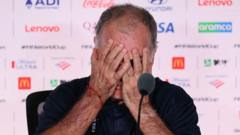
Marcelo Bielsa doesn't build monuments. He burns them down. When the 70-year-old Argentine arrived in Montevideo in 2023, he promised a revolution for La Celeste. He promised to drag a proud, old-school footballing nation into the modern age with his trademark high-octane press and breathless attacking football. Instead, he left behind a smoking ruin. Uruguay's pathetic group-stage exit from the 2026 World Cup wasn't just a sporting failure. It was a complete psychological and structural collapse. Seven games without a win. Zero victories in a group containing Saudi Arabia and Cape Verde. A final, whimpering 1-0 defeat to Spain in Guadalajara sealed their fate. The Marcelo Bielsa Uruguay era didn't just end. It vaporized.
"I have not left anything to Uruguayan football," Bielsa admitted in the post-match press conference, staring blankly ahead. He looked exhausted, older than his years, and entirely beaten by his own philosophy. It was an astonishing admission from a man who is widely idolized by coaches like Pep Guardiola and Mauricio Pochettino. But football isn't played in the minds of elite tacticians. It's played by human beings. And by the end of his three-year tenure, the human beings under Bielsa's command simply refused to run for him anymore. He didn't just fail to get results. He created an environment so hostile and disconnected that the players openly rejoiced at the end of the tournament because it meant they could finally go home.
The signs were there long before the disaster in Mexico and the United States. To understand how a squad featuring world-class talent like Federico Valverde, Darwin Núñez, and Ronald Araújo could fail to beat Cape Verde, you have to look at the emotional erosion that occurred behind closed doors. Bielsa has always proudly called himself a generator of tension. He lives for conflict. He believes that absolute comfort breeds mediocrity. But there's a very fine line between pushing players to their limits and driving them insane. Bielsa crossed that line months ago.
The Toxic Environment That Killed a Golden Generation
The rot became public after the 2024 Copa América. Luis Suárez, the undisputed icon of Uruguayan football, left the national team and immediately pulled back the curtain on Bielsa's regime. What he described wasn't a high-performance sports culture. It was a cold, clinical prison. Suárez revealed that players had to formally beg Bielsa just to say good morning to them in the corridors of the training ground. The manager didn't talk to the players. He didn't connect with the staff. He isolated himself entirely, treating everyone else as mere chess pieces rather than people.
Suárez shared a story about Darwin Núñez breaking down in tears at half-time during a match because of Bielsa's relentless, biting criticism. When Suárez tried to comfort the young Liverpool striker, Bielsa explicitly ordered him to stop. He wanted Núñez to sit in his misery. He wanted the anger to fuel him. That might work for a game or two. Over a long qualifying campaign and a major tournament, it destroys a player's confidence. Matías Vecino walked away from international football at just 30 years old because he simply couldn't endure the joyless grind anymore.
Bielsa actually agreed with the criticism. In a staggering, two-hour press conference following a humiliating 5-1 friendly loss to the United States in late 2025, he laid his own psyche bare. "I'm toxic," he told stunned reporters. He described himself as a man who only sees errors, who demands constantly, who is never satisfied, and who would rather read a newspaper alone at dinner than talk to his team. He admitted this behavior was based on fear. Fear of failing. Fear of being exposed. By acknowledging his toxicity, he thought he was showing a grand gesture of intellectual honesty. The players just saw a boss who admitted he was making their lives miserable.
Tactical Stubbornness in the Heat of Guadalajara
You can forgive a difficult personality if the tactics deliver trophies. But Bielsa's tactical model is fundamentally flawed for modern international tournaments. It demands total physical sacrifice. Players must sprint relentlessly, marking man-to-man across the entire pitch. In club football, you have ten months to build the intense physical conditioning required for this system. In international football, you get a few weeks. The players arrive at a summer tournament completely spent after a grueling European club season. Forcing them into Bielsa's physical meat-grinder is tactical suicide.
Look at the final match against Spain. Uruguay needed a result to survive. They looked like zombies. They didn't manage a single shot on target until the 83rd minute. The players weren't tracking back. Their legs were completely gone. The high press was disjointed, leaving massive oceans of space for the Spanish midfielders to exploit.
The game was decided by a horrific error from 40-year-old goalkeeper Fernando Muslera, who handed Spain their only goal. Muslera was so mentally shattered by the mistake and the relentless pressure that he asked to be taken off at half-time. Bielsa subbed him out. He also dragged Fede Valverde off the pitch in the second half. Valverde was furious. He left the field with his jersey stuffed in his mouth to hide the curses he was shouting at his manager. When your captain and your veteran goalkeeper break down in the same 45 minutes, you haven't built a team. You've built a pressure cooker that just exploded.
The Myth of El Loco versus the Reality of Uruguay
Football romanticizes Marcelo Bielsa. We love the stories of him sitting on a cooler, pacing the touchline, and obsessing over video analysis for 14 hours a day. We praise his influence on the global game. But look closely at his resume. The tangible success doesn't match the myth. He crashed out of the 2002 World Cup in the group stage with a spectacular Argentina squad. He built a beautiful Chile side but left before they actually won anything. He got Leeds United promoted but left them in a Premier League relegation scrap because his players suffered catastrophic muscle burnout.
Uruguay is a nation built on garra charrúa—a unique blend of fierce pride, intense grit, and defensive resilience. They win by being a tight-knit family that fights for the shirt against all odds. Bielsa systematically dismantled that cultural identity. He phased out legendary figures like Edinson Cavani and Suárez with brutal haste. He replaced the national team's traditional collective spirit with an individualistic, fear-driven hierarchy.
The Uruguayan Football Association president talked openly before the tournament about reaching the semi-finals. The fans expected a deep run. They had the players to do it. But Bielsa's rigid refusal to adapt to the reality of his squad's exhaustion turned them into a laughing stock. Drawing with Saudi Arabia and Cape Verde aren't minor setbacks. They are historical embarrassments for a country with two World Cup stars on their chest.
What Happens Next for La Celeste
The Bielsa experiment is over. His contract ends with this tournament, and he won't be back. The immediate task for the Uruguayan federation is massive damage control. They need to rebuild the broken spirits of their young core. Players like Valverde, Núñez, and Araújo are entering their prime years. They cannot afford to let the psychological scars of this tenure ruin their international futures.
The federation must look for a manager who values human connection over tactical dogma. They need someone who can restore the joy of playing for Uruguay. The next appointment cannot be another eccentric philosopher. It needs to be a man manager. Someone who knows how to listen, how to comfort a young striker, and how to build a tactical system that protects exhausted players rather than burning them alive.
Uruguayan football will survive this. The talent pool is too deep, and the footballing culture is too strong to stay down for long. But the past three years should serve as a permanent warning to directors worldwide. Never fall in love with a myth. When a manager tells you he is toxic, believe him.