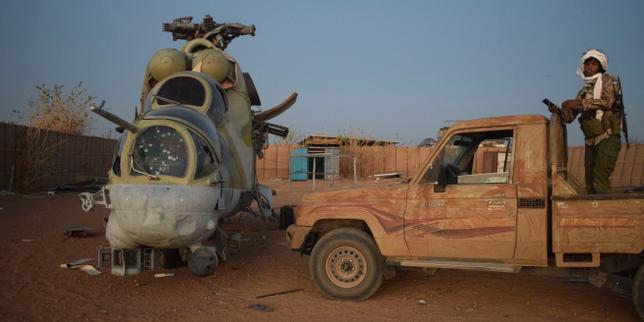
Mali's military rulers are running out of options. Saturday morning brought a brutal reminder that the junta's strategy of relying on Russian mercenaries while cutting ties with Western allies isn't working.
Around 5:00 AM, a series of highly coordinated attacks struck at least five distinct locations across the country. This isn't a localized skirmish. It's a widespread, systematic offensive hitting Aguelhok, Anéfis, Gao, Sévaré, and the high-security Kéniéroba prison just 70 kilometers south of the capital, Bamako.
The military claims these were merely "attempted attacks" that they successfully managed. But the reality on the ground tells a very different story. Residents, security sources, and even a prisoner inside Kéniéroba who managed to speak to journalists before communications cut out all describe intense firefights, rocket barrages, and explosions.
This isn't just another bad day in the Sahel. It's the continuation of a massive security collapse that began with the devastating offensives of late April, which saw the death of the Malian Defense Minister and the fall of the strategic northern hub of Kidal.
The Unholy Alliance Tearing Mali Apart
To understand how things got this bad, you have to look at who is doing the fighting. For years, the military junta insisted that removing French forces and UN peacekeepers would allow them to crush the insurgency. Instead, their aggressive tactics achieved the exact opposite. They united two groups that used to be bitter enemies.
The current offensive is driven by a tactical partnership between the Front de Libération de l'Azawad (FLA)—a Tuareg-led separatist movement—and the Jama'at Nusrat al-Islam wal-Muslimin (JNIM), the regional al-Qaeda affiliate.
The FLA focuses its energy on the north, claiming Azawad territory. JNIM handles the operations in the central and southern regions. They have temporarily set aside their deep ideological differences to focus entirely on breaking the Malian armed forces and their Russian allies, formerly Wagner and now operating as Africa Corps.
Look at what happened in Anéfis this morning. Mohamed Elmaouloud Ramadane, a spokesperson for the FLA, confirmed that their fighters pushed directly into the town, capturing several military outposts. Anéfis and Aguelhok represent the last remaining footholds for the Malian army in the Kidal region. If these positions fall completely, the state loses all authority over a massive portion of the north.
Rockets in Gao and Chaos Near the Capital
While the Tuareg rebels press their advantage in the north, the central and southern regions are facing relentless pressure. In Gao, residents woke up before dawn to the sound of heavy gunfire and rockets targeting a major military camp where both Malian and Russian forces are stationed.
Further south in Sévaré, massive explosions shook the town around 5:00 AM, followed immediately by the sound of military aircraft scrambling overhead.
The most alarming development is the assault on the Kéniéroba central prison. Holding roughly 2,500 inmates—including high-profile jihadist operatives—the facility is located dangerously close to Bamako. JNIM previously targeted this prison, and today's raid shows they can strike near the capital almost at will. It exposes the fiction that the government can guarantee security even in its own backyard.
The Economic Stranglehold
The military situation is compounded by a devastating economic blockade. Since late 2025, JNIM has effectively maintained a chokehold on major transport routes leading into Bamako. They've choked off fuel supplies, food, and basic consumer goods.
You can't run a counter-insurgency campaign when your capital is facing severe fuel shortages and your economy is suffocating. The junta under Assimi Goïta has consistently projected an image of absolute sovereignty and strength. But sovereignty means very little when you don't control the highways leading to your own seat of power.
The False Promise of the Russian Solution
When Mali's military leaders kicked out Western partners and welcomed Russian mercenaries, they promised swift victories. They claimed that Western forces were holding them back with human rights concerns.
The reality has been an absolute disaster for civilians and the military alike. Human Rights Watch and other monitoring groups have documented horrific abuses against civilians by both Islamist groups and the combined forces of the Malian army and Africa Corps. These heavy-handed tactics haven't restored order. They've served as the perfect recruitment tool for the insurgency.
The heavy losses suffered by Russian forces—including the downing of a Mil Mi-8 helicopter in previous weeks—prove that mercenary forces aren't a magic bullet. They're an expensive, brutal stopgap that is failing to hold territory.
What Needs to Happen Next
If you are tracking the security situation in West Africa, don't look at the official press releases out of Bamako. Watch the checkpoints.
The immediate priorities for regional stability require an immediate assessment of the Kéniéroba prison breach to determine exactly how many high-risk detainees escaped during the chaos. Furthermore, international analysts must watch the logistical corridors between Gao and Bamako. If the Malian military cannot clear these supply lines within the coming weeks, the government's ability to supply its remaining northern outposts will completely disintegrate. The current strategy isn't just failing—it has already run out of time.



.jpg)