History isn't clean, and it certainly isn't static. We like to think everything important about the birth of the United States is already sitting safely in a climate-controlled room in Washington, D.C. It isn't.
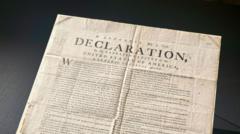
Right before the 250th anniversary of American independence, a retired insurance executive named Michael Scurr sat down for his regular Thursday morning volunteer shift at the UK National Archives in Kew. He was sifting through an uncatalogued box of 18th-century Royal Navy correspondence. What he pulled out wasn't just another routine captain's log. It was a vanishingly rare, original July 1776 printing of the US Declaration of Independence.
This isn't just a cool piece of trivia for antique collectors. Finding this specific document buried in British naval files flips the script on how news of the rebellion actually traveled. It brings to light a gritty, ocean-bound side of the Revolutionary War that standard history textbooks usually ignore.
The Secret Cargo of the Dalton
Most people think of the American Revolution as a land war fought by ragtag farmers in Valley Forge. We forget that the fight for independence was equally brutal on the high seas.
The newly discovered document is an original copy of the "Exeter printing," produced in Exeter, New Hampshire, between July 16 and 19, 1776. That was just days after the Continental Congress signed the original broadside in Philadelphia. Only 11 copies of this specific regional printing are known to exist anywhere on Earth.
This one is the only copy ever found outside the United States. How did it end up in London? It was captured at sea.
In late 1776, an 18-gun American vessel named the Dalton set sail from Portsmouth, New Hampshire. The Dalton wasn't an official navy ship; it was a privateer. Privateers were basically legal pirates—privately owned merchant ships authorized by the Continental Congress to disrupt British commerce and seize enemy cargo.
The Dalton carried a lethal combination of weapons, a diverse crew of 120 men, and a packet of crucial papers. Among those papers was a formal military commission signed personally by John Hancock, alongside a fresh copy of the Declaration of Independence.
Captured on Christmas Eve
The Dalton’s run didn't last long. On Christmas Eve 1776, a massive British warship, the HMS Raisonable, intercepted the privateer off the coast of Spain.
Captain Thomas Fitzherbert of the Raisonable seized the American ship, arrested the crew, and impounded their paperwork. When Fitzherbert bundled up his official report to send back to the Admiralty headquarters in London, he attached the captured American documents. He didn't even bother to name the Declaration explicitly in his inventory. He simply tossed it into the package, labeling it casually as "another paper."
That administrative shrug saved the document for posterity. While official legal evidence went straight to the Admiralty Court, this specific packet remained tucked away inside the captain’s letters, untouched and uncatalogued for nearly two and a half centuries.
The Sailors Who Paid the Price
The discovery of this artifact does something that a pristine museum document can't: it connects us directly to the human cost of the war. Thanks to the published journals of Charles Herbert, a 19-year-old sailor on board the Dalton, we know exactly what happened to the men who carried this copy of the Declaration.
The British didn't treat captured privateers as regular prisoners of war; they treated them as traitors to the Crown. The crew of the Dalton was thrown into Britain’s notorious Old Mill Prison. Herbert’s diary describes years of:
- Extreme hunger and systemic rationing
- Rapidly spreading diseases through crowded cells
- Brutal, freezing winters with inadequate clothing
- Repeated punishments for refusing to renounce the rebellion
Yet, the crew dynamic on the Dalton shows a fascinating picture of early American diversity that defies the classic narrative. The muster books reveal a crew comprising English, Irish, Scottish, French, and Danish sailors. Among them was a man named Daniel Cottle, identified in the records as a Black sailor. Historians at the UK National Archives note that Cottle was highly likely a free Black man fighting voluntarily for the revolutionary cause on the open ocean.
Why the Discovery Matters Right Now
Vague talk about "historical significance" misses the point. Why should you care about a piece of old paper found in a London basement?
First, it changes our understanding of how the Declaration was used. Historians like Amanda Bevan suggest that Captain Eleazer Johnson of the Dalton didn't just keep this paper hidden in a drawer. It's highly probable he read the Declaration aloud to his multi-ethnic crew on the deck of the ship before sailing into battle, using those radical words about liberty to bind a disparate group of sailors into a unified fighting force.
Second, it proves that the historical record is never truly closed. Matthew Skic from the Museum of the American Revolution points out that even after 250 years, major pieces of the puzzle are still waiting to be found in unexamined archive boxes.
Senior conservator Jillian Harrold had to use an ultrasonic humidifier to safely soften centuries-old adhesive and separate the document from the surrounding captain's letters with a spatula. The paper survived a transatlantic voyage, a naval battle, and 250 years of neglect, suffering only a single long tear that has now been meticulously repaired with fine Japanese paper and starch paste.
What to Do Next
If you want to understand the real, messy reality of 1776 beyond the myths, stop looking at polished monuments and look at the raw artifacts.
If you are near London, you can see the UK National Archives' collection of revolutionary documents firsthand. They are displaying their newly conserved American materials at the Revolution 250: America's Independence Story 1763–1783 exhibition, which runs through November 29, 2026, at the archives in Kew.
For those across the Atlantic, digitizing projects like the Prize Papers Project—a joint effort between the UK National Archives and the University of Oldenburg—are scheduled to launch thousands of captured maritime documents online by October 2026. Dive into those digitized ship logs and read the journals of everyday sailors like Charles Herbert. That's where the real history hides.