Iran is entering a week of pure political theater, religious devotion, and massive security anxiety. The body of former Supreme Leader Ayatollah Ali Khamenei has finally arrived at Tehran's Grand Mosalla mosque. It marks the beginning of a sprawling six-day multi-city funeral procession. If you've been following the chaotic news out of the Middle East, you know this isn't just any regular state funeral. It's a calculated projection of power by a regime trying to prove it's still standing after a bruising conflict.
For anyone looking at the headlines and wondering why this is happening now, the timeline tells the real story. Khamenei was killed over four months ago on February 28, 2026. He died in a joint US-Israeli airstrike on his Tehran compound during the opening hours of a sudden, devastating war. His body has been kept in cold storage ever since. The active conflict made a massive public gathering completely impossible. Now, with a fragile ceasefire holding between Washington and Tehran, the government is rushing to stage what they hope will be the largest funeral in the country's modern history.
They expect between 15 to 20 million people to take to the streets. Peace talks are on pause. The region is holding its breath. Here's what's actually happening behind the scenes, why the delay matters, and what the regime is trying to hide behind the wall of public grief.
The Logistics of a Two Nation Sendoff
A funeral of this scale requires an insane level of coordination. It's not just limited to Iran. The regime has planned a cross-border journey designed to rally Shia solidarity across the region.
The schedule is tight and highly scrutinized. Rites began with private viewings for family members and top political figures. Over the weekend, the gates of the Grand Mosalla in Tehran opened to the general public, allowing millions of everyday citizens to catch a glimpse of the casket. A massive ten-kilometer procession is scheduled to move through central Tehran, charting a route from Imam Hossein Square straight to Azadi Square. The choice of Azadi Square is deliberate. It's the iconic birthplace of the 1979 revolution.
After the capital ceremonies wind down, the logistical nightmare moves south. The body will travel to Qom, the theological heart of Iran's clerical establishment. From there, the procession crosses international borders into neighboring Iraq. Caskets and ceremonial processions will move through the holy Shia cities of Najaf and Karbala. This cross-border journey required intense diplomatic coordination between Iranian Foreign Minister Abbas Araghchi and Iraqi leadership in Baghdad.
The entire event finally wraps up on July 9 in the northeastern city of Mashhad. Khamenei will be buried at the historic shrine of Imam Reza. It's his birthplace, bringing his life and his 37-year rule to a permanent close.
The Nightmare of Crowd Disasters Past
Iranian officials are terrified of a stampede. They're obsessed with keeping things orderly. You can't blame them when you look at history.
When the founder of the Islamic Republic, Ayatollah Ruhollah Khomeini, died in 1989, his funeral was pure chaos. Millions of hysterical mourners mobbed the procession. They literally broke the wooden casket apart and tore pieces of his burial shroud for blessings. The Revolutionary Guards lost control completely. They had to fly Khomeini's body out by helicopter to re-shroud him and try again the next day. Then came the 2020 funeral of military commander Qasem Soleimani in Kerman. A massive crowd crush killed at least 56 people and injured hundreds more. The burial had to be put on hold.
To prevent another high-profile disaster, the government has built a massive security blueprint. Gholamhossein Mozaffari, the governor of Razavi Khorasan Province, confirmed that military helicopters will hover over the procession routes to monitor crowd density from above. Temporary airspace restrictions have been slapped over Tehran and Mashhad. Roadblocks, specialized pilgrim hostels, and thousands of security personnel are lining the streets. The regime wants an image of disciplined, united strength, not a tragic viral video of crowd failure.
The Secret Casket and the Broken Family
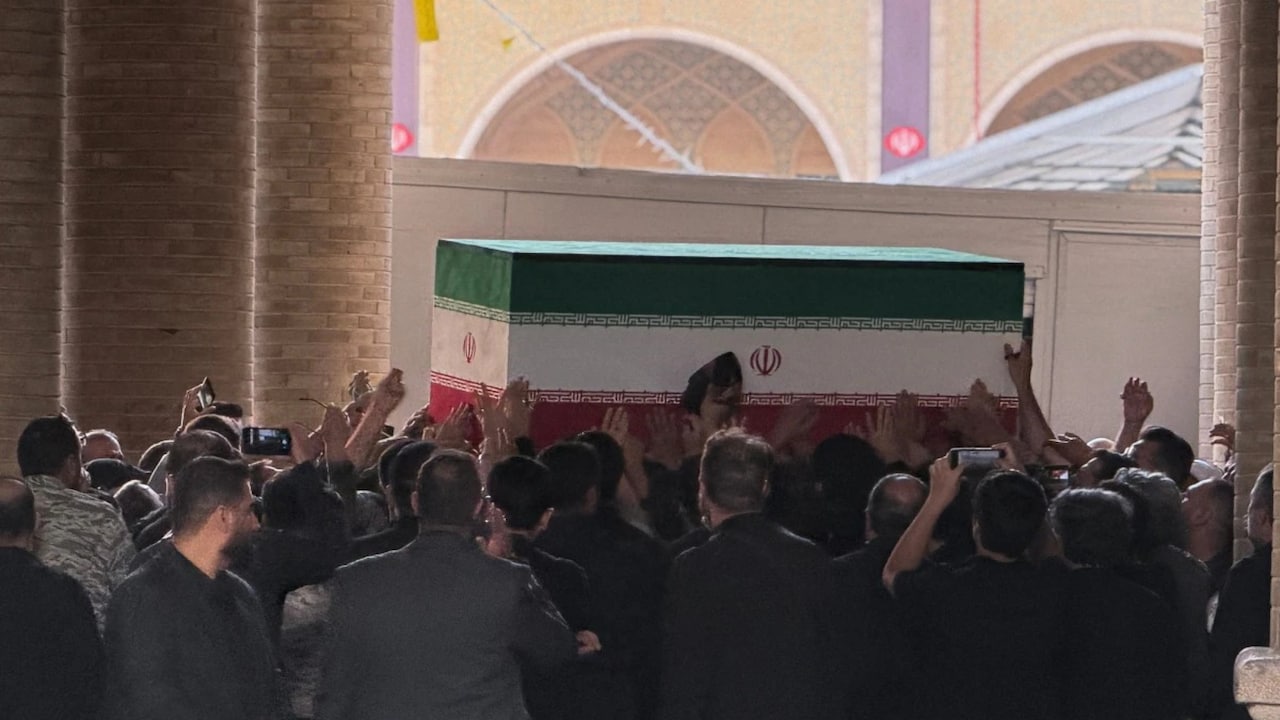
If you look closely at the footage coming out of the Grand Mosalla, the visual layout tells a tragic story. Khamenei's casket isn't sitting alone. It's surrounded by smaller coffins wrapped in the Iranian tricolor flag.
The airstrike on February 28 didn't just kill the Supreme Leader. It wiped out generations of his immediate family. Among the small coffins is one belonging to his 14-month-old granddaughter, Zahra Mohammadi Golpayegani. His daughter, son-in-law, and daughter-in-law were also killed in the initial strike. His wife died from her wounds just days later in early March. The state is utilizing these images of family loss to build an emotional narrative of martyrdom and sacrifice.
There's also a glaring absence hanging over the entire event. Khamenei’s son, Mojtaba Khamenei, was quickly named as his father’s successor to maintain continuity. But Mojtaba isn't expected to show his face at the funeral. He was severely wounded in that very same February airstrike. He's reportedly still in deep hiding, recovering from his injuries under intense security. A new Supreme Leader who can't even attend his own father's funeral speaks volumes about how vulnerable the top tier of Iranian leadership still feels.
Paused Peace Talks and Regional Power Plays
While the mourners weep, the international community is watching the geopolitical chess board. The timing of this funeral has brought global diplomacy to a screeching halt.
The United States and Iran had been engaging in high-stakes denuclearization and peace talks mediated by Qatar and Pakistan. Those talks are officially frozen for the week. Fox News and CBS have confirmed that negotiators agreed to a temporary pause to let the funeral ceremonies play out. There's even a fragile, one-week de-escalation agreement covering the crucial Strait of Hormuz to keep commercial shipping lanes safe while Iran is distracted.
But don't mistake this pause for a softening of stances. The regime is using the global stage to send aggressive warnings. General Ahmad Vahidi, the powerful head of the Revolutionary Guard, emerged from months of hiding to sit right next to Khamenei's casket. Army Chief Major General Amir Hatami openly vowed to avenge the Supreme Leader's blood.
To back up those threats, Iran issued a stern warning to oil tankers in the Persian Gulf. They must follow strict, government-approved routes or face immediate military action. It's a classic Iranian strategy. They're projecting absolute control over their sphere of influence even while preparing a burial.
Foreign Dignitaries and Domestic Realities
The guest list for the official ceremonies highlights Iran's current geopolitical reality. It's a mix of close allies and regional players, but major Western heads of state are completely absent.
Former Russian President Dmitry Medvedev arrived in Tehran to pay his respects, signaling Moscow's continued alignment with Iran. The Taliban government's foreign minister from Afghanistan made an appearance, along with Pakistani Prime Minister Shehbaz Sharif. India sent a lower-level diplomatic delegation led by Bihar Governor Syed Ata Hasnain and Minister of State for External Affairs Pabitra Margherita. Prime Minister Narendra Modi skipped the event entirely, opting instead for pre-scheduled visits to Indonesia, Australia, and New Zealand.
Inside Iran, the public mood is far more complicated than state television suggests. The government is treating this week as a national referendum on the survival of the Islamic Republic. They're plastering cities with posters promising a bright economic future.
They're trying to win over a public that is utterly exhausted. Before the war broke out in February, Iran was being torn apart by massive anti-government protests. The economy is in shambles due to years of sanctions and the heavy toll of recent bombardments. Some citizens interviewed anonymously by foreign press admitted they have absolutely no intention of attending. They're angry that the state is spending massive amounts of money on a lavish, six-day spectacle while ordinary people struggle to buy basic groceries.
What Happens Next
The next few days will test the regime's organizational limits. If you're watching this situation develop, keep your eyes on the following key flashpoints.
First, watch the crowd management during Monday’s massive central Tehran procession. Any sign of logistical breakdown or crowd panic will instantly undermine the image of absolute control the government is trying to project.
Second, monitor the border crossing into Iraq. Moving a highly sensitive, symbolic state procession through Najaf and Karbala during a fragile regional truce is a massive security risk. Any security breach there could instantly reignite regional tensions.
Finally, keep an eye on the diplomatic front. The moment the burial ends on July 9 in Mashhad, the clock starts ticking on the paused peace talks. The international community will quickly see whether the new leadership under Mojtaba Khamenei will use the momentum of this funeral to pursue a permanent ceasefire or push the region back toward active conflict. This funeral isn't the end of a chapter. It's the messy, high-stakes beginning of a completely new one.