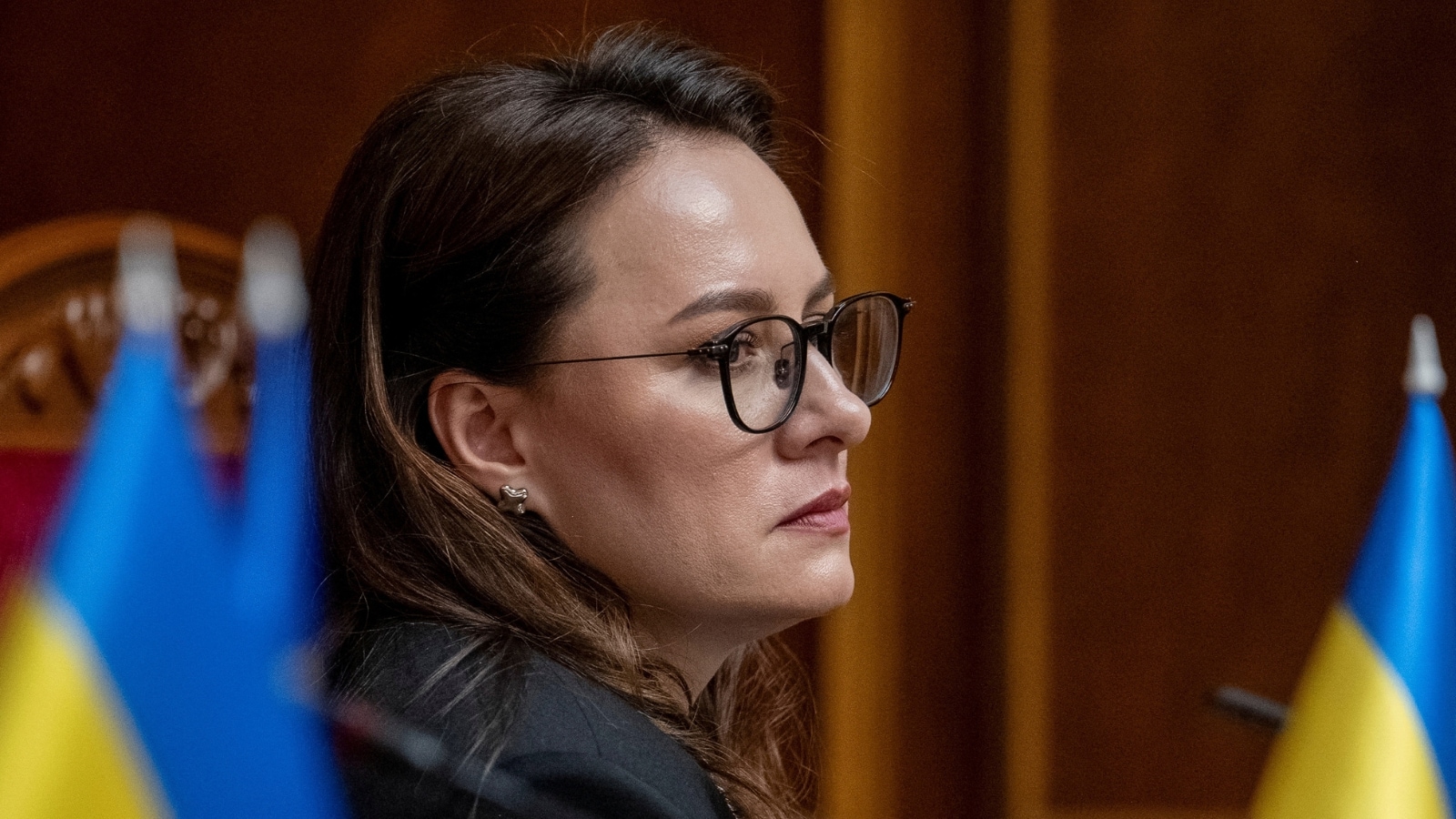
When Ukraine's parliament accepted the resignation of Prime Minister Yulia Svyrydenko on Tuesday, it felt like a rerun of a show everyone has watched way too many times. She lasted barely a year. The 40-year-old economist walked into parliament dressed in all-white, gave a polite speech about hard choices, and walked out.
Meanwhile, the people actually running the country did not even bother to explain why she was leaving.
This is the fourth major government shakeup since Russia’s full-scale invasion began. If you are looking at this from the outside, you might think it is a sign of a healthy democracy constantly refining its leadership during a crisis. It is not. It is a sign of a deep, systemic structural bottleneck. Zelenskyy’s critics are completely right to look at this latest cabinet shuffle and see absolutely no point.
The real problem in Kyiv is not who sits in the prime minister’s office. The problem is that the office itself has been stripped of any real, independent power.
Another cabinet shakeup in Kyiv
To understand why this resignation is drawing so much cynicism, you have to look at what the prime minister actually does in wartime Ukraine. On paper, they manage the domestic economy, oversee the rebuilding of shattered infrastructure, and coordinate with Western donors.
Yulia Svyrydenko took the job in July 2025. She was a rising star, highly regarded by Western diplomats for her role in hammering out a massive critical minerals agreement with the United States. That deal was supposed to be a golden key, locking American financial and security interests directly to Ukrainian soil.
Yet, her year in office was defined by brutal challenges. Russia spent the winter systematically tearing apart Ukraine's power grid. Svyrydenko was tasked with keeping the lights on, keeping the factories running, and convincing a weary population that the government had a plan.
At the same time, her administration was hit by relentless corruption scandals. Did she take bribes? No. No one is accusing her of that. But opposition lawmakers point out that she did almost nothing to clean house. The systemic rot remained.
During her farewell address, Svyrydenko warned that preparing for the upcoming winter is going to be the toughest challenge yet. Russia is already prepping to double down on strikes targeting Ukraine's gas transit systems and electrical distribution networks. It is a terrifying prospect.
So why replace the person in charge of managing this crisis right before it hits?
The illusion of wartime change
Zelenskyy has made reshuffling his cabinet a routine tactic. Because martial law is in place, democratic elections are legally suspended. This makes sense in a country where millions are displaced and active fighting is happening on a massive front line. You cannot hold a fair election when voters are in trenches or fleeing drone strikes.
But without elections, Zelenskyy has very few ways to show the public and international allies that he is keeping things fresh. Changing ministers is his primary tool to signal progress, show accountability, or distract from stagnation.
The strategy has worn incredibly thin. Opposition politicians are openly mocking the entire process.
Yaroslav Zhelezniak, a lawmaker from the opposition Holos party, did not hold back. He openly ridiculed the outgoing cabinet's record of empty public relations. He pointed out that the government promised major results every day, but instead delivered endless slide decks, daily conferences, and a constant stream of high-profile corruption suspects.
When a government's primary output is public relations rather than tangible reform, changing the face on the presentation slide does not change the reality on the ground.
Another opposition lawmaker, Kira Rudik, expressed zero optimism that a new cabinet would do anything differently. Oleksiy Honcharenko noted that no one in the administration could even offer a basic, logical explanation for why the prime minister was being dismissed in the first place.
It is political theater. It keeps the spotlight moving so nobody looks too closely at where the real power lies.
Where the power actually goes
In wartime Ukraine, the prime minister is essentially a manager, not a leader. The real policy, the real strategy, and the real decisions are made in the Office of the President, heavily concentrated under Zelenskyy and his chief of staff, Andriy Yermak.
This hyper-centralization is the elephant in the room.
When Svyrydenko’s predecessor, Denys Shmyhal, stepped down, he did not go away. He was simply moved to another slot, eventually taking over defense and then energy. It is a game of political musical chairs. The same small pool of trusted loyalists gets rotated through different ministries.
This setup has a couple of major side effects:
- It kills initiative. Ministers are terrified of making big decisions because they know they can be thrown under the bus the moment a policy fails or public mood sours.
- It blocks new talent. By recycling the same group of bureaucrats, the government fails to bring in fresh, independent experts who might actually challenge the status quo.
- It damages institutional memory. When you change the head of a ministry every twelve months, long-term planning becomes practically impossible.
We see this playing out with the likely appointment of Serhiy Koretskyi, the current head of the state-owned oil and gas giant Naftogaz, as the next prime minister.
Koretskyi is a capable executive. He knows the energy sector inside and out. If he takes the job, his immediate focus will be the desperate scramble to defend and patch up the energy grid before the temperatures drop. But if he is not given the independence to make massive, sometimes unpopular structural decisions without running every single memo past Zelenskyy's chief of staff, he will face the exact same dead end as Svyrydenko.
Why delegation is the real problem
Western allies are watching this play out with growing frustration. They are pouring billions of dollars into the Ukrainian economy, and they want to see deep, structural reforms. They want to see an independent judiciary. They want to see real anti-corruption measures that actually bite, not just flashy press releases about new arrests.
To get those things, Ukraine needs a prime minister who can stand up to the presidential administration. They need someone who can say "no" to the inner circle when necessary.
Under the current system, that is a fantasy.
The real test of this new reshuffle has nothing to do with Serhiy Koretskyi or any other candidate. The test is whether Zelenskyy is actually willing to let go of the reins. Is he ready to delegate real, legally binding authority to his ministers? Or does he want to keep managing everything from a highly centralized war cabinet?
If he keeps micro-managing, the new prime minister will simply be another shield to absorb public anger when the power goes out this winter.
What happens next on the ground
The immediate aftermath of this political drama will be felt by ordinary Ukrainians. While politicians in Kyiv argue over cabinet seats, the reality of the war grinds on.
If you want to track whether this political shakeup actually matters, stop watching the parliament votes. Watch these three areas instead:
- The winter energy defense. Keep a close eye on the speed of repairs to the high-voltage grid and the acquisition of mobile gas turbines. If the new government cannot secure these before November, Kyiv's political drama won't matter because the capital will be dark.
- The flow of Western aid. Watch how the European Union and the United States react to the new cabinet appointments. If we see delays in financial tranches, it means Western donors do not trust the new team to spend the money cleanly.
- The anti-corruption prosecutions. Watch whether the National Anti-Corruption Bureau of Ukraine (NABU) is allowed to investigate high-level officials without interference from the presidential office. If the investigations stop at the minister level and never go higher, you know the status quo has won.
Changing the face at the top of the table is easy. Rebuilding a country under fire while fighting internal corruption is incredibly hard. Until Kyiv realizes that shuffling the deck does not change the hand you are dealt, these political dramas will continue to be nothing more than a distraction.