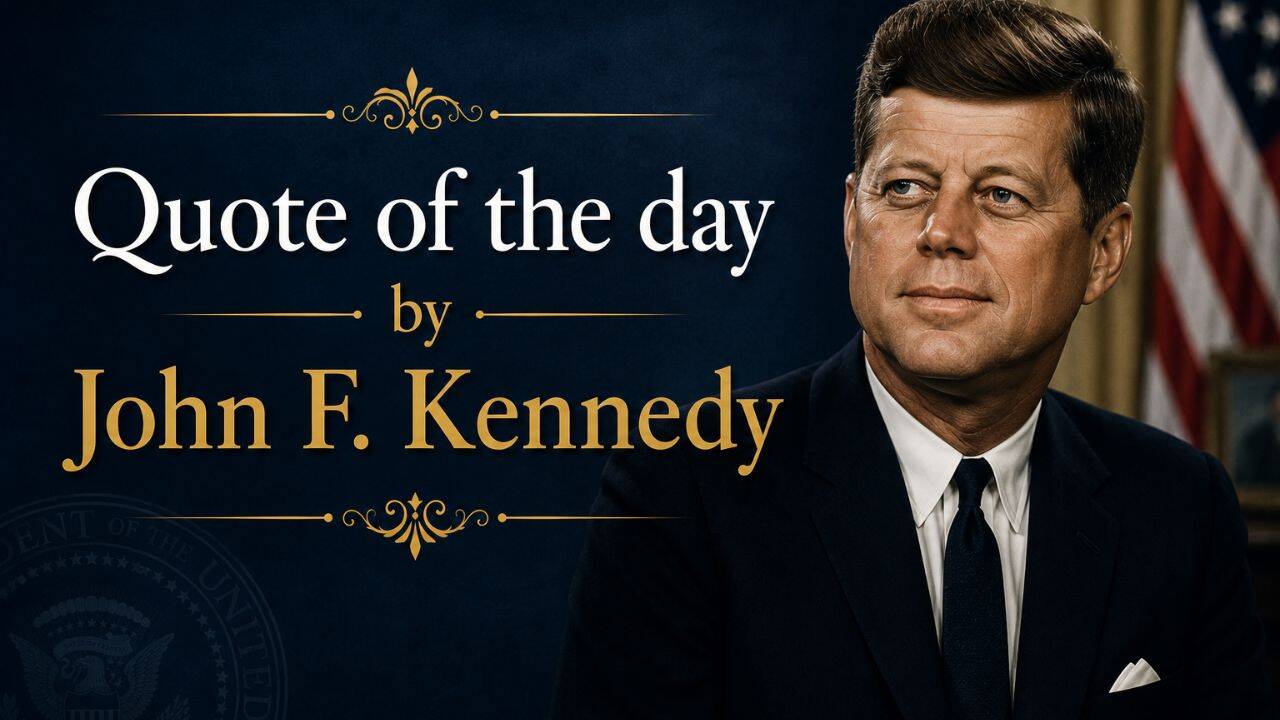
Most people treat their relationship with their country like a standard transaction. You pay your taxes, you expect the roads to be paved, the schools to be open, and the police to show up when you call. It's a consumer mindset. On January 20, 1961, John F. Kennedy stood on a freezing Washington podium and completely flipped the script.
His iconic line, “Ask not what your country can do for you—ask what you can do for your country,” wasn't just a catchy piece of political rhetoric. It was a direct challenge to the lazy entitlement that creeps into successful societies.
Today, politicians usually win elections by promising you free things, tax breaks, or systemic fixes that require zero personal effort. Kennedy did the exact opposite. He didn't promise comfort; he demanded sacrifice. If you look closely at the mechanics of that speech, the history behind it, and the raw geopolitical stakes of the moment, you realize the line is far sharper—and far more demanding—than the watered-down version we repeat today.
The Secret Evolution of a Masterpiece
People assume Kennedy or his legendary speechwriter, Ted Sorensen, just stumbled upon this perfect phrase while drafting the inaugural address on a yellow legal pad. That's a myth. The core idea had been rattling around in Kennedy's brain for at least fifteen years.
Historical records show that as early as 1945, a young JFK scribbled a quote from Jean-Jacques Rousseau in his loose-leaf notebook: “As soon as any man says of the affairs of the State, 'What does it matter to me?' the State may be given up as lost.”
He spent the next decade and a half trying to find a punchier way to say it. During his 1960 presidential campaign, he tried out early drafts of the phrase. In Detroit, he told a crowd that the "New Frontier" was about "what I intend to ask of the American people, not what I intend to offer them." But it lacked rhythm. It didn't stick.
The breakthrough happened right before the inauguration. Kennedy didn't just want an abstract request for volunteerism. He wanted a structural mirror. Look at how the final sentence is actually put together. It uses a classical rhetorical device called chiasmus, where words are repeated in reverse grammatical order.
[what your country can do for you]
               ⇅
[what you can do for your country]
By using the exact same words but swapping the subject and object, Kennedy forces you to confront the absolute imbalance of a one-way relationship with your society. Even on the morning of the speech, he was still tinkering. He manually scratched out the word “will” on his reading copy and replaced it with “can.” “Can” implies capability and duty; “will” sounds like an optional future plan. Kennedy wanted duty.
Cold War Stakes and the Missing Domestic Agenda
To understand why this hit so hard in 1961, you have to look at the terrifying backdrop of the era. The world was locked in a brutal ideological struggle between American capitalism and Soviet communism. The nuclear arms race was accelerating. Cuba was shifting rapidly into the Soviet orbit. Kennedy explicitly designed his speech to focus almost entirely on global affairs rather than domestic politics.
Why? Because domestic policies—like civil rights and economic spending—divided Americans at home. Kennedy knew that to fight a cold war, he needed a unified home front.
When he told Americans to ask what they could do, he wasn't talking about picking up litter in their local parks. He was prepping a generation for existential conflict. He noted that only a few generations are granted the role of "defending freedom in its hour of maximum danger." The line was a recruiting pitch for public service, military readiness, and international development. It directly paved the way for the creation of programs like the Peace Corps later that year.
Critics at the time, however, pointed out a massive blind spot. By focusing so heavily on what citizens owed the state to fight communism abroad, Kennedy largely sidestepped the civil rights movement exploding across the American South. For millions of Black Americans fighting for basic legal protections, the state did owe them something—protection from state-sanctioned violence and the enforcement of constitutional rights.
This tension highlights the ultimate debate behind the quote: Can a state legitimately demand total devotion from citizens it refuses to treat equally?
What Most People Get Wrong About the Quote
The biggest modern misconception is that Kennedy was arguing the government has no obligation to its citizens. That's a complete misreading of the text.
Kennedy spent other parts of the address outlining heavy global obligations, famously stating that a free society "cannot save the few who are rich" if it fails to "help the many who are poor." He wasn't advocating for a brutal, every-man-for-himself libertarianism where the state abandons its people.
Instead, he was arguing that a society's health is a two-way street. A country that only distributes resources without demanding civic responsibility eventually hollows out. When citizens view their government merely as a vending machine—where you insert taxes and extract services—the shared sense of national purpose dies.
How to Apply the JFK Test Today
If you want to move past the historical nostalgia and actually live the ethos of that speech, you have to stop treating your community as a product you consume. Here are the practical steps to shift from a consumer citizen to a contributor citizen:
- Audited Consumption: Look at the public spaces, safety systems, and civic benefits you use daily. Identify one area where you take the infrastructure for granted without offering anything back.
- Direct Civic Engagement: Don't just vote every four years and complain on social media in between. Join local boards, volunteer for emergency services, or manage community programs where your physical presence creates a tangible result.
- Generational Responsibility: Stop asking how policy changes affect your immediate pocketbook today. Ask how the decisions made by your city or country right now will impact the generation coming twenty years behind you.