Taiwan wants its own Iron Dome, but domestic politics is getting in the way.
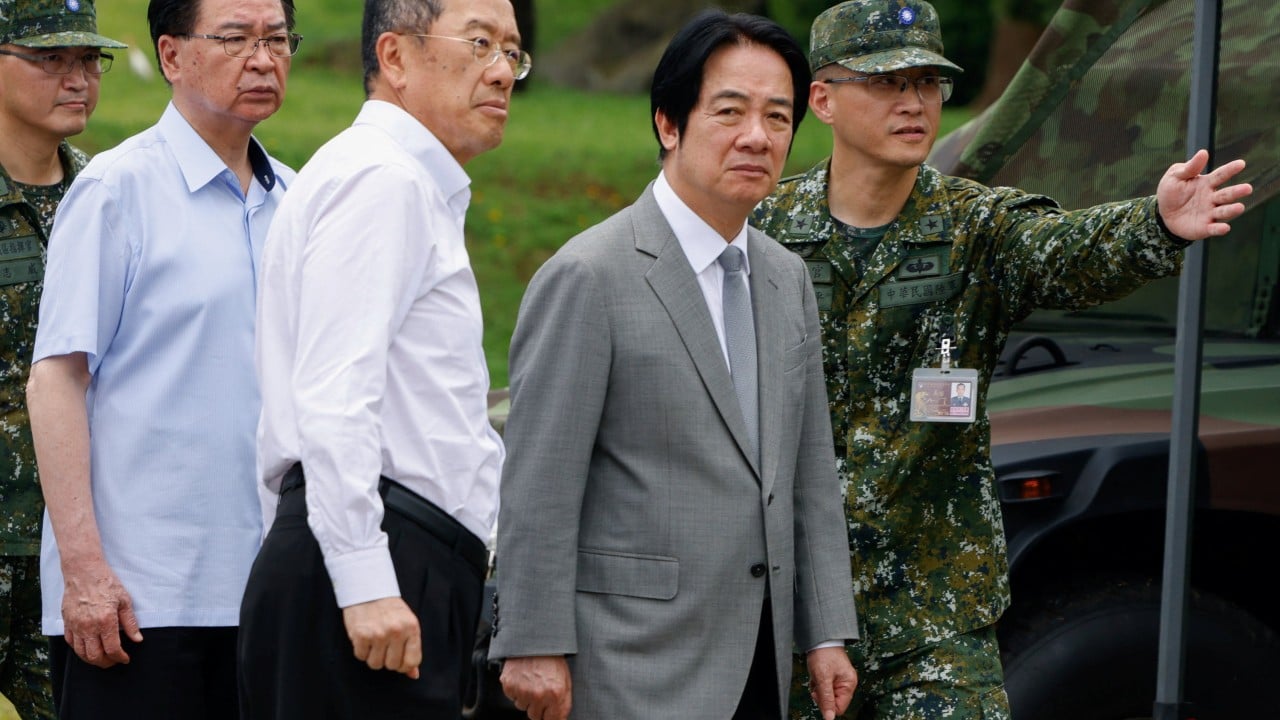
The island is trying to build a multi-layered air defense shield known as the T-Dome. President William Lai Ching-te announced the plan with great fanfare, aiming to protect the territory from a potential saturation attack by China's People's Liberation Army (PLA). But a defense network is only as strong as its funding, and right now, Taipei's political infighting is leaving massive holes in the blueprint.
The biggest casualty of this legislative gridlock is the Chiang-Kong, or Strong Bow, anti-ballistic missile system. It is a critical, home-grown piece of the T-Dome puzzle. Without it, the entire concept of a unified defensive shield starts to crumble. The opposition-controlled legislature slashed the government's requested special defense budget earlier this year, cutting it from a proposed NT$1.25 trillion down to NT$780 billion. That decision did not just trim the fat. It chopped off vital capabilities, delaying the full deployment of the T-Dome to 2028 or even later.
This is not a technical failure. It is a political choice. While Beijing continues to ramp up its gray-zone warfare and simulate blockades, Taiwan's leaders are fighting each other over the purse strings. If Taipei cannot resolve its internal budget disputes, it won't matter how advanced its indigenous missiles are. They simply won't exist in large enough numbers to matter.
The Political Gridlock Threatening Taiwan's Missile Shield
The core problem stems from a deeply divided government. President Lai’s Democratic Progressive Party (DPP) does not hold a majority in the Legislative Yuan. Instead, the opposition coalition, led by the Kuomintang (KMT), holds the reins of the budget. When the DPP pushed for a massive special budget to fund the T-Dome and other defense initiatives, the opposition balked.
Opposition lawmakers argue that the executive branch uses special budgets to bypass ordinary financial oversight. They claim these large, multi-year lump sums lack transparency and open the door to waste or corruption. The KMT prefers allocating funds through the regular annual defense budget, which allows for yearly legislative review and adjustments.
But defense manufacturing does not work like that. You cannot build a domestic missile industry when your funding changes every twelve months. Defense contractors and local research institutes need long-term financial predictability to scale up production lines, hire engineers, and buy specialized raw materials. When the legislature cut the special budget by nearly forty percent, it threw the entire procurement timeline into chaos.
The executive cabinet and the defense ministry are now stuck in a bureaucratic finger-pointing match. The military wanted to rescue the Strong Bow system by securing a supplementary budget or stuffing it into next year’s regular budget. The cabinet, however, failed to create a viable alternative funding mechanism in time. The Strong Bow system was left completely out of the latest special bill on uncrewed systems. This bureaucratic paralysis means the chance of saving the project through supplementary funds this year is basically zero.
Inside the T-Dome Project and the Strong Bow Dilemma
To understand why losing the Strong Bow system is a disaster, you have to look at what the T-Dome is supposed to accomplish. The T-Dome is not a single missile battery. It is an ambitious attempt to tie Taiwan’s existing, fragmented air defense assets into a single, unified command platform. It is designed to track hundreds of incoming threats simultaneously, separate real threats from harmless decoys, and assign the right interceptor to the right target.
Taiwan already possesses capable individual systems. It operates American-made Patriot PAC-3 batteries alongside its own indigenous Tien Kung III (Sky Bow) systems. The Chiang-Kong (Strong Bow) system was engineered to take this a step further, providing a high-altitude, anti-ballistic missile capability that extends the island's reach and intercept window. Think of it as the upper roof of the dome, catching fast-moving ballistic missiles before they drop into the lower atmosphere where shorter-range systems operate.
When you remove the Strong Bow from the equation, the entire multi-layered strategy thins out. Shorter-range systems like the Patriot or standard Tien Kung batteries will have to shoulder the entire burden. That means less reaction time for commands, fewer opportunities to intercept incoming salvos, and a much higher probability that saturation strikes will break through the line.
The National Chung-Shan Institute of Science and Technology (NCSIST), Taiwan's primary state-owned defense contractor, has done the hard work of developing this technology. The missiles have been tested, and the prototypes exist. The obstacle isn't engineering capability; it's the missing checks to start mass assembly.
Why a Fractured Budget Strategy Plays into Beijing's Hands
Beijing is watching this legislative drama closely. The People's Liberation Army Rocket Force holds an immense stockpile of short- and medium-range ballistic missiles, cruise missiles, and heavy artillery rockets specifically aimed at Taiwan's critical infrastructure. Their strategy relies on numbers. They don't need to bypass Taiwan's air defenses with stealth; they can just overwhelm them with volume.
A fractured, year-by-year budget strategy feeds right into China's plans. When Taiwan's defense ministry cannot guarantee multi-year contracts, the local supply chain suffers. Subcontractors won't invest in expanding their factories if they think the budget might get axed in the next legislative session. This slow-rolling approach limits Taiwan's ability to stockpile interceptor missiles.
An interceptor deficit is a massive vulnerability. During an actual conflict, standard military doctrine requires firing multiple interceptor missiles at a single incoming threat to guarantee a kill. If China launches a combined wave of five hundred cruise missiles and ballistic missiles, Taiwan would need to burn through over a thousand interceptors in the first few hours. If production lines are bottlenecked due to erratic funding, the island will run out of ammunition long before a sustained blockade can be lifted.
Washington is also losing patience with Taipei's domestic political squabbles. American lawmakers and defense officials are legally bound by the Taiwan Relations Act to provide defensive weapons, but they expect Taiwan to show serious skin in the game. When opposition leaders stall major defense appropriations, it sends a terrible signal to the international community. It makes it look like Taiwan's political class is more interested in partisan warfare than national survival.
Breaking Down the Real Cost of Asymmetric Defense
The debate over the T-Dome also exposes a deeper tactical disagreement about what kind of defense Taiwan actually needs. Some military analysts argue that copying Israel’s Iron Dome is fundamentally flawed because the threat profile is completely different. Israel primarily intercepts low-tech, slow-flying rockets fired by non-state actors like Hamas or Hezbollah. Taiwan faces a superpower capable of deploying supersonic cruise missiles, hypersonic weapons, and massive swarms of cheap, weaponized drones.
The math behind missile defense is brutal. A single American-made Patriot PAC-3 interceptor costs roughly $3.7 million. Even Taiwan’s domestic Tien Kung III missiles cost more than $600,000 each. On the other side of the strait, Chinese factories can produce commercial-grade, one-way attack drones for a few thousand dollars apiece.
If the T-Dome is forced to use half-million-dollar missiles to shoot down three-thousand-dollar drones, Taiwan will bankrupt itself in days. This is why the opposition's budget cuts, while politically motivated, have accidentally forced a necessary conversation about cost-exchange ratios.
Taiwan cannot afford a defense system that relies purely on expensive kinetic interceptors. The T-Dome concept must evolve to incorporate cheaper, asymmetric counter-measures like electronic warfare jamming, directed-energy weapons, and rapid-fire gun systems.
The executive branch's fixation on a high-end missile shield like the Strong Bow shouldn't distract from the desperate need for low-cost, high-volume defenses. The opposition recently tried to address this by pushing for a mandate that requires a high percentage of defense drones to be sourced from domestic producers. They want fifty percent domestic sourcing within two years and eighty percent within four years. It's a solid concept on paper, but it doesn't solve the immediate crisis of a missing high-altitude missile shield.
Next Steps for Taiwan's Security Architecture
Taipei needs to fix this mess before the legislative session ends, or the T-Dome project will remain a half-baked political slogan rather than an operational shield. To salvage its national security posture, the government must take direct action.
- Establish a Bipartisan Defense Council: The cabinet and the opposition leadership need to create a ring-fenced, independent body specifically to review multi-year defense acquisitions. National survival shouldn't be a political football used for regular legislative posturing.
- Decouple Strong Bow from Political Feuds: The defense ministry must present an isolated, transparent audit of the Chiang-Kong system's costs to satisfy KMT oversight concerns. Get the funding approved under regular appropriations if necessary, but guarantee the multi-year production stability that NCSIST needs.
- Pivot to Mixed-Tier Interception: Redesign the lower layers of the T-Dome to emphasize cost-effective, hard-kill and soft-kill drone counter-measures. Stop planning to use high-end anti-ballistic missiles for low-tier threats. Save the expensive inventory for the real structural threats.
- Distribute and Harden the Infrastructure: A centralized command system is an easy target for a blinding opening strike. Taiwan must invest heavily in physical concealment, mobile radar units, and decentralized command nodes so that the T-Dome can survive the initial hours of a conflict.
The military threat from across the strait isn't slowing down to wait for Taiwan's politicians to finish their arguments. Every month spent bickering over budget structures is a month of production time lost forever. Taipei must find a compromise between executive speed and legislative oversight immediately, or the T-Dome will remain a shield made entirely of paper.