Space isn't just empty. It's stubborn. For decades, astrophysicists operated under a strict cosmic rulebook that dictated exactly how far back into the early universe we could peer using conventional light waves. We knew the early cosmos was choked by a thick, opaque shroud of neutral hydrogen gas that essentially acted like a cosmic brick wall, absorbing energetic radiation and keeping the universe in a state of murky twilight. But a sudden breakthrough has completely shattered those expectations. The impossible light spotted by Hubble has bypassed this supposed wall, forcing scientists to rethink how the universe transitioned from a pitch-black fog into the transparent, star-filled cosmos we inhabit today.
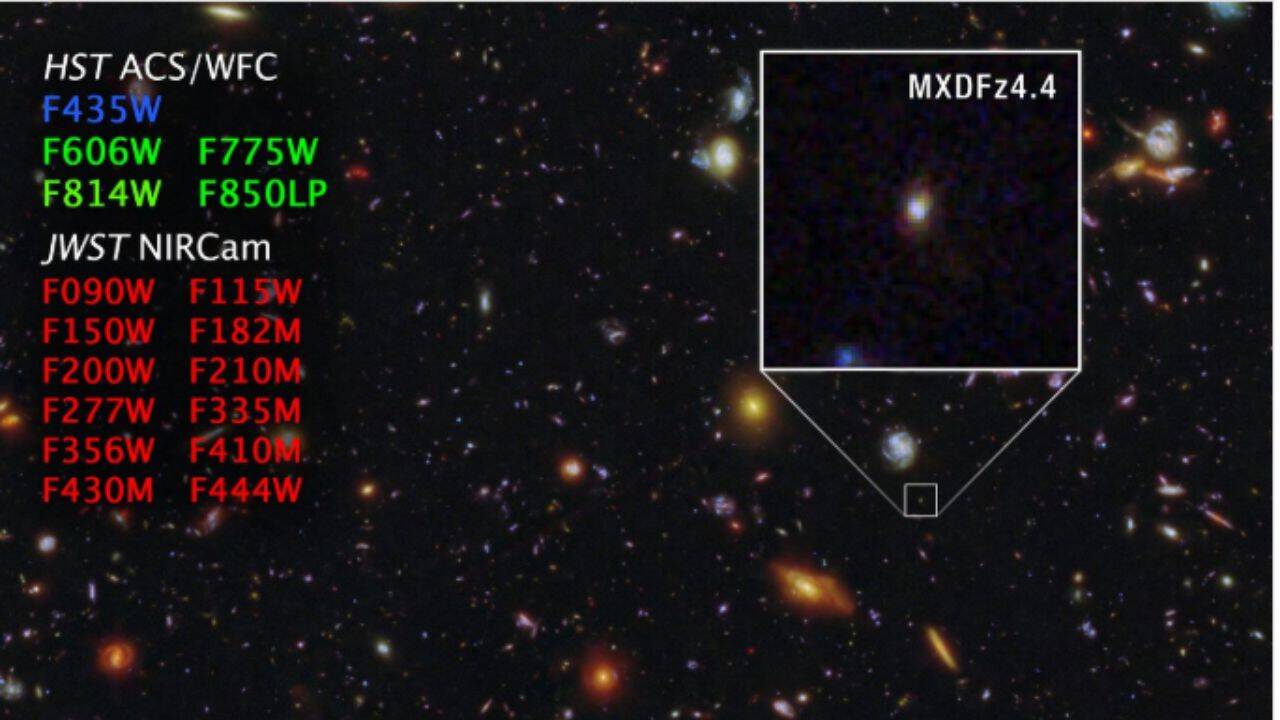
Astronomers detected a powerful stream of ionizing ultraviolet photons escaping from a minuscule, ancient galaxy known as MXDFz4.4. This galaxy existed roughly 1.4 billion years after the Big Bang. Under existing models, detecting this specific type of light from such a distant era was considered an absolute impossibility. The intergalactic medium should have swallowed those photons long before they ever had a chance to reach our satellite mirrors. Instead, this tiny galaxy managed to blast a clear channel through the cosmic fog, providing a direct, unfiltered look at a critical era in cosmic history that was previously deemed unreachable.
The cosmic fog that should have blocked everything
To understand why this discovery sent shockwaves through the astronomical community, you have to understand what the universe looked like in its infancy. Shortly after the Big Bang, the cosmos entered a period known as the Dark Ages. There were no stars, no galaxies, just a vast, chilling expanse of neutral hydrogen gas.
When the first generation of massive stars finally ignited, they began pouring out intense ultraviolet radiation. This energetic light possessed enough punch to strip electrons away from hydrogen atoms, a process called ionization. This multi-million-year transformation is known as the Epoch of Reionization.
During this transition, the universe was a chaotic mess of clear bubbles expanding into a dense sea of opaque hydrogen fog. If a galaxy was sitting inside one of these early murky zones, its ultraviolet light would get instantly absorbed by the surrounding neutral gas. It's the cosmic equivalent of trying to shine a flashlight through a brick wall. Astronomers assumed that any ionizing light from this era would be utterly lost to history, scattered and neutralized billions of years before the Earth even formed.
MXDFz4.4 shattered that assumption completely. The galaxy managed to leak its ionizing photons directly into the deep void, allowing them to travel across billions of light-years to hit Hubble’s detectors. It didn't just emit the light; it cleared a path through the intergalactic medium, showing that our understanding of how the early universe cleared its own fog is fundamentally incomplete.
An accidental discovery born from a funding deadline
Great discoveries in astronomy usually conjure up images of sleepless nights spent staring intentionally at targeted coordinates. This wasn't one of those times. The detection of this impossible light was entirely accidental.
Ilias Goovaerts, a postdoctoral fellow at the Space Telescope Science Institute in Baltimore, was buried in paperwork. He was trying to wrap up a funding proposal just days before a major deadline. To double-check some data and ensure nobody else had already claimed a specific line of research, he pulled up an existing, incredibly deep image captured by the Hubble Space Telescope. He started sifting through the pixels, expecting to find the usual background noise and well-documented red-shifted shapes.
Within two hours, Goovaerts noticed a strange, highly energetic signal coming from a coordinate that shouldn't have been emitting much of anything in the ultraviolet spectrum. It was an unmistakable spike of ionizing photons. Recognizing that this could disrupt prevailing theories of cosmic evolution, he immediately paused his grant writing to assemble a team of global researchers. They spent the following months verifying the data, terrified that they were looking at a glitch, a calibration error, or a stray reflection from a nearby foreground star. It turned out to be completely real.
Anatomy of a tiny cosmic powerhouse
You might expect a galaxy capable of tearing holes in the cosmic fabric to be a massive, sprawling monster like our Milky Way. It's actually the exact opposite. MXDFz4.4 is a cosmic runt.
Physical measurements indicate that this galaxy is roughly 100 times smaller in physical area than our own galaxy. It's compact, dense, and tightly packed. But what it lacks in pure scale, it makes up for in absolute violence.
Galaxy Comparison:
- Milky Way: Massive, slow-burning star production (roughly 1-2 solar masses per year).
- MXDFz4.4: 100x smaller area, hyper-accelerated star production (10x faster than Milky Way).
This tiny system is producing new stars at a rate roughly ten times faster than the modern Milky Way. It is a hyper-accelerated engine of stellar birth, packing millions of young, massive, incredibly hot stars into a highly compressed region of space.
This extreme crowding is the exact secret to its power. When you stuff that many volatile, high-mass stars into a tight space, their collective radiation pressure and supernova explosions create cosmic super-winds. These ferocious winds act like leaf blowers on a galactic scale, ripping through the host galaxy’s native gas reserves and carving out empty, transparent tunnels.
Because these channels are completely cleared of neutral gas, the ionizing ultraviolet light produced deep within the stellar clusters can escape without being absorbed. The research team estimates that anywhere from half to nearly all of the galaxy’s ionizing photons managed to escape into the open universe. It's a remarkably efficient escape mechanism that astounded the team, as most local galaxies only leak a tiny fraction of their ionizing light into intergalactic space.
The triple telescope alliance that confirmed the impossible
In modern astrophysics, a wild claim requires an absurd amount of collaborative evidence. Hubble spotted the anomalous light, but the team needed to bring in the heavy hitters of modern observational astronomy to prove they weren't chasing a ghost.
They combined three distinct datasets to build an airtight case:
- An incredibly deep, 40-hour exposure sequence captured by Hubble's optical instruments.
- High-resolution multi-wavelength infrared imaging from the James Webb Space Telescope.
- Ultra-deep spectroscopic data from the European Southern Observatory's Very Large Telescope located in the high deserts of Chile.
The James Webb Space Telescope was used to dissect the structural history of the galaxy. It analyzed the ages of the stars, the total mass of the system, and the speed at which the starburst was occurring. Meanwhile, the Very Large Telescope provided one of the deepest spectroscopic analyses ever performed on a single patch of sky.
The VLT specifically looked for the Lyman-alpha emission line, which is essentially the chemical fingerprint of excited hydrogen gas. By measuring how much this fingerprint had been stretched by the expansion of the universe, the team calculated the precise distance and age of MXDFz4.4. The data confirmed that the light had traveled through an immense amount of intergalactic plasma, making its survival and ultimate arrival at Earth even more shocking.
Why the old cosmic models are officially broken
Before this discovery, the consensus was relatively simple. Astronomers believed that the early universe was cleared of its hydrogen fog slowly and uniformly by large, massive networks of bright galaxies working in tandem over hundreds of millions of years. The smaller, dwarf-like galaxies were largely ignored or treated as minor players because their individual light output was deemed too weak to impact the vast reaches of intergalactic space.
MXDFz4.4 changes that narrative completely. It proves that tiny, compact dwarf galaxies aren't just passive bystanders; they can be incredibly efficient cosmic drill bits. If a tiny galaxy can pack enough star-forming punch to clear its own surroundings and shoot light straight through the intergalactic medium, then the entire timeline of how the universe became transparent needs to be recalibrated.
It strongly suggests that the early universe wasn't cleared by giant galactic empires, but rather by an aggressive army of tiny, hyperactive starburst systems punching millions of individual holes in the hydrogen fog until the entire structure collapsed.
Where astronomy goes from here
We can't just look at this as a cool, isolated space anomaly. It changes the target list for future deep-space observation campaigns. If one accidental glance at a archived Hubble photo could reveal a rule-breaking galaxy like MXDFz4.4, it means there are likely thousands of these systems hiding in plain sight within our existing sky surveys.
The immediate next step for the astronomical community isn't to keep debating the theoretical limits of hydrogen absorption. It's to actively hunt for the copies. Teams are already restructuring their observational proposals for the upcoming cycles of both Hubble and JWST. They are shifting focus away from purely searching for the largest, brightest objects on the cosmic horizon and redirecting telescope time toward finding these compact, high-density powerhouses.
Expect to see a massive push in analyzing archived deep-field images using new algorithmic filters designed specifically to look for anomalous ultraviolet leaks. The rules of early cosmic visibility have changed, and now the hunt is on to find out just how many holes these tiny stellar engines managed to punch through the ancient darkness.