Imagine turning on your television to watch the evening news, only to find a stark black screen with white text apologizing for lying to you for sixteen years. That is exactly what happened to millions of viewers in Hungary on Tuesday afternoon.
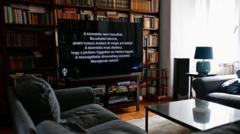
Hungary's public news broadcasts halted suddenly in an unprecedented political purge aimed at destroying the massive propaganda apparatus built by former Prime Minister Viktor Orbán. The state's flagship channel, M1, went silent on news programming, replacing its usual anchors with a blunt message. "Public media should not lie," the screen read. "We are sorry for doing it for so long." Over on the radio dial, Kossuth Radio killed its voice feeds and started running classical music by Béla Bartók. Websites went dark. It was a dizzying, immediate dismantling of a system that once seemed completely untouchable.
This is not a technical glitch. It is a calculated, aggressive political reset by the newly elected Prime Minister, Péter Magyar, whose Tisza party swept into power after a landslide election victory in April. Magyar did not wait around to gently reform the system. He cut the power cord.
For over a decade, Hungarian state media operated as a blunt instrument for the ruling Fidesz party, rewriting reality to shield Orbán from scrutiny. Now, the country faces a chaotic transition. Can a media system that was systematically weaponized ever become truly independent, or did the keys just change hands?
The Moment Hungary's Public News Broadcasts Halted
The shutdown happened fast. By Tuesday afternoon, the main broadcast feeds of MTVA, the umbrella organization running Hungarian state media, began dropping their scheduled programming. Viewers expecting the usual talking points on M1 were met with that jarring black screen apology. The notice promised that the news service was temporarily suspended while public media is rewritten to be trustworthy.
Behind the scenes, the new government fired top editorial managers at both the television and radio networks. They did not just stop at state-funded networks either. The shockwaves quickly hit the private sector. At TV2, a major commercial network previously controlled by business owners closely linked to Orbán, the main news anchors disappeared from the air and the news director was pushed out.
Magyar wasted no time celebrating on social media. He declared it a historic day, celebrating the end of what he called a factory of lies that pumped out North Korean style deception day and night. For a candidate who spent the entire election campaign being smeared by these very same stations as a traitor and a puppet of foreign interests, the move carried an undeniable sense of personal vengeance.
But clearing the airwaves is the easy part. The actual work of rebuilding a shattered journalistic culture in Budapest is bound to be incredibly messy.
Inside the Factory of Lies
To understand why Magyar took such drastic measures, you have to understand how deeply corrupted the Hungarian information space had become. When Viktor Orbán took power back in 2010, Hungary sat at a respectable 23rd place in the Reporters Without Borders press freedom index. By 2026, it had collapsed to 74th.
Orbán did not use Soviet-style violence to silence journalists. Instead, he used cash, corporate law, and regulatory pressure.
- The Funding Squeeze: Independent outlets were starved of state advertising revenue, which was redirected exclusively to friendly conservative publications.
- The Umbrella Structure: Public television, radio, and the national news agency MTI were forced under the centralized control of MTVA, ensuring a single, approved editorial line.
- The Corporate Takeover: Loyal oligarchs purchased independent newspapers and websites, turning them overnight into pro-government mouthpieces.
By the time the 2026 election arrived, estimates suggested that Orbán's allies controlled roughly 80 percent of the Hungarian media market. State media did not just report the news; they ran targeted character assassinations against political opponents, vilified the European Union, and echoed Kremlin talking points regarding the war in Ukraine. Independent journalists were treated as hostile political actors, banned from press conferences and cut off from public records.
It was a total monopoly on information outside the major cities. If you lived in a rural Hungarian village, the state radio and the local newspaper—both controlled by the regime—were your only windows to the world.
The Risky Reality of Media Cleansing
The immediate response from European media observers has been a mix of relief and deep anxiety. Everyone knew the Orbán propaganda machine needed to go. But pulling the plug overnight sets a wild precedent for Central European democracy.
Critics from the remnants of the Fidesz party are already screaming about tyranny, calling the broadcast freeze an authoritarian attack on free expression. That defense is hypocritical given their own record, but it highlights a genuine dilemma. When a new government uses executive decrees to shut down media outlets, even corrupt ones, it walks a very thin line.
Magyar insists this is a temporary pause to clean house, replace the compromised leadership, and establish strict guidelines for objective reporting. He has ordered an immediate financial and operational review of the entire public broadcasting network.
The danger is obvious. If the new administration fills those empty anchor chairs with journalists who are merely loyal to the Tisza party instead of Fidesz, Hungary will not have fixed its democracy. It will have simply traded one propaganda machine for another. True independence requires structural insulation from politics, something Hungarian politicians have rarely been eager to provide.
What to Watch Next in Budapest
The black screens will not stay black forever. M1 has already stated it plans to resume regular programming, though without its traditional news bulletins for the time being. The real test of Magyar's reform will happen over the coming weeks through several specific flashpoints.
First, keep an eye on who gets appointed to the new regulatory boards. If these positions are filled by independent legal experts and veteran journalists rather than political operatives, it will show the government is serious about real reform.
Second, watch the funding model. As long as state media relies on arbitrary budget allocations from the ruling party, it can never be free. A decentralized, public-license fee model would offer a far safer path forward.
Finally, look at what happens to the private media cartels created under Orbán. Dismantling the massive corporate entities that hold hundreds of local newspapers will require complex anti-trust actions that could take years to resolve.
The halting of Hungary's public news broadcasts is a massive, symbolic victory for a population tired of being lied to. But symbols do not write objective news stories. The hard part starts now.

:max_bytes(150000):strip_icc()/TAL-nassau-bahamas-BEAUTCARIB0323-4fbfce903e5a4418b895e03717e3de0d.jpg)