You probably don't associate the hyper-dense, skyscraper-heavy skyline of Hong Kong with advanced space exploration. Most people think of the city as a financial playground, all stocks and real estate. But right now, 400 kilometers above our heads, a piece of custom engineering developed in Hong Kong is keeping an eye on the planet.
It's called the Multi-Spectral Imaging Carbon Observatory. The team behind it nicknamed it MUSICO, or the "Eye for Space." It isn't just a fancy camera. It's the first-ever scientific payload from Hong Kong to be deployed on China's Tiangong space station.
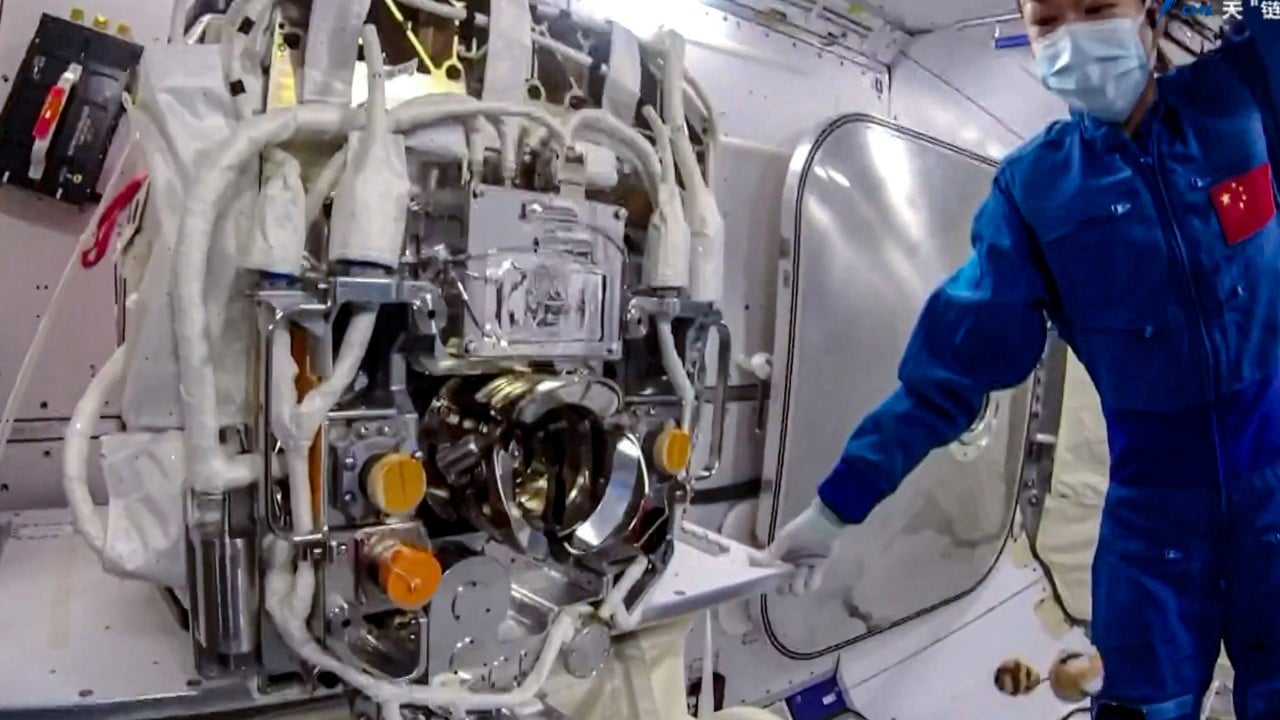
The installation didn't happen by remote control. In a poetic twist of timing, Lai Ka-ying—Hong Kong's first female payload specialist and first-ever astronaut—completed the external installation and orbital testing of MUSICO alongside her Shenzhou XXIII crewmates, Colonel Zhu Yangzhu and Colonel Zhang Zhiyuan.
This isn't just a feel-good local interest story. It changes the way we map emissions globally, and it proves Hong Kong is moving from a passive academic helper to a core operator in high-stakes space exploration.
The Engineering Impossible: Shrinking a Climate Observatory
If you want to track carbon dioxide and methane emissions from orbit, you usually need a satellite payload the size of a delivery van. Big optics, heavy shielding, massive power draws.
The research team led by the Hong Kong University of Science and Technology (HKUST) threw that old playbook away. They built a fully functional, high-precision climate observatory that's smaller than a domestic washing machine. It weighs less than 80 kilograms and measures roughly 60 centimeters long.
How does something that small actually do any real science?
MUSICO measures the intensity of sunlight as it punches through the Earth's atmosphere and bounces back up into space. Every gas has an optical fingerprint. By studying the precise way light gets absorbed at specific spectral bands, the device calculates the exact concentration of greenhouse gases below.
The resolution is the real kicker here. The hardware achieves a spectral resolution of just 0.2 nanometers. When looking down at the ground, it maps emissions inside a 100-meter grid.
Think about that scale. Most environmental satellites give you broad, regional data blocks. MUSICO can pin down individual culprits. It can see the exact power plant, the specific coal mine, or the single landfill leaking methane. The team estimates that the hardware can accurately catch 99% of all carbon dioxide and methane emissions from these point sources nationwide.
Moving From Ground Support to Orbital Operations
For decades, Hong Kong's elite universities acted like an elite consulting firm for the national space program. Scientists like Professor Yung Kai-leung at The Hong Kong Polytechnic University (PolyU) built the camera pointing systems for the Chang'e 3 and Chang'e 4 lunar landers. They built the surface sampling tools that scooped up rocks from the far side of the moon during the Chang'e 6 mission. They built the landing surveillance cameras for the Tianwen 1 Mars mission.
It was brilliant work, but it was always ground-based support. The mainland built the rockets, flew the missions, and ran the operations. Hong Kong sent the hardware in a crate.
Not anymore.
Having Lai Ka-ying on board Tiangong to test and bolt MUSICO onto the exterior of the space station changes the dynamic completely. Hong Kong now has both the hardware and the human capital in orbit. It's a massive shift toward full integration into deep-space missions.
The Global Implications for Climate Data
We often treat carbon accounting like a giant guessing game based on self-reported corporate sheets and rough economic estimates. MUSICO strips away the guesswork.
The instrument covers an orbital path ranging from latitudes 42 degrees south to 42 degrees north. That slice of the globe happens to contain the absolute highest concentration of human population and heavy industrial activity on Earth.
The data won't sit locked away in a vault in New York or Beijing. Under current data management frameworks, the raw readings will stream to China's Ministry of Ecology and Environment, but they'll also go straight to the United Nations Environment Programme (UNEP). The UN plans to dump this data into an open global dataset accessible to researchers worldwide.
If a factory in the Greater Bay Area or a coal mine along the Belt and Road initiative claims they've cut emissions, scientists will have hard, independent numbers to verify it within days.
What Comes Next for Space Engineering
This orbital success is triggering a massive institutional shift back home in Hong Kong. The city isn't just cheering from the sidelines; institutions are doubling down on the infrastructure needed to keep this momentum going.
- Launching PARA: PolyU is establishing the PolyU Aerospace Research Academy later this year, aiming to focus entirely on space resource development and long-term aerospace applications.
- Space Manufacturing Hubs: The PolyU-CSU Joint Research Center for Space Manufacturing Technology is ramping up work with the Chinese Academy of Sciences to perfect 3D printing and additive manufacturing inside microgravity environments.
- Commercial Offshoots: Academic projects are already spinning out into commercial entities, such as Stellerus Technology Limited, a university-incubated startup that helped support the development of MUSICO.
If you're still looking at Hong Kong as just a city of banks and retail malls, you're missing the bigger picture. The technical execution of the MUSICO deployment proves the city can design, build, and help operate the most demanding instruments in orbit. Expect to see Hong Kong hardware riding along on the upcoming Tianwen 3 Mars sample return mission and the construction phases of the International Lunar Research Station. The baseline has shifted, and the city's tech sector is aiming straight up.