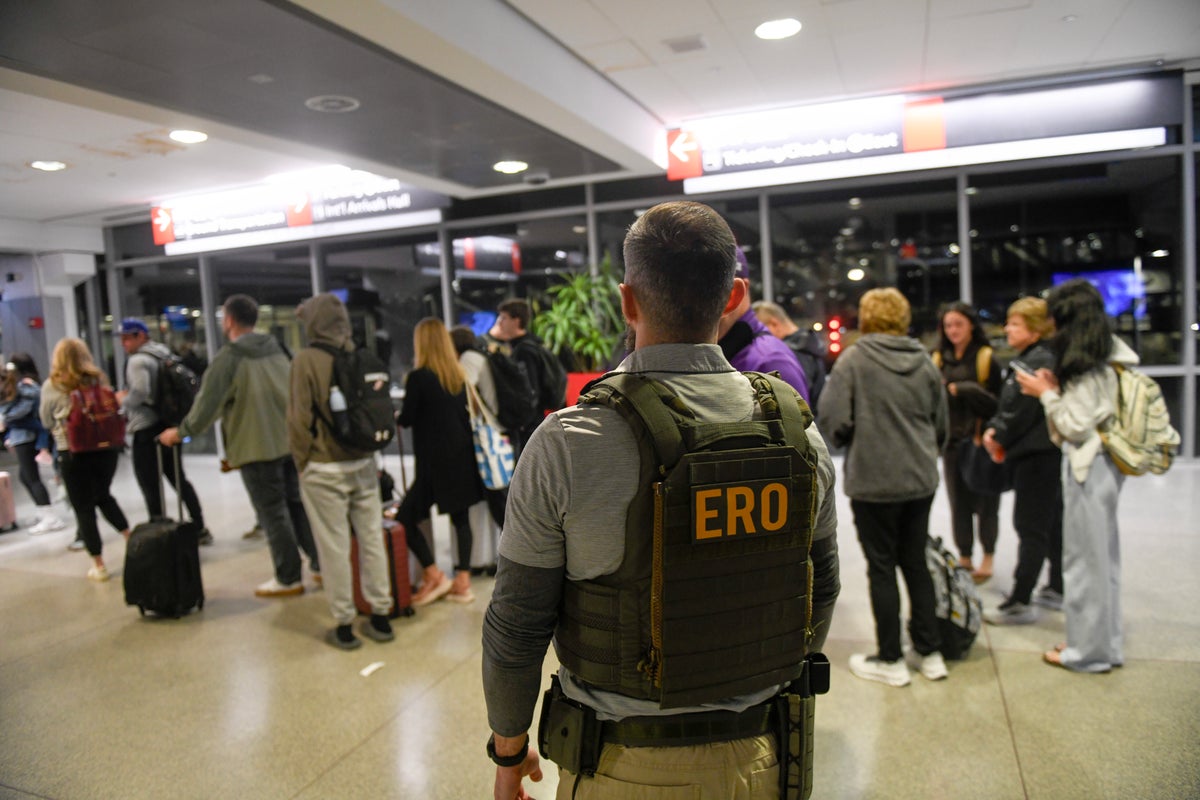
You think your green card is a golden ticket that guarantees you can return to the United States after a vacation abroad. It isn't. A quiet but devastating 6-3 decision handed down by the U.S. Supreme Court on June 23, 2026, stripped away a massive layer of security that permanent residents have relied on for decades.
If you have a green card and a single skeleton in your legal closet, your next international flight could end in a deportation cell.
The case is Blanche v. Lau. It changes the ground rules for how federal authorities handle lawful permanent residents at airports and border crossings. The core issue centers on a vague legal concept known as a "crime involving moral turpitude" or CIMT. Under the new ruling, Customs and Border Protection agents don't need ironclad proof of a conviction to upend your life at the gate. They just need reason to believe you committed an offense.
For years, immigration advocates argued that the government needed clear and convincing evidence at the border before stripping a returning resident of their status. The Supreme Court just threw that argument out the window. If you are a permanent resident planning a trip outside the country, you need to understand exactly what happened and why the old rules no longer protect you.
The Illusion of Permanent Residence
Many people assume a green card means permanent residence is unconditional. That is a dangerous mistake. Under the Immigration and Nationality Act, a returning permanent resident is generally not treated as an applicant for admission. You pull up to the booth, show your card, and walk through.
But Congress carved out specific exceptions. One major exception applies to any permanent resident who has committed a crime involving moral turpitude.
Before this new ruling, if the government wanted to treat you as a fresh applicant for admission rather than a returning resident, lower courts held that border officials needed solid, definitive proof at the moment you landed. The Second Circuit Court of Appeals had explicitly ruled that the state couldn't just guess or use pending, unproven allegations to trigger this exception. They needed clear and convincing evidence right then and there.
The Supreme Court flipped that logic. Justice Clarence Thomas, writing for the 6-3 majority, declared that the statute does not impose a heightened evidentiary burden on border officers at the port of entry.
Think about what that means in practice. A border agent doesn't have to prove you are guilty before treating you as an outsider. They can make that call on the spot based on raw arrest data, pending charges, or old records. Once they do, the legal burden shifts. You are suddenly fighting for admission from scratch.
The Case of Muk Choi Lau
To understand how this plays out in the real world, look at the man at the center of the case. Muk Choi Lau is a Chinese citizen who obtained a U.S. green card. In 2012, he took a trip to China. When he flew back into New York's John F. Kennedy International Airport, his file flagged an open legal issue. He was facing trademark counterfeiting charges in New Jersey.
He hadn't been convicted yet. The charges were just pending.
Instead of formally admitting Lau back into the country as a permanent resident, border agents chose to "parole" him in. In immigration law, parole is a legal fiction. It means you are physically inside the country, but legally you are still standing outside the border knocking on the door.
Lau later pleaded guilty to the counterfeiting charges. Once that conviction hit the books, the Department of Homeland Security launched formal removal proceedings to deport him. They argued he was inadmissible because counterfeiting qualified as a crime involving moral turpitude.
Lau fought back. His lawyers argued that back at JFK Airport, the border patrol didn't have clear and convincing evidence that he had committed a disqualifying crime. Therefore, the agents should have been forced to admit him as a green card holder. If he had been formally admitted, the government's path to deporting him later would have been much harder, requiring different legal standards and shorter statutory timelines.
The Supreme Court didn't care about the timing. The majority ruled that the word "committed" in the immigration statute means the act itself matters, not whether a judge had signed a conviction sheet at the exact hour the traveler landed. The conviction later simply proved that the border agent's initial suspicion was right.
The Dangerous Vagueness of Moral Turpitude
What exactly is a crime involving moral turpitude? The government has never written down a precise, clear definition. Instead, it has been defined by decades of messy, conflicting court decisions.
In simple terms, courts describe it as conduct that shocks the public conscience, or acts that are inherently base, vile, or depraved. That sounds like it should only apply to extreme, violent crimes. It doesn't.
The reality is far more mundane. Minor offenses can easily fit the definition if they involve an element of fraud, dishonesty, or intent to deceive.
Shoplifting can be a crime of moral turpitude if the local statute requires an intent to permanently deprive the owner of property. Passing a bad check can count. Writing a fake number on a government form can count. Small-scale financial scams, petty theft, and possession of stolen property frequently qualify.
Because the definition is fluid, border agents have immense discretion. They don't need a law degree to look at an arrest record and decide your past behavior falls under this umbrella.
A Two Step System to Deportation
The Supreme Court outlined a clear two-step framework that gives immigration authorities vast power.
The first step happens at the airport. The border agent reviews your file. If they see an arrest, a pending charge, or an older conviction that looks like a moral turpitude offense, they can classify you as an applicant for admission. They don't need to prove the case. They just change your legal status right there. You lose the automatic protections of your green card. They parole you into the country so you can attend a future court date.
The second step happens later in an immigration court. This is where the actual trial takes place. During these removal proceedings, the government must formally establish that you were convicted of or admitted to the crime.
The danger for green card holders is that step one triggers step two automatically. By making step one incredibly easy for border patrol, the Supreme Court has opened the floodgates. Returning residents will find themselves trapped in the backlogged immigration court system for years, unable to travel and living under the constant threat of exile.
The Fierce Dissent from the Bench
The ruling wasn't unanimous. Three justices dissented strongly, exposing the real-world dangers this decision creates.
Justice Ketanji Brown Jackson wrote a sharp dissent, joined by Justices Sonia Sotomayor and Elena Kagan. Jackson argued that the majority turned the law on its head. She pointed out that Congress specifically used restrictive language to protect green card holders, intending for them to retain their secure status unless the government could definitively prove they had forfeited it.
Jackson warned that the ruling gives federal agents a blank check. Under this new standard, border patrol can target a permanent resident based on a hunch, a vague police report, or an unproven accusation. They can strip them of their returning resident status, push them into the parole track, and then rely on evidence gathered months or years later to retroactively justify the decision.
This completely undermines the security that a green card is supposed to provide. It treats long-term, lawful residents who have built lives, bought homes, and raised families in America the exact same way it treats a first-time undocumented arrival at a desert crossing.
Who Is at Risk Right Now
This ruling does not affect every single green card holder. If your record is completely pristine, you can still travel. But the circle of vulnerable residents is much wider than most people realize.
You face an elevated risk if you fall into any of the following categories.
First, anyone with pending criminal charges. If you have an open court case for a theft, fraud, or assault charge and you step outside the U.S., you are walking into a trap. Even if you are completely innocent and assume the charges will be dropped next month, a border agent can see the open arrest warrant or active indictment and deny you regular reentry.
Second, people with very old convictions. Many permanent residents believe that if an offense happened ten or twenty years ago, it is old news. It isn't. Immigration law has no statute of limitations for these grounds. An old misdemeanor conviction from your college days can suddenly be dug up by an automated system at the border.
Third, individuals with dismissed charges or expunged records. This trips up thousands of people. In state criminal courts, a defense attorney might tell you, "Take this plea deal, do probation, and the charge will be dismissed and expunged." You think your record is clean.
Immigration law completely ignores state expungements. If you admitted guilt or a judge found sufficient facts to find you guilty as part of a diversion program, that counts as a conviction for immigration purposes. The physical record might be sealed from public view, but federal immigration systems can still see it.
Your Immediate Next Steps Before Traveling
If you have any history of contact with law enforcement, you cannot treat international travel casually anymore. You must protect yourself before you book a flight.
Obtain a complete copy of your criminal record. Do not rely on your memory. You need the certified final certificates of disposition from the clerk of the court where your case was handled.
Take those records to an experienced immigration attorney before you buy a ticket. Let them analyze the exact language of the state statute you were charged under. A good lawyer can tell you whether that specific offense matches the federal definition of a crime involving moral turpitude.
If you are already outside the country and know you have an issue, do not just fly back blindly. Consult counsel remotely. If you are stopped at the border and agents try to force you to sign a Form I-407 to abandon your green card, refuse. You have a right to a hearing before an immigration judge. Do not sign your rights away at an airport desk out of fear.
The landscape has turned hostile for permanent residents with complicated pasts. The Supreme Court made it clear that the executive branch has the power to screen you aggressively at the border. Plan accordingly.