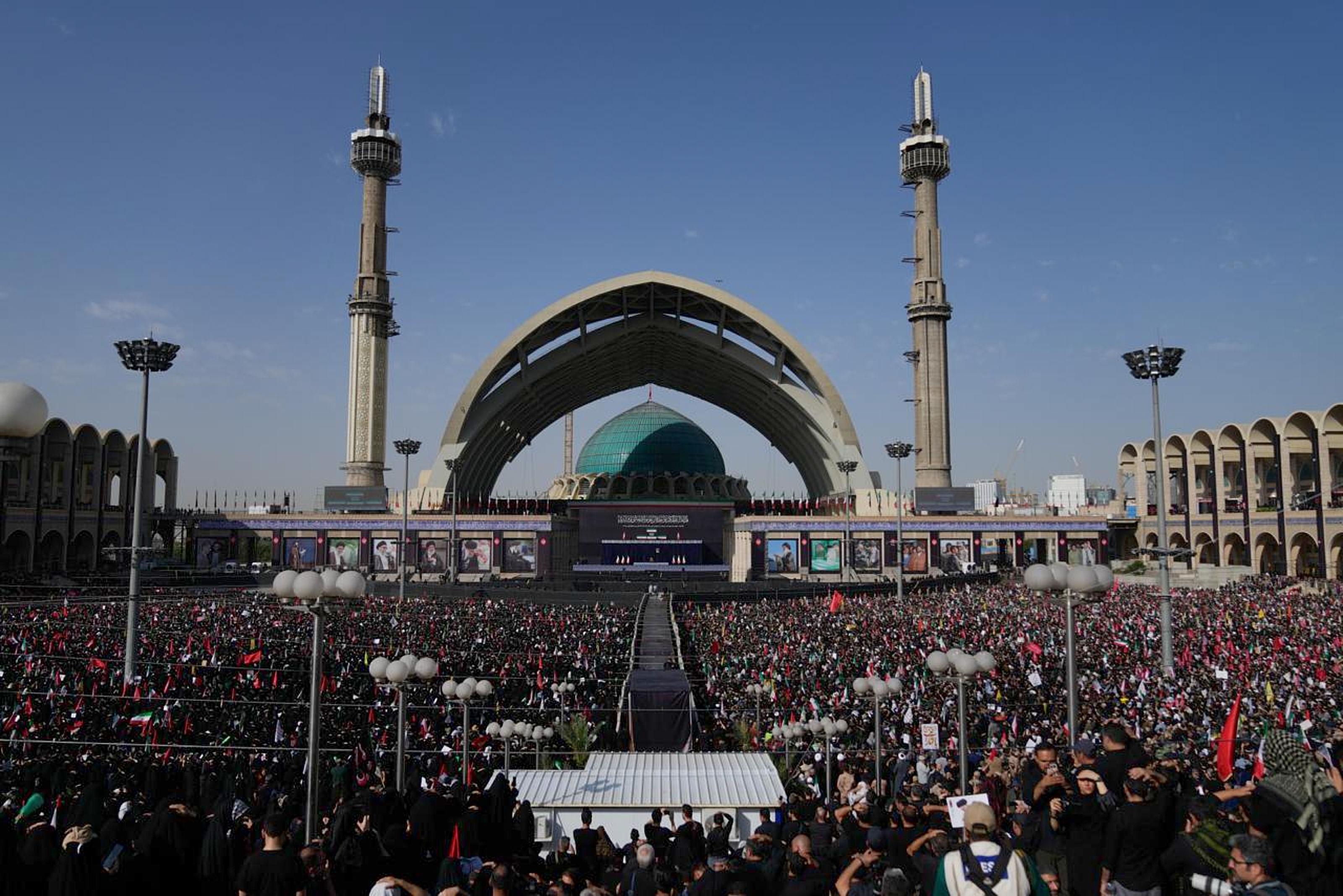
Millions of mourners are filling the sun-baked streets of Tehran right now. The Iranian government is staging a massive, six-day public funeral for late Supreme Leader Ayatollah Ali Khamenei, who ran the country with an iron fist for nearly four decades. His flag-draped casket rests inside a glass enclosure at the Imam Khomeini Grand Mosalla, topped with his signature black turban. Surrounding his body are the caskets of his family members, including his eldest daughter, his son-in-law, and a 14-month-old granddaughter. They all died together on February 28, 2026, when a devastating joint U.S. and Israeli airstrike hit the supreme leader's compound, igniting a brutal regional war.
This isn't just a moment of grief. It's a highly coordinated political theater engineered by a regime trying to survive. By delaying the funeral for months until a temporary wartime pause could be reached, the Islamic Republic set up a high-stakes display of national defiance. The timing is deliberate. The ceremonies kicked off publicly on July 4, the exact day the United States marks its 250th anniversary. As American cities celebrate with fireworks, the crowds in Tehran are chanting for revenge, waving banners that read "We must rise," and openly calling for the assassination of Donald Trump.
If you think this funeral is just about burying the past, you're missing the real story. This event marks the official, turbulent beginning of a new era under his son and successor, Mojtaba Khamenei. It lays bare the fierce internal power struggle between Iran's civilian government and its hardline paramilitary forces.
The Long Wait for a Final Farewell
Holding a body for over four months before burial is incredibly rare in Islamic tradition, which dictates that the dead should be buried as quickly as possible. The regime had no choice. The joint military strike in late February didn't just assassinate the 86-year-old cleric. It plunged the entire region into a chaotic, multi-front war that made large public gatherings an impossible security risk. With U.S. and Israeli warplanes active, the government couldn't risk putting its entire leadership cadre in one open courtyard.
The state kept the bodies preserved under strict religious and legal standards while the country fought for its survival. Now that Washington and Tehran have agreed to a temporary, one-week pause in hostilities to allow for de-escalation, the regime is seizing its window. They built a massive platform designed to look like the Kaaba in Mecca, installed heavy concrete blast walls around the perimeter, and set up industrial cooling systems to keep millions of pilgrims from collapsing in the intense July heat.
The authorities aren't leaving the turnout to chance. They've shut down the airspace over Tehran, closed major transit arteries, and suspended daily operations across the capital. State-run networks are providing free transportation, free food, and temporary housing to bus in millions of believers from provincial cities like Tabriz and Mashhad. The government wants to recreate the staggering, chaotic scale of Ayatollah Ruhollah Khomeini's 1989 burial. They need to show the world that the theocracy still commands the absolute devotion of the masses, even after a catastrophic war.
A Fractured Regime Emerging from the Shadows
Look closely at who showed up at the Grand Mosalla, and you'll see the real power dynamics shaping Iran's immediate future. Civilian leaders like President Masoud Pezeshkian, Parliament Speaker Mohammad Bagher Qalibaf, and Foreign Minister Abbas Araghchi all stood by the caskets to pay their respects. They represent the faction that wants to use Iran's lingering leverage—specifically its ability to choke off global shipping in the Strait of Hormuz—to secure a permanent ceasefire and economic relief from the West.
The real shadow over this ceremony belongs to the Islamic Revolutionary Guard Corps. General Ahmad Vahidi, the hardline commander-in-chief of the IRGC, stepped into the public eye at the funeral for the first time since early February. Vahidi is the man who brutally crushed domestic protests in January and directed the asymmetric missile and drone strikes that defined the recent war. When Vahidi spoke to state television at the viewing, he didn't talk about peace or diplomacy. He told the crowds that the blood of the supreme leader would mark a turning point for global Islam and vowed that Iran would never surrender.
The IRGC wants to use the collective grief of this week to cement its total control over the state. They're positioning the late supreme leader's death not as a defeat, but as a martyrdom that demands total, uncompromising war against the West. This creates a dangerous friction with the civilian officials trying to negotiate an end to the conflict.
The Secretive Rise of Mojtaba Khamenei
The biggest question hanging over the entire six-day procession is whether the new supreme leader will actually show his face. The cleric's son, Mojtaba Khamenei, was quickly named his father's successor by the Assembly of Experts following the February attack. He has spent the last few months operating entirely from the shadows. Reports indicate he was wounded in the very same airstrike that killed his father, and his own wife was among the family members killed in the blast.
Having his wife's casket displayed right below his father's creates an intensely personal, bloody grudge at the very top of Iran's new leadership. The joint military command issued a blunt warning to the U.S. and Israel to avoid any miscalculations during the funeral ceremonies, knowing that a sudden appearance by Mojtaba could make him a prime target.
If Mojtaba chooses to remain in hiding throughout the week, it will broadcast a sense of vulnerability and fear to both his domestic critics and foreign adversaries. If he does appear, it will mirror his father's visible, tearful ascent at Khomeini's funeral in 1989. That moment launched a 37-year reign defined by an unyielding confrontation with the West.
Where the Mourners Go From Here
The logistics of this funeral are designed to touch every major center of Shiite power in the region. After the public viewing and formal funeral prayers conclude in Tehran on Sunday evening, the caskets will begin a highly symbolic journey.
First, the procession moves to Qom, the theological heart of Iran's clerical establishment, to solidify Mojtaba's legitimacy among the country's top religious scholars. From there, the bodies are scheduled to cross the border into neighboring Iraq. They'll visit the holy cities of Najaf and Karbala, a move meant to project Iran's enduring influence over the regional Shiite diaspora. The final burial will take place on Thursday in Mashhad, home to the Imam Reza shrine, the holiest pilgrim site in Iran.
What This Means for Global Security
Don't buy into the idea that this pause in the war means peace is on the horizon. The next steps for regional security are incredibly volatile, and you need to watch three specific areas as the funeral concludes.
Keep a close eye on the Strait of Hormuz. The one-week de-escalation agreement will expire almost immediately after Khamenei is laid to rest in Mashhad. The IRGC has spent weeks positioning anti-ship missiles along the coast, and they'll likely use the end of the mourning period to reassert pressure on global energy corridors.
Watch the denuclearization talks. U.S. and Iranian mediators have paused their dialogue for the duration of the funeral. When those talks resume, Iran's negotiators will be operating under intense pressure from the hardline military factions who are currently capitalizing on public outrage. The chance of a diplomatic breakthrough is incredibly low right now.
Monitor the domestic security situation inside Iran. While millions are mourning, millions of other Iranians are quietly watching from home, deeply alienated by the regime's economic mismanagement and the devastation of the recent war. The heavy deployment of military units and aviation rescue teams along the funeral routes isn't just for medical emergencies. It's a massive show of force designed to deter any anti-government uprisings while the leadership is distracted.
The regime is spending this week looking backward, honoring the man who built their modern security state. Once the caskets are in the ground, they'll have to face the reality of a ruined economy, a wounded new leader, and an unresolved war with the world's most powerful militaries.