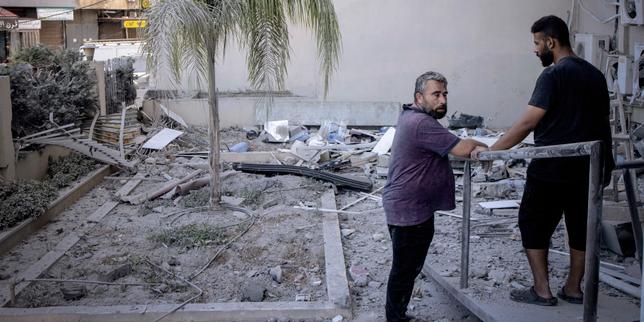
International law often feels like a paper tiger. You see the destruction on your screens, you read the death tolls, and you wonder if anyone will ever pay for it. But a quiet legal shift in Paris is changing how we look at accountability in the Middle East. For the second time this year, French prosecutors have been handed a formal complaint targeting Israeli military operations in Lebanon for alleged war crimes and crimes against humanity.
This isn't just about symbolism. It's a calculated legal strategy utilizing specific jurisdictional hooks that could force European judges to look at evidence the rest of the world is ignoring.
The latest case stems from a devastating airstrike in the southern Lebanese city of Tyre during the intense military escalation of April 2026. A Franco-Lebanese citizen filed the complaint after losing four family members in the attack. By bringing this case to Paris, the plaintiffs are bypassing a paralyzed local judiciary in Lebanon and testing the boundaries of international justice.
The Devastation in Tyre and the April Escalation
To understand why this complaint matters, you have to look at what happened on April 8, 2026. Dubbed Black Wednesday by local residents, that day saw some of the most intense aerial bombardments inside Lebanon since the wider regional conflict flared up again in early March.
The Israel Defense Forces called it Operation Eternal Darkness, claiming they targeted strictly Hezbollah military installations, command bunkers, and weapons caches. But the reality on the ground told a wildly different story. Over a hundred airstrikes hit densely populated urban areas within a window of just a few hours.
Tyre, an ancient port city with a massive civilian population that had already absorbed thousands of displaced families from border villages, took a direct hit. The strike central to the new French legal filing flattened a residential area, killing four members of the complainant's family instantly. They weren't combatants. They were civilians caught in a rain of fire that local health officials reported killed over 350 people and injured more than a thousand across the country in less than 48 hours.
When military forces use explosive weapons with wide-area effects in densely populated towns, the line between collateral damage and a war crime disappears. That's the core argument driving this new push in Paris.
Bypassing Lebanon Shattered Legal System
Why file a case in Paris for a bomb dropped in southern Lebanon? The answer is simple. You can't get justice in Beirut.
Lebanon's domestic judicial system is broken, crippled by years of political gridlock, economic collapse, and direct intimidation from various political factions. If the country couldn't even manage an independent investigation into the 2020 Beirut port explosion, it has zero chance of holding a foreign military accountable for cross-border airstrikes.
The International Criminal Court isn't an easy option either. Neither Israel nor Lebanon is a party to the Rome Statute. While Lebanon could theoretically make an ad hoc declaration accepting ICC jurisdiction, its deeply divided cabinet has consistently dragged its feet, terrified of the political fallout.
That leaves national courts abroad that recognize forms of extraterritorial jurisdiction. France has specialized prosecution units dedicated to investigating crimes against humanity and war crimes. More importantly, France shares deep historical, cultural, and legal ties with Lebanon, meaning a significant number of victims hold dual Franco-Lebanese citizenship.
The Dual Citizenship Hook for International Justice
French courts don't just open investigations because a tragedy happened somewhere else in the world. They need a legal tether. In this specific case, that tether is personal jurisdiction.
Under the French penal code, the judiciary can claim jurisdiction over international crimes if the victim is a French citizen at the time of the offense, or if the perpetrator is found on French soil. When a dual Franco-Lebanese national loses immediate family members or suffers severe property damage, their lawyers can argue that the crime directly impacts a French citizen.
We saw this exact strategy play out earlier this year. On April 2, 2026, the Franco-Lebanese artist and filmmaker Ali Cherri, alongside the International Federation for Human Rights, filed the first major war crimes complaint in Paris. Cherri’s parents were killed on November 26, 2024, when an Israeli strike demolished their residential building in the Mazraa-Barbour neighborhood of Beirut, just hours before a brief ceasefire was set to take effect.
Because Cherri is a French citizen and owned property destroyed in the strike, his legal team found a path forward. This second complaint regarding the Tyre bombing solidifies the trend. It shows that the first case wasn't a fluke. It's a repeatable blueprint for families seeking accountability.
Building a Case with Digital Forensic Evidence
One of the biggest hurdles in prosecuting war crimes is proving intent and the lack of military necessity. Armies always claim they were aiming at a legitimate target that just happened to be hidden next to civilians.
The teams behind these French complaints are fighting back with modern data collection. Instead of relying solely on emotional courtroom testimonies, the filings incorporate highly technical spatial reconstructions from independent watchdogs like Forensic Architecture and detailed field reports from Amnesty International.
Lawyers are using open-source intelligence, satellite imagery, bomb fragment analysis, and synchronized smartphone footage from bystanders to recreate the exact moment of the strikes. In the Beirut case, this digital modeling helped demonstrate that no military targets existed near the residential building. For the Tyre case, the sheer scale of the indiscriminate destruction on Black Wednesday forms the backbone of the argument that the strikes violated the international law principle of proportionality.
What Happens Next on the Legal Path
Don't expect French police to show up in Tel Aviv with handcuffs anytime soon. International legal battles are painfully slow, and political pressure from diplomatic channels will be immense.
The immediate goal for the lawyers is getting a French investigative judge assigned to the case. Once a judge is appointed, an official judicial investigation begins. This gives investigators the power to issue formal requests for information, interview witnesses, and potentially issue international arrest warrants or red notices through Interpol for specific military commanders if they ever travel to Europe.
Even if those warrants are never executed, they completely change the calculus for military and political leaders. It restricts their travel, stains their international standing, and creates a permanent legal record that cannot be wiped clean by a diplomatic ceasefire.
If you are a victim of dual nationality looking to understand how to navigate these international avenues, or an advocate tracking these developments, here are the practical steps currently shaping this legal landscape.
Documenting the Evidence for Extraterritorial Filing
Families and legal teams looking to utilize European courts must focus on concrete documentation rather than just casualty statistics.
- Secure certified proof of French or European citizenship of the direct victim or immediate family member, ensuring it was valid at the time of the attack.
- Preserve original property deeds, utility bills, and residential records to establish ownership of targeted civilian structures.
- Compile immediate physical evidence including metadata-preserved photographs of bomb fragments, geo-located video footage of the immediate aftermath, and local hospital intake records.
- Partner early with recognized international human rights organizations to sync local data with satellite imagery and independent ballistic assessments.