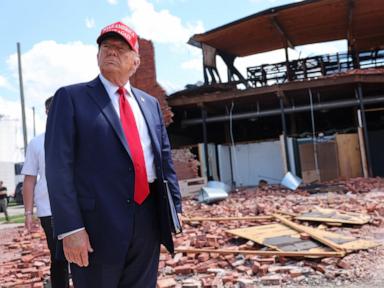
Natural disasters used to be the one area where American politics paused. When a tornado ripped through a town or a flood washed away a highway, presidents signed federal aid declarations without checking the local voting patterns first. That unwritten rule is completely dead.
Donald Trump has officially turned the federal disaster relief system into an extension of his campaign apparatus. By explicitly linking emergency funding to political endorsements, Trump combined disaster aid announcements with plugs for GOP candidates across multiple states. It is a bold, transactional approach to governance that rewards loyalty and leaves opposing states out in the cold.
If you think this is just standard political theater, you are missing the bigger picture. This shift fundamentally alters how Washington dispenses emergency money. It turns vital recovery infrastructure into a partisan prize. Here is how the strategy works, who wins, and what it means for local communities trying to rebuild.
The Pay to Play Model of Emergency Relief
When the White House approves a major disaster declaration, it opens up millions of dollars in federal financial assistance. The Federal Emergency Management Agency uses this money to rebuild public infrastructure, clear debris, and provide temporary housing for survivors. Historically, these decisions relied on strict technical assessments of damage and state capability.
Now, the process looks more like a political rally.
When approving aid for states like Alaska, Missouri, Nebraska, and North Dakota, the announcements came packaged with heavy political commentary. Social media posts and press releases openly touted election victories. The administration praised the "incredible Patriots" in states that voted heavily for the president, while making sure to mention upcoming GOP candidates who deserved support.
This is not a subtle strategy. It is an explicit message to governors and voters alike. If you back the administration, the administration backs you when the storm hits.
The strategy creates an immediate crisis for states on the wrong side of the political aisle. While Republican-leaning states see their requests fast-tracked, Democratic governors face a much steeper hill. Recently, the administration denied major disaster requests from Illinois, Vermont, and Maryland. The contrast is sharp, direct, and intentional.
Breaking Down the Partisan Funding Gap
The numbers behind this shift show exactly how deep the divide goes. A recent analysis highlighted a massive disparity in how disaster declarations are handled depending on who controls the governor's mansion.
Consider these figures:
- Republican-controlled states have seen roughly 89% of their disaster funding requests approved.
- Democratic-led states have seen their approval rates plummet to just 23%.
This is an unprecedented gap. No previous administration has maintained such a stark statistical difference in emergency aid distribution. During a Senate Homeland Security committee hearing on June 17, 2026, lawmakers pressed FEMA nominee Cameron Hamilton on these very numbers. Democratic senators openly called the gap unconscionable and argued that Americans suffering from natural disasters should never be treated differently based on their voting habits.
Hamilton, who has walked a fine line during his confirmation process, insisted that the agency would strive to remain objective and fair. But the reality on the ground tells a completely different story. The white house determines the final sign-off on major declarations, not the agency bureaucrats.
The weaponization of this funding creates a dangerous precedent. It forces state leaders to consider political optics before they even submit an application for federal help.
How the Stafford Act Gets Stretched
The legal foundation for all federal disaster relief is the Stafford Act. This law gives the president immense discretion to define what constitutes a major disaster and when the federal government should step in. The law was written to give executives flexibility during unprecedented crises. It was never intended to serve as a political carrot or stick.
By using this discretion to reward political allies, the administration exploits loopholes in the law's vague wording. The Stafford Act requires states to prove that a disaster exceeds their internal capabilities. However, defining that threshold is highly subjective. What looks like an unmanageable crisis to a governor can easily be dismissed as a minor issue by a hostile White House.
We are seeing this play out in real-time. A rural county in a red state might secure millions for infrastructure repair after a severe storm. Meanwhile, a blue state dealing with widespread flood damage gets told to handle it internally. The administration often justifies these denials by arguing that states need to take more financial responsibility for their own problems.
The irony is that this policy shift hits the poorest states the hardest. Many of the states that rely most heavily on federal money are rural, low-income areas that lack the tax base to fund massive recovery efforts on their own. By treating disaster aid as a personal favor rather than an institutional duty, the federal government leaves local municipalities vulnerable to financial ruin.
What This Means for Local Communities
The real victims of this strategy are not the politicians trading barbs in Washington. The consequences hit home for ordinary people waiting for roads to be cleared, schools to be rebuilt, and clean water systems to be restored.
When federal aid is delayed or denied for political reasons, the local economic fallout is immediate.
Skyrocketing Local Debt
Without federal matching funds, which usually cover 75% or more of disaster costs, local municipalities must borrow heavily. Small towns cannot afford to absorb multi-million dollar repair bills. They end up taking out high-interest bonds or cutting essential public services like education and policing just to fix broken pipes and washed-out bridges.
Prolonged Recovery Timelines
Rebuilding stalls completely. When Illinois or Vermont gets turned down for federal aid, projects get put on hold indefinitely. Families remain stuck in temporary housing. Businesses stay closed. The long-term economic dampening effect can suppress a region's growth for a decade.
Rising Insurance Costs
As federal backing becomes unpredictable, private insurance companies take note. They raise premiums or pull out of vulnerable markets entirely. Homeowners find themselves paying double for less coverage, or worse, unable to secure a policy at all.
Steps States Must Take to Protect Themselves
Governors and local leaders cannot afford to sit around and hope the political wind changes. They have to adapt to this transactional environment immediately if they want to protect their citizens. Relying on traditional disaster protocols is a recipe for failure.
If you are a state or local official managing disaster preparedness, you need to shift your strategy right now.
Build Independent Reserve Funds
Stop assuming Washington will write a check. States must aggressively build up their own emergency rainy day funds specifically earmarked for infrastructure recovery. This requires tough budgetary choices today, but it prevents total financial paralysis when the next storm hits.
Document Damage with Absolute Precision
Because requests from opposing states face intense scrutiny, your data must be bulletproof. Do not just send estimates. Use drone photography, independent engineering assessments, and clear economic impact statements. Make it politically costly for the administration to deny the claim by presenting undeniable, public proof of the crisis.
Form Regional Response Coalitions
If the federal government is scaling back its role, states must fill the void collectively. Mutual aid agreements between neighboring states should be expanded. Sharing equipment, personnel, and emergency supplies across state lines can lower immediate recovery costs and reduce reliance on federal intervention.
The era of predictable, non-partisan federal disaster relief is officially over. The current administration has made it clear that loyalty matters just as much as need. Accepting this reality is the only way state and local leaders can effectively prepare for what comes next.