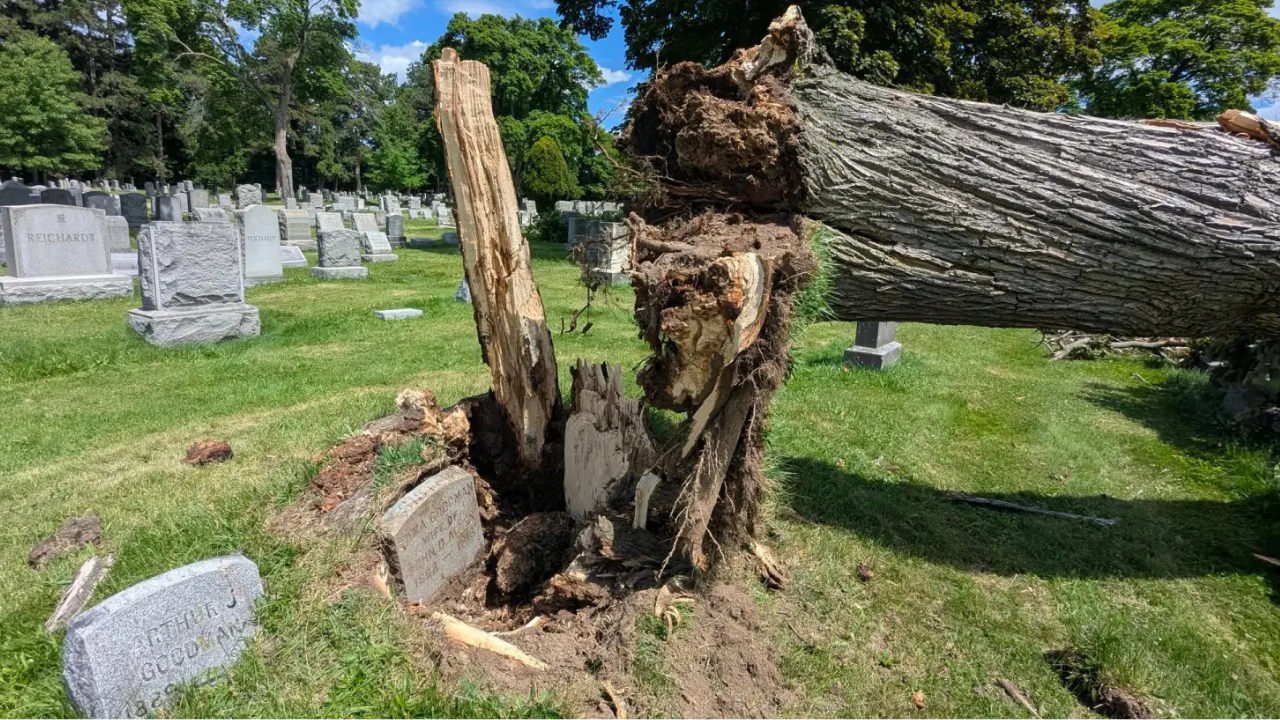
Nature has a strange way of rewriting history when we least expect it. On June 18, 2026, a fierce windstorm ripped through Rochester, New York, bringing down trees and cutting power across the region. At the historic Mount Hope Cemetery, a massive Norway maple couldn't withstand the 55 mph gusts and came crashing down.
When volunteers went out to clean up the wreckage, they didn't just find shattered branches. They found Edna Amelia Goodman Allen.
Her gravestone had been completely swallowed by the earth and the roots of that invasive maple tree for over a century. It took a violent act of nature to pull back the dirt and bring her memory back into the light. This isn't just a spooky cemetery story. It is a stark reminder of how quickly our personal histories can vanish into the ground.
The Day the Wind Changed Everything
Tom Jones was wandering through Mount Hope Cemetery doing what dedicated volunteers do after a major storm. He was picking up sticks and assessing damage. Jones is an amateur arborist and a volunteer with the non-profit group Friends of Mount Hope Cemetery. He knows these grounds well.
The storm on June 18 was unusual. The winds kept shifting directions, twisting back and forth rather than blowing from the usual western path. That erratic twisting is likely what snapped the root system of the massive Norway maple.
As the giant tree tipped over, its upper roots tore out of the ground like a giant fist lifting a chunk of the earth. Embedded right in the center of that root ball was a beautifully preserved headstone. Jones spotted it immediately among the dirt and torn fibers.
Who Was Edna Amelia Goodman Allen
We live in an age where we assume everything is digitized and preserved forever. The reality is much more fragile. Before the storm, Edna Allen was largely a ghost in the records, her physical resting place entirely erased from view.
Cemetery records and university databases show that Edna was born in 1892. She died young. She was only 26 years old when she passed away in 1918.
She left behind a husband named John D. Allen, a young son, her mother, and six siblings. Her mother was of German descent, and her family members are buried nearby. Records indicate that Edna died of volvulus. That is a painful medical condition where the intestine twists around itself and causes a fatal blockage. In 1918, medical interventions for such conditions were limited, and her young life was cut tragically short.
How a Gravestone Disappears in Plain Sight
People wonder how a solid stone monument just vanishes. It didn't happen overnight. It was a slow, silent process that took decades.
The Norway maple is an invasive species known for aggressive surface roots. As the tree grew right next to or on top of Edna’s grave, its roots spread out and began trapping soil, dead leaves, and debris. Over more than a century, the ground built up into a mound. The tree literally swallowed the stone.
A photograph from 2022 uploaded to FindaGrave shows just how hidden it was. Only a microscopic sliver of the top of the stone was visible back then, showing nothing more than the single word sister peering through the weeds. Most people walking by would have assumed it was a broken fragment or a footstone. Nobody knew an entire monument was buried underneath.
Chris Petote, the secretary for the Friends of Mount Hope Cemetery, points out that this happens more often than people think. It isn't a result of corporate neglect. It is just the raw nature of an old cemetery. Trees grow, the earth shifts, and things get absorbed.
The Living History of Mount Hope
Mount Hope Cemetery isn't just a place for the dead. Founded in 1838, it is one of the oldest municipal rural cemeteries in the United States. It stretches across nearly 196 acres of glacially formed hills and valleys.
More than 350,000 people are buried here. It is the final resting place of massive historical figures like abolitionist Frederick Douglass and women's rights leader Susan B. Anthony. Because of its beauty and history, it functions as a public park and a treasure trove of Victorian-era architecture.
Christine Klein, the president of the volunteer group, believes this discovery highlights why their work matters. Old cemeteries are alive with history, nature, and art. There are always more secrets waiting under the turf.
The Plan for Restoration
The immediate focus for the cemetery crew is safety and preservation. Several nearby gravestones are still pinned under the fallen canopy of the maple tree. Once tree removal experts cut away the massive trunk and stabilize the ground, the real preservation work begins.
Volunteers plan to carefully detach the headstone from the root structure without fracturing the old marble. The stone itself is in surprisingly good condition despite its long burial. The inscriptions are perfectly legible.
The team will clean the stone using specialized, non-destructive solutions to remove the packed dirt and biological growth. After the landscape is repaired, they will reset Edna's headstone in its proper, upright position. She will finally have her marker back.
How to Check on Your Own Family Plots
This incredible discovery should prompt you to think about your own family history. Countless historic graves disappear every year due to shifting soil and aggressive plant growth. If you want to ensure your ancestors' markers don't get swallowed by nature, take these immediate steps.
First, visit the cemetery and document everything. Take clear photographs from multiple angles and log the exact GPS coordinates using your smartphone. Databases like FindaGrave or BillionGraves are invaluable for uploading these records so they survive even if the stone sinks.
Second, talk to the cemetery management about tree maintenance. Fast-growing trees with shallow root systems are dangerous to old masonry. Ensuring that trees near your family plots are trimmed and monitored can prevent a catastrophic root takeover.
Third, clean stones safely if you notice dirt accumulation. Never use harsh chemical cleaners, bleach, or pressure washers on old grave markers. Soft plastic scrapers, clean water, and biological cleaners like D/2 are the industry standard for removing lichen and moss without destroying the stone.
Fourth, support local cemetery volunteer groups. Organizations like the Friends of Mount Hope rely entirely on community members to clear brush, document unlisted graves, and keep history from being buried forever. Joining a local group or donating to their preservation fund helps save forgotten stories just like Edna's.